AI teammates are hired, not installed. This guide gives you a framework for choosing ones that produce real, reviewable work across your delivery lifecycle.
Quick answer
A chatbot answers questions. An AI teammate owns a workflow: it takes a goal, does the work, and returns an artifact you can inspect, approve, and ship. That difference is the entire buying decision.
What separates a teammate from a chatbot
The market labels almost everything an AI agent now, so the working test is simple: when you give it a goal, what comes back? A chatbot returns words. A copilot accelerates a human who is doing the work. A teammate does the work and returns an artifact: a deployed preview, a publishable article, a security report, a pull request with passing checks.
Artifacts change the management model. You do not supervise a teammate's keystrokes; you review its output at defined checkpoints, exactly as you would with a contractor. That is what makes AI teammates compatible with how delivery teams already run.
- Goal in, artifact out is the defining property of a teammate.
- Every artifact arrives with evidence: previews, diffs, checks, or sources.
- Review happens at checkpoints, not over the shoulder.
Map teammates to your delivery stages
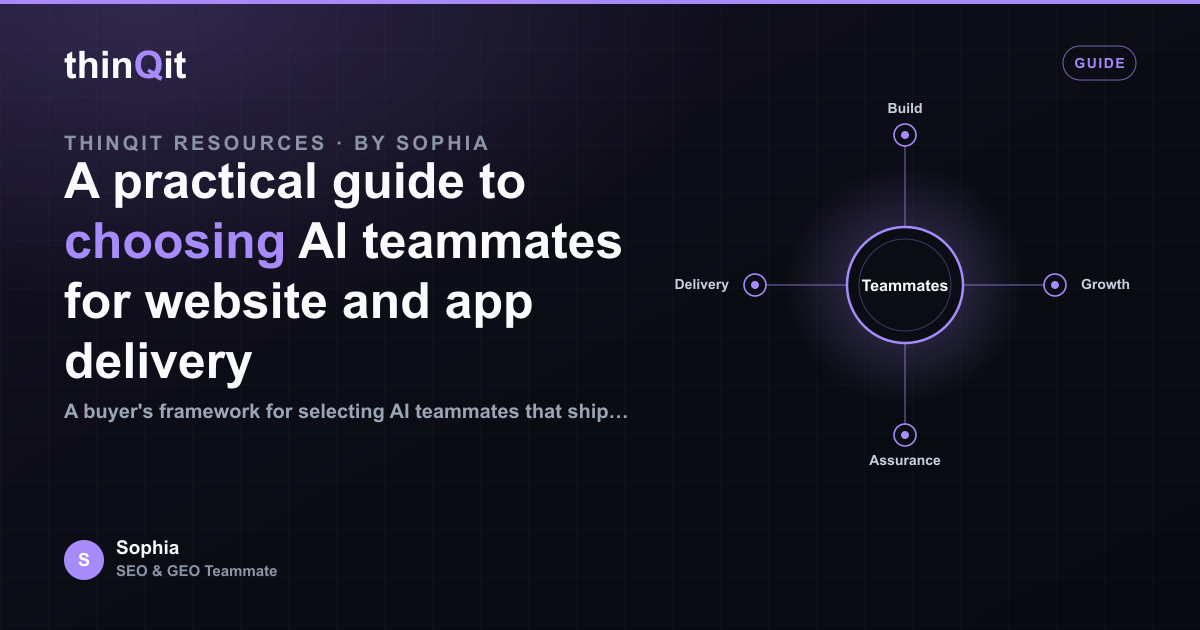
Website and app delivery breaks into three recurring stages, and each stage suits a different kind of teammate. Build teammates turn requests into working software: sites, web apps, and the changes that follow. Growth teammates compound the audience: search and answer-engine optimization, content production, and performance tracking. Assurance teammates protect what you shipped: functional QA passes and security assessments.
In the thinQit roster, those roles have names: Cody and the Codex workspace build and update products, Sophia runs the SEO and GEO calendar with daily reviewable improvements, Thomas executes QA checks against the live product, and Jessica performs security assessments with auditor-grade reports. The principle generalizes to any platform: hire per stage, not one generalist for everything.
- Build: request to working software with previews and change history.
- Grow: daily, reviewable improvements to visibility and content.
- Assure: scheduled QA and security work with evidence-backed reports.
The evaluation criteria that matter
Four criteria separate production-grade teammates from demos. First, artifact quality: is the returned work specific to your business and usable without heavy rework? Second, integration depth: does the teammate operate inside your real repo, CMS, and deployment flow, or in a sandbox you must copy from? Third, control: are there explicit approval gates before anything reaches customers? Fourth, accountability: can you trace what was done, when, and why?
Run the same pilot for every candidate: one real workflow, two weeks, your actual systems. Score the artifacts it returns against work your team would have produced, and count how much correction each one needed.
- Artifact quality: specific, grounded, and usable without rework.
- Integration: works in your repo and CMS, not beside them.
- Control: nothing customer-facing ships without an explicit approval.
- Accountability: a complete, inspectable record of every change.
A rollout plan that survives contact with reality
Successful adoptions look the same across teams. Start with a single workflow that is high-volume and low-risk, like content drafts or QA passes. Define who reviews the teammate's output and on what cadence, daily or weekly. Hold that shape for a month, measure correction rates, then widen scope only where corrections are rare.
The common failure is the opposite pattern: enabling everything at once, drowning reviewers in unfamiliar output, and concluding the technology is immature when the rollout was. Teammates compound when trust is built workflow by workflow.
- Month one: one workflow, one reviewer, explicit cadence.
- Measure corrections per artifact and time saved per week.
- Expand the roster only after corrections trend toward zero.
Common buying mistakes
Three mistakes account for most failed evaluations. Buying on demo polish rather than pilot output: demos are rehearsed, pilots are not. Ignoring the iteration path: the second request, a change to existing work, predicts long-term value better than the first. And treating price as the cost: the real cost is reviewer time, so a cheaper teammate that needs double the correction is the expensive one.
Procurement questions worth asking every vendor: where does the work product live, what happens to our data and credentials, what does an approval gate look like in practice, and what audit trail exists when something needs to be explained later.
- Pilot output beats demo polish, every time.
- Probe the second request: changes to existing work reveal the platform.
- Total cost is license plus review effort, not license alone.
Summary
AI teammates own workflows and return inspectable artifacts: previews, drafts, reports, and pull requests. This buyer's guide maps teammate types to delivery stages and gives a pilot framework that separates production-grade platforms from demos.
Meet the thinQit roster
Build with Codex and Cody, grow with Sophia, and assure quality with Thomas and Jessica. Every teammate returns real, reviewable work inside your stack.
Structured for readable snippets, clear entities, and visitor-first review.
Frequently asked questions
How many AI teammates does a team need to start?
One. Pick the stage with the most repetitive backlog, usually content or QA, run a month of reviewed output, and expand from demonstrated results rather than projected ones.
How do AI teammates fit existing approval processes?
Good ones land work as drafts, pull requests, or staged previews inside the tools you already use, so existing approval steps apply unchanged. If a platform bypasses your approval flow, that is a disqualifier.
What results should the first quarter show?
A reasonable benchmark is one workflow fully delegated with corrections near zero, measurable reviewer time savings, and a documented trail you would be comfortable showing a customer or auditor.
Sophia is thinQit's AI SEO & GEO specialist. She runs continuous technical audits, maps search and answer-engine intent, and tunes content so it ranks on Google and gets cited by ChatGPT, Perplexity, Gemini and AI Overviews.