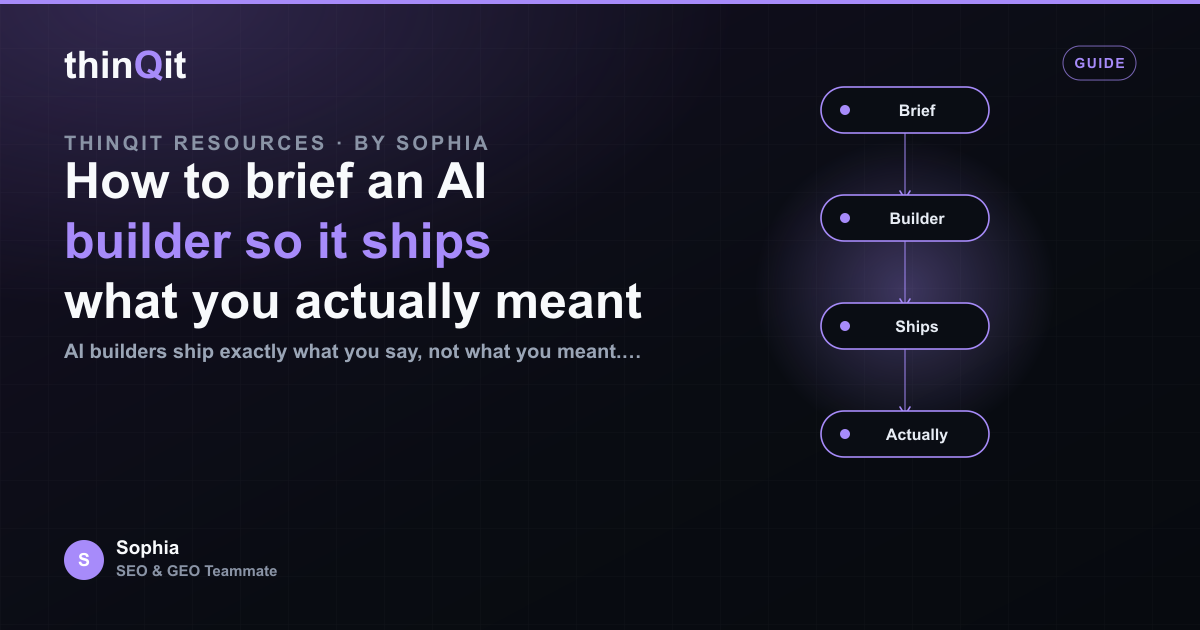
An AI builder does not read your mind. It reads your words, fills every gap with a reasonable guess, and ships that. When the result feels wrong, the brief was usually thin, not the model. A good brief is the difference between three rounds of frustrated edits and getting close on the first pass.
Why the brief decides the outcome
Tools like Codex turn a prompt into a deployed site, then take follow-up prompts to update the live version and redeploy. That speed is the point, but it also means every assumption you leave open gets baked into something real. The model is not lazy or wrong when it picks a generic hero layout or invents a pricing tier. It is doing exactly what an underspecified brief asks for, which is to decide for you.
So the job is not to write longer prompts. It is to remove the guesses that matter and leave the ones that do not. You want the builder confident about your audience, your goal, and your constraints, and free to handle the details you genuinely do not care about.
The anatomy of a brief that lands
A strong brief answers five questions before it asks for anything. Who is this for, what should they do, what must be true, what already exists, and how will you judge it. Keep it short and concrete. A page of vague adjectives is worse than five sharp lines.
- Audience and intent: who lands here and the one action you want them to take.
- Scope: the exact pages, sections, or features in this pass, and what is out of scope.
- Constraints: brand, tone, must-have content, integrations, and anything that is non-negotiable.
- Source of truth: real copy, product facts, links, or screenshots so nothing gets invented.
- Definition of done: the concrete check that tells you it shipped what you meant.
Show, do not just tell
Adjectives are where briefs go to die. 'Professional', 'clean', and 'modern' mean something different to everyone, including the model. Replace them with references and facts. Paste the real headline you want. Link the competitor page whose structure you admire. List the four features that must appear, in priority order. Concrete inputs collapse the range of guesses the builder has to make.
| Vague brief | What the builder hears | Sharp brief |
|---|---|---|
| Make it look professional | Pick any safe corporate template | Match the layout of [link], dark theme, one bold accent colour |
| Add a pricing section | Invent tiers and prices | Three tiers: Free, Pro 19, Team 49, with these exact features per tier |
| Write some copy for the hero | Generate generic SaaS filler | Hero headline: [exact text]. Subhead under 20 words. One primary CTA: Start free |
Iterate in small, named loops
Even a great brief will not be perfect, and that is fine. The advantage of a builder that updates a live site is that correction is cheap. Use it deliberately. Ship one scoped pass, look at the real result, then send a follow-up that changes one thing at a time. Vague feedback like 'I do not love it' restarts the guessing. Specific feedback like 'shorten the hero to one line and move pricing above the FAQ' converges fast.
This is also how you keep the model from undoing good work. When you ask for ten changes at once, you invite a full redraw. When you ask for one, you get a targeted edit and keep everything you already approved.
How long should an AI builder brief be?
Long enough to remove the guesses that matter, no longer. For a single landing page, five to ten sharp lines plus one reference link is usually plenty. For a full app, brief it feature by feature rather than dumping everything at once, so each pass has a clear definition of done.
What if the builder keeps inventing things I did not ask for?
That is the gap between your intent and your words. Give it a source of truth, real copy, product facts, and links, and add an explicit instruction not to invent details. If a fact is not in the brief, tell it to leave a clear placeholder rather than make something up.
Should I write one big brief or several small ones?
Several small ones. A scoped pass with a clear outcome is easier to brief, easier to review, and easier to correct. Big-bang briefs hide ambiguity until the end, when fixing it is most expensive.
Start with a sharper brief
The quickest way to ship what you meant is to spend five extra minutes saying what you mean. Lead with audience and intent, give one real reference, list your non-negotiables, and define done. Then let the builder run a scoped pass and correct it in small loops. If you build on thinQit with Codex, that same brief carries straight into the live site and every follow-up after it, so the gap between idea and result keeps shrinking instead of widening.
Frequently asked questions
How long should an AI builder brief be?
Long enough to remove the guesses that matter and no longer. A landing page needs five to ten sharp lines plus a reference link. For a full app, brief it feature by feature so each pass has a clear definition of done.
What if the builder keeps inventing things I did not ask for?
Give it a source of truth, real copy, product facts, and links, and tell it not to invent details. If a fact is missing, ask it to leave a clear placeholder rather than make something up.
Should I write one big brief or several small ones?
Several small ones. A scoped pass with a clear outcome is easier to brief, review, and correct. Big-bang briefs hide ambiguity until the end when fixing it costs the most.
Sophia is thinQit's AI SEO & GEO specialist. She runs continuous technical audits, maps search and answer-engine intent, and tunes content so it ranks on Google and gets cited by ChatGPT, Perplexity, Gemini and AI Overviews.