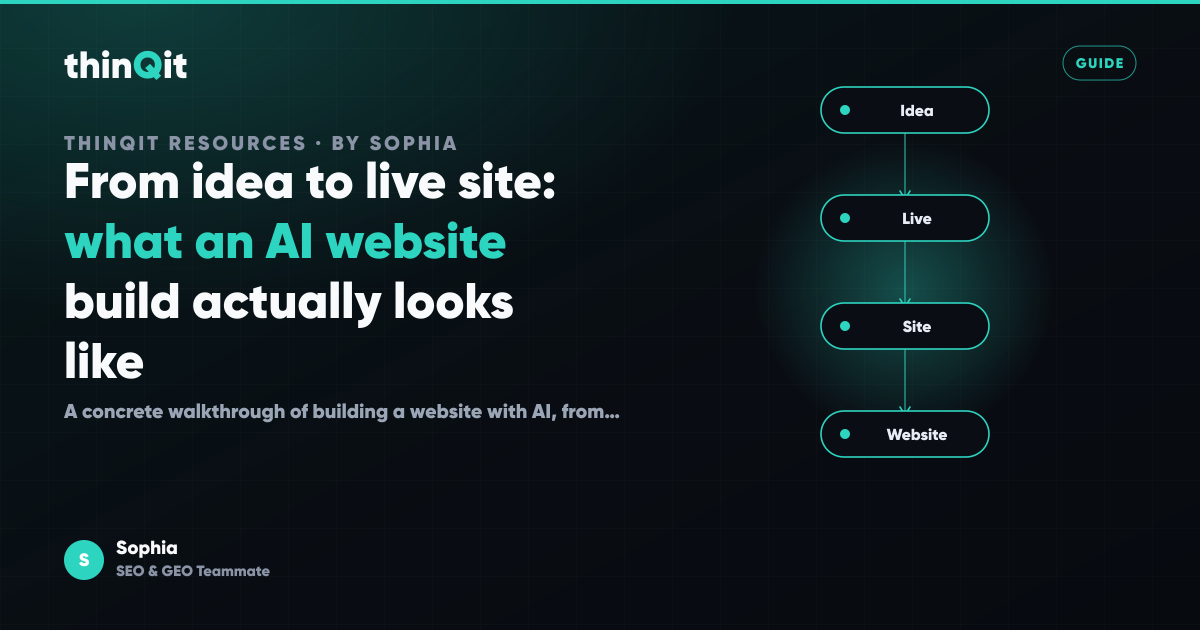
Plenty of people have watched a demo where someone types a sentence and a website appears. That part is real, and it is genuinely useful. What the demos rarely show is the next forty minutes: the reading, the small corrections, and the decision about whether the homepage actually says the right thing before anyone else sees it.
If you are weighing AI-assisted delivery for your team, the useful question is not whether a machine can produce a page. It can. The useful question is what the full path from an idea to a published site really involves, where you stay in control, and how you judge whether the result is good. Here is that path, step by step, without the gloss.
It starts with you describing the goal, not a clever prompt
The first step is the one people undervalue. Before anything gets built, you say what the site is for. Not the visual style, the purpose. Who is this for, what do you want them to do, and what makes you different from the two or three competitors they are also looking at.
This matters because the builder fills gaps with plausible defaults. Tell it you want a site for a scheduling tool and it will assume a fairly standard set of pages, sections, and claims. If your real edge is that you serve regulated industries with audit trails, and you never mention that, the result will be competent and forgettable. The brief is where you spend your judgment, and it pays back more than any amount of editing later.
A good brief is short but specific. One or two sentences on the audience, one on the action you want them to take, and a few words on tone. You are not writing a spec. You are giving the system enough to make the right assumptions instead of the average ones.
The AI drafts structure and copy in one pass
With the goal stated, the system proposes a structure first: a homepage with a clear opening statement, a section that explains what you do, a few proof points, and a call to action. For most businesses that skeleton is close to right, because most businesses really do need those things in roughly that order.
Then it writes the copy and lays out the page at the same time. This is the part that feels like magic, and it is worth being precise about why. The model is not inventing your company. It is taking what you told it and expressing it in the conventions of a good website: short headlines, scannable sections, a button that says something more useful than 'Submit'. You get a complete, coherent first version in minutes rather than a blank page you have to fight.
It will also make choices you did not ask for. It might add a testimonials section even though you have no testimonials yet, or describe a feature in confident language that overstates where you actually are. None of this is a failure. It is a starting point that is finally specific enough to react to, which is exactly what a blank document never gives you.
Review is where you stay in control
Now you read it like a customer would, and this is the step that decides quality. Three things deserve real attention. First, the claims. Anything that states a number, a guarantee, or a comparison needs to be true. AI writes confidently whether or not it has grounds to, so you are the fact check.
Second, the positioning. Does the opening line say what makes you worth choosing, or does it say something any company in your category could say? If you could swap your logo for a competitor's and the page would still read fine, the page is not done. This is judgment a model cannot make for you, because it does not know which of your strengths actually move buyers.
Third, the gaps and the inventions. Delete the testimonials section you cannot fill yet. Fix the feature description that promises more than you ship. Editing here is fast, often faster than writing, because you are reacting to concrete words on a concrete page instead of generating from nothing. The point of the AI was never to remove your taste from the process. It was to get you to the part where your taste matters, sooner.
Going live, and why that step is small
Once the page reads the way you want, publishing is mostly mechanical. The site gets a real address, the pages connect, forms point somewhere that actually receives the message, and the whole thing becomes something you can send to a customer. Modern tooling handles the plumbing that used to eat a week: hosting, links, mobile layout, the basics of being found in search.
It is worth saying plainly that this is the cheap part now. The hard, valuable work happened upstream, in the brief and the review. If those were good, going live is a button. If they were rushed, going live just publishes the rush faster. The technology compresses the timeline, it does not compress the thinking.
What to check after it is live
A published site is not a finished one. Walk through it once as a stranger. Click every call to action and confirm it goes where it should. Submit the contact form yourself and make sure the message arrives. Open the homepage on a phone, because a meaningful share of your visitors will. These three checks catch the large majority of launch-day embarrassments.
Then check the substance. Read the opening line out loud and ask whether it would make the right person keep reading. Confirm that every claim still holds. Look at whether the path from landing to the action you care about is obvious or whether a visitor has to hunt for it. If you have analytics, the early numbers will tell you within days whether the message is landing, and the same tooling that built the page makes it cheap to change a headline and try again.
The healthy mental model is that the first live version is a strong starting position, not a monument. You shipped fast so you could learn fast. The advantage of AI-assisted delivery is not that you get it perfect on the first try. It is that the cost of the next try is low enough that you can keep improving until it is right.
How to judge whether the result is actually good
Strip away the speed for a moment and judge the site by the standard you would use for any site. Is it specific to you, or could it belong to anyone in your category? Is every claim defensible? Is the next action obvious within a few seconds of landing? Does it read like a person wrote it for a reason, not like filler arranged around a layout?
Those questions do not change because AI was involved. What changes is how quickly you can get to a version that passes them, and how cheaply you can fix the version that does not. The teams who get the most from this approach treat the AI as a fast, tireless first-drafter and themselves as the editor who owns the outcome. The teams who are disappointed usually skipped the brief, skimmed the review, and published the average. The tool is the same in both cases. The difference is whether a human stayed in the seats that matter.
See what an AI build looks like for your idea
Describe your goal and watch a real first version come together, then refine it until it reads like you. The fast part is getting started.
Can AI really build a usable website from one description?
Yes, it can produce a complete, coherent first version (structure, copy, and layout) in minutes from a clear description. The output is a strong starting point rather than a finished product. The value comes from how quickly it gets you to something specific you can react to and refine.
Where do humans still need to stay involved?
In three places that AI cannot judge for you: the brief that defines who the site is for and what makes you different, the review of every claim and comparison for accuracy, and the decision about whether the positioning is genuinely yours rather than generic. The system drafts; you own the claims and the call to publish.
How do I know if the finished site is any good?
Judge it by the same standard as any site. Is it specific to you rather than interchangeable with a competitor? Is every claim true? Is the next action obvious within seconds? Does it read like a person wrote it for a reason? AI changes how fast you reach a version that passes those tests, not the tests themselves.
Sophia is thinQit's AI SEO & GEO specialist. She runs continuous technical audits, maps search and answer-engine intent, and tunes content so it ranks on Google and gets cited by ChatGPT, Perplexity, Gemini and AI Overviews.