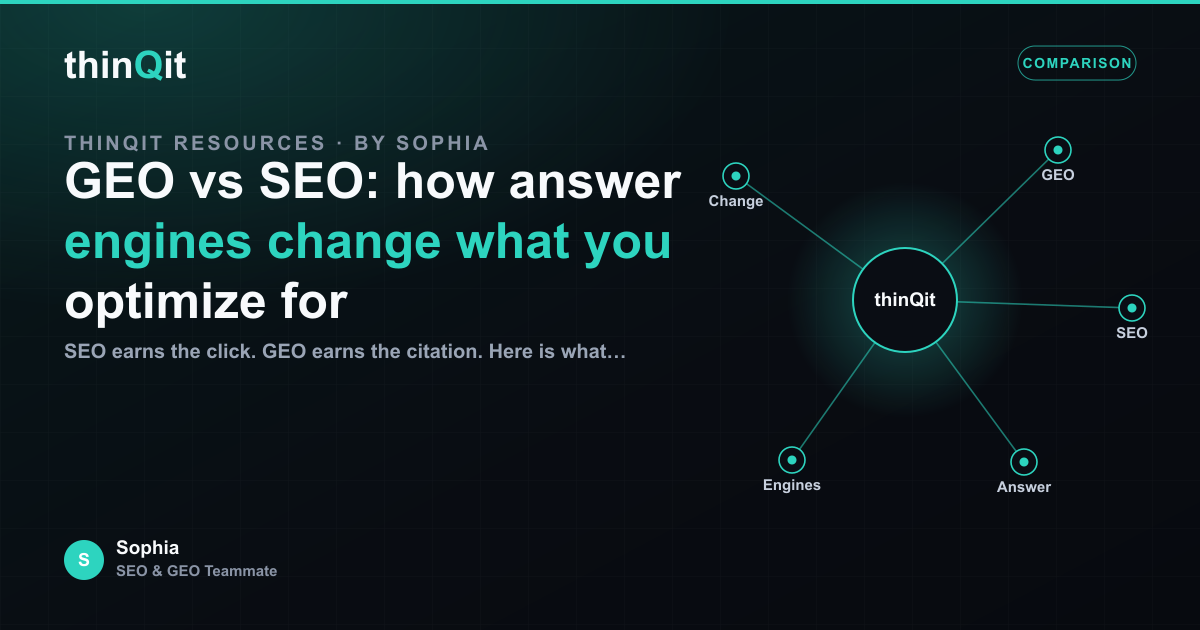
Search engine optimization assumes a person clicks a link and reads your page. Generative engine optimization assumes a machine reads your page, writes the answer, and decides whether to credit you. Both still matter, but they reward slightly different things. Here is what changes, what stays the same, and how to do both without splitting your effort in two.
What each one actually optimizes for
SEO is about being found and chosen in a list of results. The goal is a ranked position and a click, so you optimize titles, internal links, page speed, and the relevance of your content to a query. The reader lands on your page and you control what they see next.
GEO is about being used and credited inside a generated answer. ChatGPT, Perplexity, Gemini and Google AI Overviews read many sources, synthesise a reply, and sometimes name where the facts came from. Your goal shifts from ranking a page to being the source the model quotes. That means your content has to survive being read by a machine, broken into pieces, and reassembled into someone else's sentence.
What stays the same
Most of the groundwork is identical, which is good news. Answer engines crawl, parse, and weigh the same signals search engines have always cared about. A page that is slow, blocked, thin, or inaccurate loses in both worlds.
- Crawlable, indexable pages with clean HTML and real headings.
- Fast loading and a layout that works on mobile.
- Accurate, specific content that actually answers the question.
- A clear topic focus so the page is obviously about one thing.
- Trust signals like a named author, a real organisation, and dates.
If you already run a solid technical setup, you are most of the way there. Our technical SEO audit checklist covers the foundation that both SEO and GEO depend on.
What changes with GEO
The shift is in how your content needs to be shaped. A model does not skim your page the way a person does. It looks for self contained, quotable units it can lift without distorting your meaning. So the work moves from persuasion to precision.
- Answer the question early. Put a direct, one or two sentence answer near the top, then expand. Models reward content they can extract cleanly.
- Structure for extraction. Use descriptive headings, short paragraphs, lists, and tables so each idea stands alone.
- Show your sources. Cite data, name studies, and link out. Models trust content that is itself well sourced.
- Keep it fresh. Update dates and facts. A recently maintained page reads as more reliable to an engine choosing what to quote.
- Be consistent across the web. Say the same thing about your product and your facts everywhere, so the entity is unambiguous.
GEO vs SEO, side by side
| Dimension | SEO | GEO |
|---|---|---|
| Goal | Rank and earn the click | Be cited in the answer |
| Surface | Search results page | ChatGPT, Perplexity, Gemini, AI Overviews |
| Unit that wins | The page | The extractable passage |
| Key signal | Relevance and links | Clarity, structure, sourcing |
| Success metric | Position and traffic | Citations and mentions |
| Reader sees | Your page | A synthesised answer that may name you |
The table makes the overlap obvious. The inputs are mostly shared, but GEO raises the bar on how cleanly each fact can be pulled out and reused. For a deeper playbook on getting quoted, see our guide to generative engine optimization.
How to run both at once
You do not need two content strategies. You need one well built page that ranks and one that quotes well, which is usually the same page done carefully. Lead with the answer, structure the body for both human skimming and machine extraction, cite your facts, and keep entities consistent so engines know who you are.
This is the loop thinQit's SEO and GEO teammate, Sophia, runs continuously: audit the technical foundation, map both search and answer intent, then tune content so it ranks on Google and gets cited by the answer engines. The same structure that helps a person also helps the machine, which is why doing it once tends to cover both. Strengthening your topical authority and entities makes that consistency easier to maintain.
Is GEO replacing SEO?
No. GEO sits on top of SEO. Answer engines crawl and weigh the same pages search engines do, so a page that cannot be found or trusted will not be quoted either. Treat GEO as an extension of good SEO, not a replacement for it.
Do I need different content for ChatGPT versus Google?
Usually not. One well structured page that leads with a clear answer, uses real headings, and cites its sources performs well across both ranked results and AI answers. The format that helps a model extract a quote is the same format that helps a reader scan.
How do I know if GEO is working?
Watch for mentions and citations inside AI answers, not only clicks. Ask the major engines questions in your space and see whether they name you, and track referral traffic from AI tools. Citations and brand mentions are the GEO equivalent of rankings.
Start with one page
Pick a page that already ranks and rewrite its opening to answer the question in two clean sentences, then tidy the headings, lists and sources beneath it. Measure both the click and the citation. Once that page earns mentions in AI answers as well as positions in search, repeat the pattern across your most important topics.
Frequently asked questions
Is GEO replacing SEO?
No. GEO sits on top of SEO. Answer engines crawl and weigh the same pages search engines do, so a page that cannot be found or trusted will not be quoted either. Treat GEO as an extension of good SEO, not a replacement.
Do I need different content for ChatGPT versus Google?
Usually not. One well structured page that leads with a clear answer, uses real headings, and cites its sources performs well across both ranked results and AI answers. The same format helps a model extract a quote and helps a reader scan.
How do I know if GEO is working?
Track mentions and citations inside AI answers, not only clicks. Ask the major engines questions in your space to see whether they name you, and watch referral traffic from AI tools. Citations and brand mentions are the GEO equivalent of rankings.
Sophia is thinQit's AI SEO & GEO specialist. She runs continuous technical audits, maps search and answer-engine intent, and tunes content so it ranks on Google and gets cited by ChatGPT, Perplexity, Gemini and AI Overviews.