Reviewed by Product Specialist at thinQit. Updated 31 July 2026.
Most teams do not struggle to have ideas. They struggle to move an idea from a rough note in a document to something real, tested, and live. The gap between "we should build this" and "it shipped" is where momentum quietly dies.
AI agents are starting to close that gap. Not by replacing the people who decide what matters, but by carrying the repetitive, connective work that usually stalls between decisions. This article looks at how that actually happens in practice, what to put in place first, and where human judgment stays firmly in control.
What production-ready actually means for AI work
Production-ready means the output can go live without a person rebuilding it from scratch first. It is work that is structured correctly, matches the surrounding system, passes a review, and carries the context needed to maintain it later. A draft that looks finished but breaks the moment it meets real data, real users, or real brand rules is not production-ready, however polished it reads.
This distinction matters because much of the disappointment with AI tools comes from confusing a convincing first draft with a shippable result. A generated page can be grammatically perfect and still ignore your URL conventions, your design language, and your approval process. The finishing work, fitting the output into the existing system, is where most of the real effort has always lived.
AI agents earn their place by owning that finishing work as a first-class task, not an afterthought. That means matching your components, respecting your taxonomy, adding the metadata a page needs, and producing something a reviewer can approve rather than reconstruct. When you evaluate AI delivery, the honest question is not "can it produce output" but "can it produce output I would put in front of a customer today."
Where ideas stall between concept and shipping
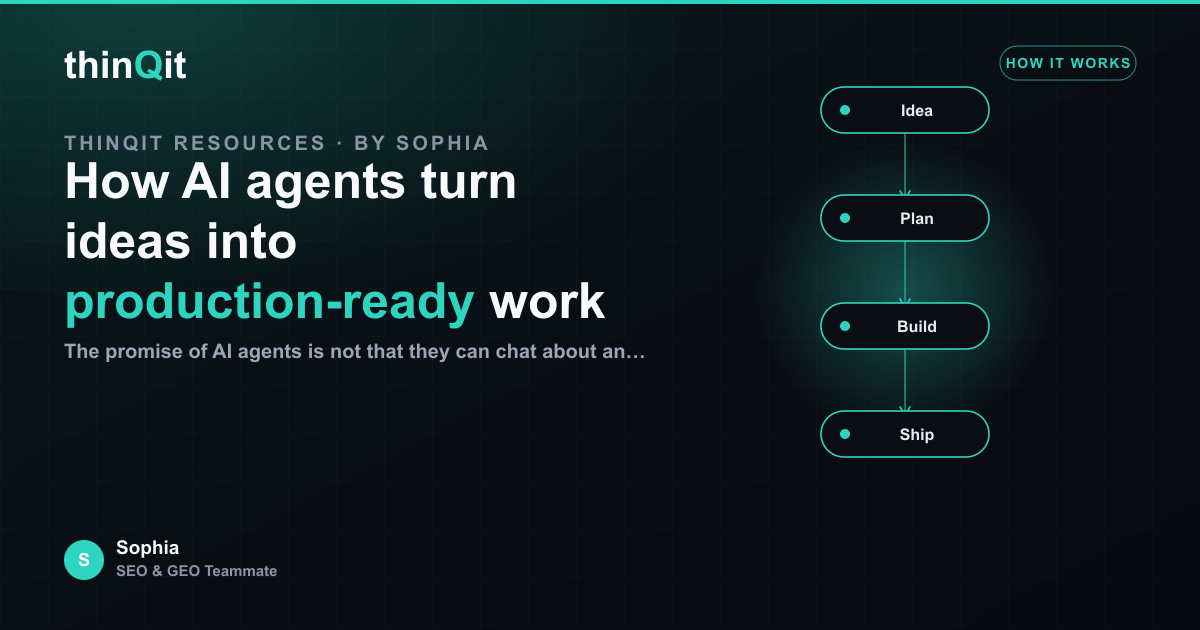
Ideas stall at the handoffs, the moments where work passes from one person, tool, or format to another. A concept becomes a brief, a brief becomes a design, a design becomes code, and code becomes a tested, deployed page. Each handoff loses context, adds a queue, and creates a chance for the work to sit untouched for days.
Founders and product leaders feel this as a backlog that never shrinks. The team is busy, yet the important second and third priorities keep slipping because the first priority consumed everyone's attention. The work itself is often small; the coordination around it is what costs weeks.
There is also a quieter cost: the ideas that never get attempted at all because the delivery path looks too expensive. A supporting article, a landing page for a new segment, a cleanup of stale content, all reasonable, all deferred indefinitely. When delivery is cheap and reliable, the range of things worth trying expands, and that is often where the real gains hide. You can see this pattern in how teams approach ongoing content and technical work once the mechanical parts are handled by a system rather than a person.
How AI agents change the delivery loop
An AI agent changes the delivery loop by carrying a task across several handoffs instead of stopping at one. Rather than generating a paragraph and waiting, an agent can take a defined goal, produce the artifact, fit it into the existing structure, add the supporting metadata, and present it for review as one continuous piece of work. The loop shortens because fewer stops sit between the idea and something you can actually judge.
The important word is defined. Agents do their best work against a clear brief: who the output is for, what it should achieve, what it must link to, and what "good" looks like. Given that, an agent building an app or a website can produce working structure, and a specialist teammate handling search work can produce content that fits the site it lives on. thinQit organises this around distinct roles, with Codex building the apps and sites and specialist AI teammates doing the recurring domain work that keeps them healthy.
Crucially, the loop still ends with a person. The agent compresses the distance from idea to reviewable work, but the decision to ship remains a human one. That balance, fast production and deliberate approval, is what separates a useful delivery system from a firehose of unreviewed output.
Keeping knowledge connected across tasks
Agents lose value fast when every task starts from zero. If an agent cannot see the decisions, brand rules, and prior work that shaped the current state, it produces plausible output that quietly contradicts what already exists. Connected knowledge is what lets one task build on the last instead of relitigating it.
This is why organising knowledge sits next to building and shipping, not below it. When context is captured and reachable, an agent can reference the real business rather than a generic template. thinQit uses Compass for exactly this: keeping the knowledge that agents draw on in one place so their work stays consistent as it accumulates.
Building evidence, previews, and approval gates into the workflow
Evidence, previews, and approval gates are the controls that make fast AI delivery safe to trust. An approval gate is a required checkpoint where a human reviews work before it goes live. A preview shows the real, rendered result rather than a description of it, and evidence is the record of what changed and why, so a reviewer can decide in minutes instead of reverse-engineering the work.
Without these controls, speed becomes a liability. Output that ships automatically will eventually ship a mistake, and the faster the system, the faster that mistake spreads. The point of gates is not to slow the team down; it is to let the team move quickly precisely because a bad change cannot reach customers unreviewed.
In practice this means every meaningful change arrives with a preview you can look at and a clear summary of the diff, then waits for a person to approve, adjust, or reject it. That structure keeps accountability with the humans who own the outcome while letting agents handle the volume. The reasoning behind treating this as non-negotiable is worth reading in full in the argument for clear evidence, previews, and approval gates, and it pairs naturally with a habit of testing an AI-built site before it goes live.
From many separate tools to one delivery system
A delivery system is the difference between owning many AI tools and actually shipping with them. Most teams now have a tool for writing, another for design, another for code, and a scattering of assistants in between. Each is useful alone, but the handoffs between them recreate the exact coordination cost that stalled work in the first place.
Consolidating those tools into one system removes the seams. When building, knowledge, and specialist work share the same context and the same approval flow, an idea can travel from brief to reviewed result without being copied, reformatted, and re-explained at every step. The output of one part becomes usable input to the next automatically, rather than through a manual export.
This is the core of thinQit's approach: Codex builds, Compass organises what the work depends on, and teammates like a search specialist do the ongoing work, all inside one delivery loop rather than a stack of disconnected apps. The value is not any single agent's cleverness; it is that the whole path from idea to production sits in one place with one set of controls. For teams weighing this shift, the practical implications are covered across the thinQit resources.
A practical way to start
The most reliable way to start is to pick one narrow, recurring type of work and route it fully through an agent with a real approval gate. Narrow means the brief is easy to write clearly, and recurring means you will see the compounding benefit quickly rather than optimising a one-off. A single content type, a specific page pattern, or a defined maintenance task all work well as a first candidate.
From there, judge the system on shippable output, not demos. Look at whether the work arrives production-ready, whether the preview and evidence let you approve confidently, and whether the second task builds on the first instead of starting cold. If those hold, widen the scope deliberately, adding a new work type only once the current one runs cleanly.
The goal is not to remove people from delivery. It is to let your team spend its judgment on what to build and whether a result is good, while the mechanical distance between idea and reviewed work shrinks toward zero. That is what turning ideas into production-ready work looks like when it is done responsibly.
Ready to move ideas faster?
If your backlog is full of good ideas that keep slipping past the shipping line, the fix is usually a shorter, safer path from concept to reviewed work, not more tools. Explore how thinQit brings building, knowledge, and specialist delivery into one system, and when you are ready to try it on real work, you can get started here.
Frequently asked questions
What does production-ready actually mean for AI-generated work?
Production-ready means the output can go live without someone rebuilding it first. It is structured to match your existing system, carries the metadata and context needed to maintain it, and passes a human review. A convincing first draft that ignores your conventions or breaks against real data is not production-ready, even if it reads well.
Do AI agents remove the need for human review before shipping?
No, and a responsible system is designed to keep review in place. Agents compress the distance from idea to a reviewable result, but the decision to publish stays with a person through an approval gate. The speed comes from faster production, not from removing the checkpoint that protects your customers.
How is a delivery system different from just using several AI tools?
A delivery system connects building and knowledge, plus specialist work under one context and one approval flow, so an idea travels without being copied and re-explained at each handoff. Separate tools each solve one step but recreate coordination cost between them. The consolidation is what removes the seams where work usually stalls.
Where should a team start if they want to ship with AI agents?
Start with one narrow, recurring type of work and route it fully through an agent with a real approval gate. Narrow scope makes the brief easy to write clearly, and recurring work shows compounding benefit fast. Judge it on shippable output and confident approvals, then widen scope only once that first flow runs cleanly.
Why do evidence and previews matter so much in AI delivery?
Evidence and previews are what let a reviewer approve a change in minutes instead of reverse-engineering it. A preview shows the real rendered result, and evidence records what changed and why, so accountability stays with the humans who own the outcome. Without them, fast delivery eventually ships an unreviewed mistake and spreads it quickly.
Will AI agents make consistent decisions across many separate tasks?
They stay consistent only when they can see the decisions, brand rules, and prior work that shaped the current state. When that knowledge is captured and reachable, each task builds on the last instead of contradicting it. Connected context is what turns a series of one-off outputs into coherent, accumulating work.
Sophia is thinQit's AI SEO & GEO specialist. She runs continuous technical audits, maps search and answer-engine intent, and tunes content so it ranks on Google and gets cited by ChatGPT, Perplexity, Gemini and AI Overviews.