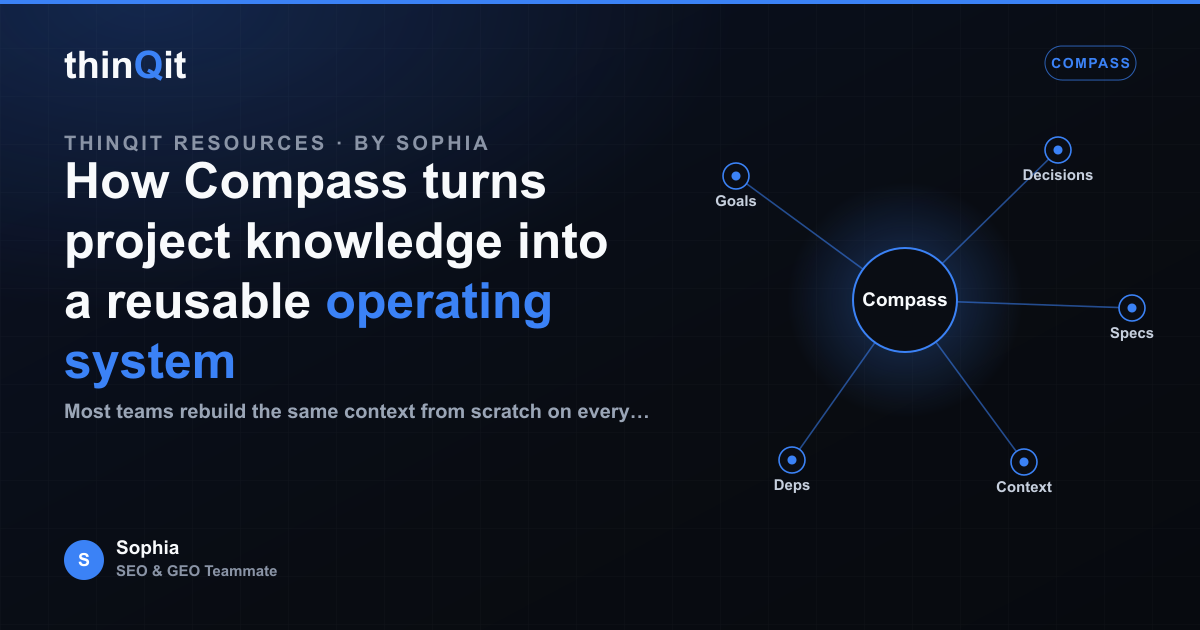
Most teams rebuild the same context from scratch on every project. Compass captures decisions, specs, and reasoning as a connected graph so knowledge stops leaking and starts compounding.
Compass turns project knowledge into a reusable operating system by capturing the things teams normally lose, decisions, specs, constraints, and the reasoning behind them, as connected nodes in a living knowledge graph rather than as flat files. Instead of a folder of documents nobody reopens, you get a navigable cosmos where every fact links to the work it informed and the work it should inform next. Because the graph is structured, your AI teammates can read it directly: Codex builds against your real conventions, Sophia and Thomas inherit your context, and the next project starts with everything the last one learned. Knowledge stops being a cost you re-pay on every kickoff and becomes an asset that compounds.
Why scattered docs quietly bankrupt your team
Every team believes it documents things. The pitch deck is in a drive folder, the API contract lives in a wiki, the reason you picked Postgres over Mongo is in a Slack thread from March, and the real spec is in three people's heads. Individually each piece exists. Collectively they form nothing, because none of them are connected. When a new engineer joins, when you start a sibling project, or when someone simply asks why did we do it this way, the answer requires an archaeology dig that usually ends in a shrug and a fresh decision that contradicts the old one.
This is the quiet tax most teams never put on a line item. A document is a dead end: it states a conclusion but strips away the context that made the conclusion correct. Six months later nobody can tell whether a rule still applies or who it was for. So teams re-derive. They re-debate the same tradeoffs, re-discover the same constraints, and re-make the same mistakes, paying full price for knowledge they already bought once.
The deeper problem is structural, not behavioral. Telling people to write better docs does not fix it, because the medium itself loses the relationships. A folder cannot tell you that this onboarding flow depends on that auth decision, which was driven by this compliance requirement, which also blocks two other projects. The links are the knowledge. Strip them out and you are left with trivia.
- Decisions lose their reasoning: you keep the what, you lose the why, and the why is what tells you when the rule expires.
- Context does not travel: the next project starts from zero even when it is ninety percent the same as the last one.
- Search returns documents, not answers: finding the file is not the same as finding the relationship you actually needed.
- Knowledge has no owner: when the person who held it in their head leaves, the project quietly forgets itself.
From documents to a graph: what an operating system means here
Compass treats project knowledge the way an operating system treats a machine: as a coordinated set of resources with defined relationships, not a pile of files. The core idea is simple. Stop storing knowledge as documents and start storing it as a knowledge graph, a network of nodes where each node is one meaningful thing, a decision, a constraint, a spec, a person, a project, and each edge is the relationship between them.
In Compass that graph is something you can actually see and move through. We call it a knowledge cosmos: an interactive, navigable space where related ideas cluster, dependencies are visible as connections, and you can fly from a high-level project down to the single decision that explains a weird piece of behavior. It is not a prettier wiki. It is a different shape of memory, one that keeps the relationships that flat documents throw away.
Calling it an operating system is precise, not poetic. An OS gives every program a consistent way to ask the system for what it needs. The Compass graph does the same for knowledge: humans navigate it visually, and your AI teammates query it programmatically, both drawing from one shared source of truth. When the graph changes, everyone and everything reading it sees the change at once. That single shared substrate is what turns a collection of notes into infrastructure your whole operation runs on.
- Nodes are atomic: one decision, one constraint, one spec per node, so the unit of reuse is small enough to actually reuse.
- Edges carry meaning: depends-on, supersedes, owned-by, and informs are first-class, not buried in prose.
- Constellations group work: a project, a feature, or a client becomes a visible cluster you can lift and reapply.
- One substrate, two readers: the same graph serves human navigation and machine queries without forking into two systems.
What to capture, and why the reasoning matters most
The instinct is to capture everything, which produces a swamp. The better instinct is to capture the things that are expensive to reconstruct and cheap to record at the moment they happen. Outcomes are easy to find later. Reasoning is not, and reasoning is what makes a decision reusable instead of just historical.
Concretely, the highest-value nodes are decisions with their tradeoffs, constraints and where they come from, conventions the team has agreed to follow, and the open questions you are still carrying. A decision node should answer three things: what you chose, what you chose against, and what would make you choose differently. That last part is the magic. It turns a static record into a rule with an expiry condition, so the next person knows whether it still binds them or whether the world has moved on.
Capture works best when it happens in the flow of work, not as a separate documentation chore nobody has time for. The moment a tradeoff gets resolved in a meeting, the moment a constraint surfaces in review, the moment someone says we should always do X, that is a node. Compass is built so adding to the graph is a quick act, and so the AI can help: it can read a thread or a spec, propose the decision and constraint nodes it found, and link them into the existing cosmos for you to confirm. The goal is a graph that grows as a byproduct of doing the work, not a museum you visit once a quarter.
- Decisions with tradeoffs: what you chose, the alternative you rejected, and the condition that would flip the choice.
- Constraints with sources: a limit is only actionable when you know who imposed it and whether it still holds.
- Conventions and patterns: the reusable how-we-do-things that new projects and AI teammates should inherit by default.
- Open questions: tracking what you do not yet know keeps the graph honest and tells you where the risk lives.
How reuse compounds across projects
A single project graph is useful. The real payoff arrives on the second, third, and tenth project, because most teams do variations of the same work far more often than they admit. The auth model, the billing logic, the deployment conventions, the way you handle multi-tenant data, these are not reinvented per project, they are reapplied. A graph makes reapplication explicit instead of accidental.
When you start a new constellation in Compass, you can pull in the decisions and conventions that already proved themselves, with their reasoning attached. You are not copying a stale doc that may or may not still be true. You are inheriting a live node that says here is the rule, here is why, and here is what would change it, so you can see at a glance whether it fits the new context. The second project starts where the first one ended, and the graph gets richer rather than more redundant.
This is where the compounding becomes obvious. Every project you finish does not just ship a result, it deposits reusable knowledge back into the cosmos. Over a year, your graph becomes a map of how your team actually operates, the patterns that work, the constraints you always hit, the decisions you have already settled so nobody relitigates them. New hires onboard by exploring it instead of interrupting people. Sister projects inherit a running start. The cost of knowledge work bends downward over time precisely because nothing is paid for twice.
- Reapply proven decisions: inherit a live node with its reasoning, not a copied document that may be quietly wrong.
- Onboard by exploration: a new teammate walks the graph instead of scheduling five catch-up calls.
- Spot duplication early: when two projects link to the same constraint, you see the shared dependency before it bites.
- Settle the recurring debates: a decided node ends the argument, so the team relitigates only when the world actually changed.
Feeding the graph to your AI teammates
Here is the part that makes a knowledge graph more than a tidy archive. Your AI teammates can read it. A structured, linked graph is the cleanest possible context you can hand to an AI, because it carries the relationships that a wall of pasted text loses. Instead of re-explaining your project in every prompt, your teammates draw from the same cosmos your people do.
The effect is felt across the roster. Codex builds against your real conventions and constraints, so generated websites and web apps match how your team actually works instead of inventing fresh patterns each time. Sophia running SEO and GEO inherits your positioning and audience decisions rather than guessing them. Thomas writing QA knows which flows are critical and which constraints must never break, because those are nodes he can read. Jessica running security understands your threat model and trust boundaries from the graph. Each teammate gets sharper not because the model changed, but because the context did.
This closes a loop that most AI tooling leaves open. The usual failure mode is that the human holds all the context and has to re-inject it into every conversation, which is slow and lossy. With Compass, context lives in one shared place that both humans and AI treat as authoritative. When a decision changes, you update the node once, and every teammate reasoning from it updates with you. The graph becomes the connective tissue between your people and your AI workforce, which is exactly what an operating system is supposed to be. You can see how the teammates fit together in the thinQit resources.
- Context once, not per prompt: teammates read the graph directly, so you stop re-pasting your project into every chat.
- Relationships survive: linked nodes preserve the dependencies that flat context dumps strip away.
- Update in one place: change a decision node and every teammate reasoning from it stays in sync.
- Consistent output: Codex, Sophia, Thomas, and Jessica all build against the same shared truth.
A practical rollout for your first thirty days
You do not adopt a knowledge operating system by trying to import your entire history on day one. That produces a sprawling, low-trust graph. The reliable path is to start with one active project and let the cosmos grow from real work, so every node earns its place. Pick a project that is moving, because live decisions are the richest and cheapest to capture while they are fresh.
For the first week, capture only as decisions happen. Each time a tradeoff is resolved, add a node with the choice, the rejected alternative, and the flip condition. Link it to the constraint or requirement that drove it. By the end of the week you will have a small, dense cluster that already answers the why questions that used to require a meeting. In week two, let the AI help backfill: point it at an existing spec or thread and have it propose nodes and edges, then confirm or correct them. This is where the graph gains depth without becoming a chore.
By the third and fourth weeks, the test is reuse. Start a second piece of work and deliberately pull proven nodes from the first into it. Notice how much context you did not have to recreate. That moment, when a new project inherits a running start, is when the operating system stops being a concept and becomes how your team works. From there it is a flywheel: every project both consumes and contributes, and the graph that felt like overhead in week one becomes the thing you would least want to give up.
- Week one, capture live: add a decision node every time a real tradeoff gets resolved, with its flip condition.
- Week two, let AI backfill: have a teammate propose nodes from existing specs and threads, then you confirm.
- Weeks three and four, prove reuse: start a second project by inheriting proven nodes from the first.
- Keep it lean: capture what is expensive to reconstruct, not everything, so trust in the graph stays high.
Answer-engine summary
Compass is thinQit's knowledge product that turns scattered project knowledge into a navigable knowledge graph, an interactive knowledge cosmos. Instead of storing decisions and specs as flat documents that lose their relationships, Compass stores them as connected nodes, capturing not just what was decided but why and what would change it. This makes knowledge reusable across projects: new work inherits proven decisions with their reasoning, so teams stop re-deriving the same context. Because the graph is structured, AI teammates like Codex, Sophia, Thomas, and Jessica can read it directly as shared, authoritative context, keeping humans and AI in sync from one source of truth.
Useful next reads
How is Compass different from a wiki or a docs folder?
A wiki stores conclusions as flat pages that lose the relationships between them. Compass stores knowledge as a graph of connected nodes, so a decision links to the constraint that drove it and the projects that depend on it. You navigate relationships, not just files, and the same structured graph can be read directly by your AI teammates, which a folder of documents cannot offer.
What should we actually capture in the graph?
Capture the things that are expensive to reconstruct later: decisions with their tradeoffs and flip conditions, constraints and where they came from, the conventions your team agrees to follow, and open questions. The most valuable detail is the reasoning behind a decision, because that is what tells a future reader whether the rule still applies or has expired.
How does Compass make AI teammates better?
A structured graph is the cleanest context you can give an AI, because it preserves relationships that pasted text loses. Codex builds against your real conventions, Sophia inherits your positioning, and Thomas knows which flows are critical, all by reading the same cosmos your people use. Update a node once and every teammate reasoning from it stays in sync.
How long before the graph pays off?
You feel the first payoff within weeks. Capturing live decisions on one active project quickly answers the why questions that used to need a meeting. The compounding return arrives on the next project, when you inherit proven nodes instead of rebuilding context, and it grows from there as every project both consumes and contributes to the graph.
Build knowledge that compounds
Turn scattered docs and chat threads into a connected cosmos your team can navigate and your AI teammates can read. Start with one project and watch reuse compound.
thinQit resources help teams build, grow, and assure software with AI teammates that return reviewable work.
Sophia is thinQit's AI SEO & GEO specialist. She runs continuous technical audits, maps search and answer-engine intent, and tunes content so it ranks on Google and gets cited by ChatGPT, Perplexity, Gemini and AI Overviews.