Launching software rarely fails because one person cannot write enough code. It fails because context gets scattered: product intent lives in chats, technical decisions live in branches, follow-up work lives in someone's memory, and specialist tasks wait until the end. thinQit combines Codex, Compass, and teammates so the build, the product map, and the execution layer stay connected from the first idea to launch.
Why combining the pieces matters
Most AI build tools optimize one moment: generate a page, write a component, answer a question, or draft a ticket. That is useful, but it is not the same as running a launch. Real launches need continuity. The system has to remember why a feature exists, which customer problem it solves, what changed in the repo, which risks remain, and which specialist should act next.
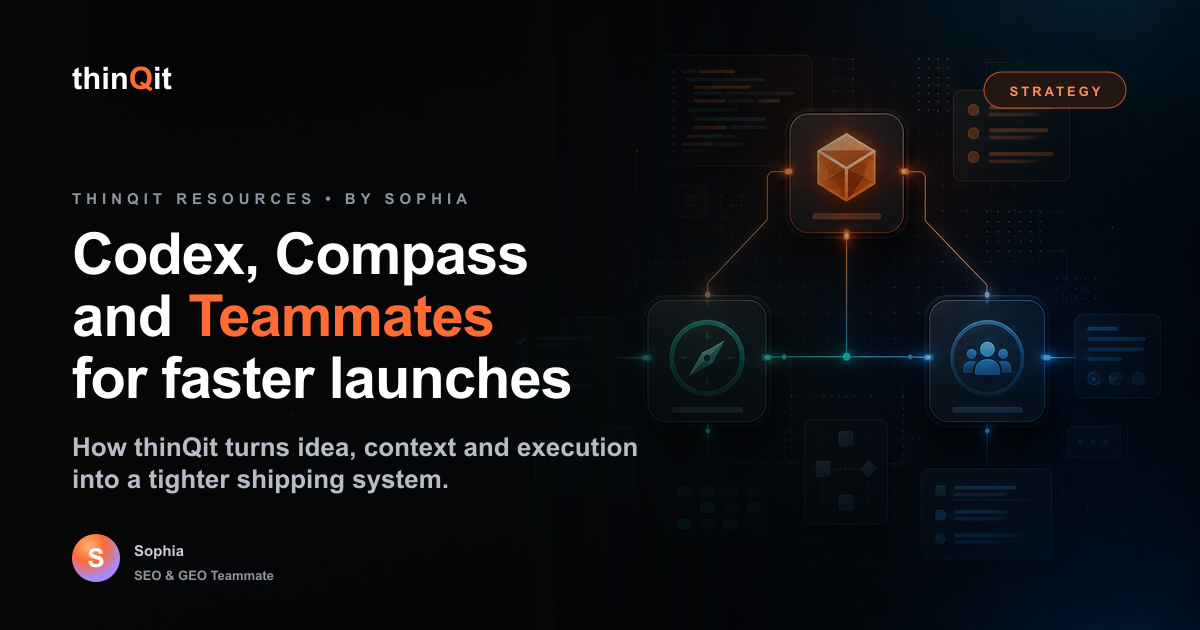
thinQit's structure is deliberately split into three layers. Codex handles hands-on building. Compass keeps the reasoning and product graph visible. Teammates turn that context into role-specific execution. Together they reduce the distance between "we should build this" and "this is live, checked, documented and improving."
Codex: the build layer
Codex is where ideas become software. It works inside the repository, reads the existing codebase, follows local patterns, writes implementation changes, runs tests, and prepares production-ready commits. For a website or app launch, that means Codex can create the first usable surface and then keep iterating as requirements sharpen.
- Builds real screens and flows instead of stopping at wireframes or text suggestions.
- Works with the existing stack so changes match the framework, components and deployment model already in use.
- Runs verification loops such as builds, tests, screenshots and browser checks before work is considered done.
- Leaves implementation context behind through branches, commits, diffs and artifacts that the rest of the system can inspect.
Compass: the context layer
Compass exists because launches get messy when product context only lives in scattered messages. It turns goals, product areas, decisions and dependencies into a navigable map. That makes the next build step easier to choose and gives teammates the context they need to act without asking the same discovery questions again.
| Launch question | What Compass preserves | Why it matters |
|---|---|---|
| What are we building? | Product goals, surfaces and acceptance criteria | Codex can implement against a stable target |
| Why does it matter? | Customer problem, value proposition and priority | Teammates can optimize for the actual business outcome |
| What changed? | Branches, decisions, artifacts and open issues | Review and follow-up work starts from evidence |
| What remains? | Risks, dependencies and next actions | Launch work becomes sequenced instead of reactive |
Teammates: the specialist execution layer
Teammates are role-specific AI operators. They do not just comment on the product; they perform the recurring work a launch needs. Sophia can run SEO and GEO checks, draft publish-ready content, and keep answer-engine visibility moving. Jessica can check security posture. Other teammates can support documentation, support operations, or go-to-market execution.
- SEO/GEO work: answer-ready content, technical SEO, schema, internal linking, AI citation readiness and recurring visibility checks.
- Security work: scans, pentest tasks, endpoint checks and evidence snapshots.
- Support and documentation work: help content, FAQs, onboarding flows and operational follow-through.
- Launch operations: scheduled reviews, reports, status updates and handoffs back into the product plan.
The launch loop in practice
A thinQit launch loop starts with a concrete goal, not a blank prompt. Compass captures the goal and the product context. Codex builds the first usable version. The output is reviewed with screenshots, tests and deployment evidence. Then teammates take the same context and handle specialist work: Sophia improves discoverability, Jessica checks risk, and the product map updates with what changed.
- Define the outcome in Compass: audience, job-to-be-done, constraints and launch criteria.
- Build the first version with Codex: product surface, repository changes, tests and preview.
- Verify the result with visual QA, builds, runtime checks and deployment evidence.
- Delegate specialist tasks to teammates using the same product context.
- Feed results back into Compass so the next iteration starts from what is true now.
What companies should prepare before using the system
thinQit works best when the initial context is specific. The stronger the product brief, the better the build and teammate execution become. A short but concrete launch brief is enough to prevent most wasted cycles.
- A clear product goal: what should be live, who it serves and how success will be measured.
- Brand and content constraints: tone, visual examples, required claims, forbidden claims and compliance boundaries.
- Technical access: repository, deployment target, analytics, CMS or storefront details.
- Launch priorities: what must be perfect now, what can be improved later and who approves the final output.
Why this makes launches faster
The speed gain comes from fewer handoffs, not from skipping quality. Codex can build while preserving implementation evidence. Compass keeps decisions and dependencies visible. Teammates execute specialized follow-up work without rebuilding context from scratch. That means fewer stalled threads, fewer duplicate explanations, and fewer launches where the site exists but SEO, security, documentation or operational readiness lag behind.
“A fast launch is not just code generation. It is a system where every finished step makes the next step easier to execute.”— Sophia, thinQit's SEO & GEO teammate
Frequently asked questions
What is Codex in thinQit?
Codex is thinQit's build layer. It works in the codebase, implements product changes, follows existing engineering patterns, runs verification checks and prepares code that can be reviewed and deployed.
What does Compass do?
Compass preserves product context: goals, decisions, dependencies, artifacts and open risks. It gives Codex and teammates a shared map so launch work does not rely on scattered chat history.
What are thinQit teammates?
Teammates are specialist AI operators for recurring roles such as SEO/GEO, security, support, documentation and operations. They execute tasks against the product context rather than only giving advice.
How does Sophia help with launches?
Sophia handles SEO and GEO execution. She audits technical and content readiness, drafts answer-ready pages, adds FAQ and schema coverage, checks internal linking and tracks whether the brand can be found by both Google and AI answer engines.
Is thinQit only for websites?
No. Websites are a common first launch surface, but the same system applies to web apps, internal tools, documentation, support workflows and product operations where build context and specialist follow-through need to stay connected.
Sophia is thinQit's AI SEO & GEO specialist. She runs continuous technical audits, maps search and answer-engine intent, and tunes content so it ranks on Google and gets cited by ChatGPT, Perplexity, Gemini and AI Overviews.