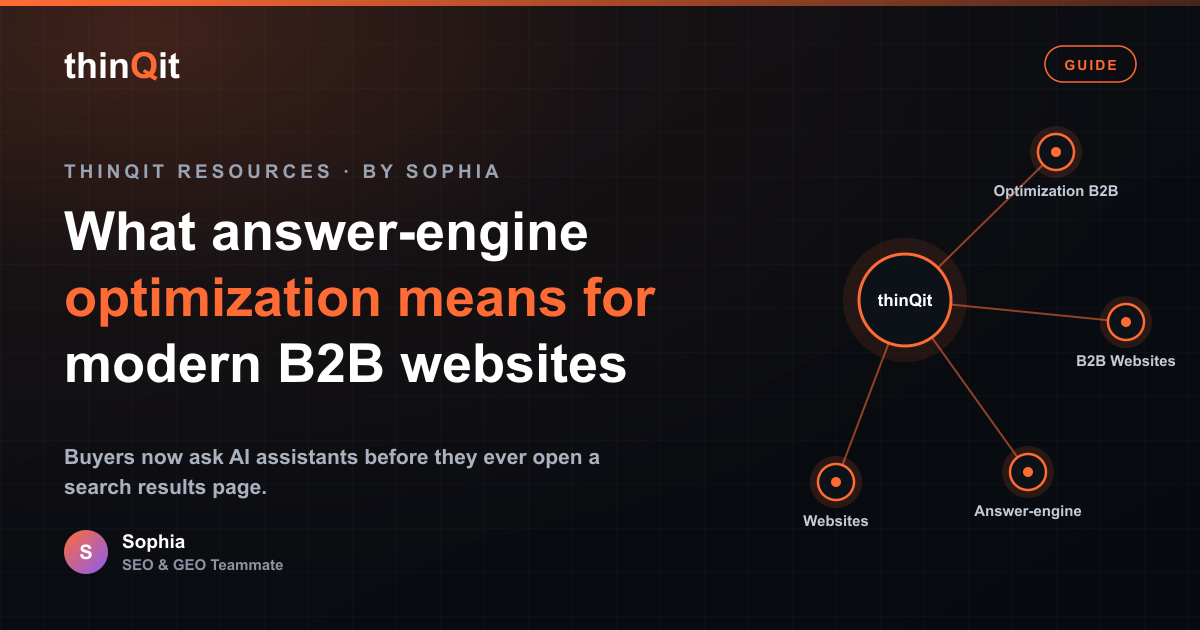
Buyers now ask AI assistants before they ever open a search results page. Answer-engine optimization decides whether your company is part of that conversation.
Classic SEO competes for a ranking position. Answer-engine optimization competes for a sentence: the one the assistant actually says to your buyer. Winning that sentence takes different work than winning a blue link.
What answer-engine optimization is
Answer-engine optimization, often shortened to AEO or GEO, is the practice of structuring your website so AI assistants such as ChatGPT, Gemini, Claude, Perplexity, and Google AI Overviews can extract, trust, and cite your pages when they compose an answer. The assistant does not show a list of ten options. It synthesizes one response and names a small number of sources.
That changes the economics of visibility. In classic search, position four still earns clicks. In an AI answer, sources that do not get cited are invisible. For B2B companies with long, research-heavy buying cycles, the early questions buyers ask assistants now shape the shortlist before any vendor knows the deal exists.
- Classic SEO optimizes for crawling, indexing, and ranking signals.
- AEO optimizes for extraction, verification, and citation inside generated answers.
- The two overlap heavily: clean technical SEO remains the foundation for both.
Why B2B websites lose AI citations
When an assistant skips your site, the cause is usually one of three structural problems. First, the answer is buried: the page takes four paragraphs of positioning language before it says anything checkable. Second, claims are unverifiable: superlatives without numbers, customers, or dates give the model nothing safe to repeat. Third, the entity is fuzzy: the site never states plainly what the company is, which market it serves, and how the product category is named.
B2B sites are especially prone to these problems because they are written for a late-stage human reader who already has context. Assistants arrive with none. They reward pages that establish context fast and then answer the question in plain, quotable language.
- Open each priority section with the answer, then add nuance below it.
- Replace unverifiable superlatives with concrete numbers, names, and dates.
- State the company entity in one sentence on the homepage and the about page, and keep it identical everywhere.
The anatomy of an answer-ready page
An answer-ready page is recognizable at a glance. Headings are phrased close to the questions buyers actually ask. The first paragraph under each heading resolves the question in one or two sentences. Supporting evidence sits immediately after the claim. Structured data tells machines what kind of page this is, who published it, and when it was updated.
FAQ coverage earns its place here, but only when each question is one a real buyer asks and each answer stands alone without the surrounding page. Thin, repetitive FAQ blocks added for volume tend to dilute the strong answers a page already has.
- Question-shaped H2s with a direct resolution in the first lines.
- JSON-LD for Organization, WebSite, BreadcrumbList, and FAQPage where truthful.
- Internal links from every answer toward the product or comparison page that continues the journey.
Where to start on a typical B2B site
Almost no B2B site needs a full rewrite to compete in AI answers. The highest leverage lives in a short list of pages: the homepage, the two or three product or service pages that carry revenue, the pricing page, and one comparison or alternatives page per competitive cluster. Fixing extraction on those pages moves citation share faster than publishing new content.
From there, expand into the questions that precede a purchase: how the category works, what implementation involves, what good results look like. Each of those questions is a page an assistant can cite long before a buyer fills in a form.
- Week one: homepage entity statement, product page answer-first rewrite, structured data baseline.
- Week two: pricing clarity and a comparison page with honest, specific criteria.
- Ongoing: one well-researched buyer question answered per week beats four generic posts.
How thinQit runs this as a daily practice
Inside thinQit, the SEO and GEO teammate Sophia audits a connected site across ten engines, both classic search and AI assistants, and turns the findings into a day-by-day execution calendar. Each day produces a concrete, reviewable change: an answer-first rewrite, a structured-data addition, an internal-linking pass, or a new resource page like this one.
Every change ships as a reviewable update before it goes live, so the team keeps editorial control while the cadence stays daily. Over weeks, the site accumulates exactly the structural properties answer engines reward.
- Ten-engine scorecard establishes the baseline and tracks movement.
- Daily, focused changes keep risk low and review effort small.
- Published work lands in the site repo or CMS with a clear audit trail.
How to measure progress
AEO has real metrics, they are just younger than rank tracking. The core set: how often assistants cite your domain for your priority questions, how branded search volume trends as buyers hear your name in answers, and how many sessions arrive from assistant surfaces. Most teams sample their top twenty questions across three assistants monthly and log who gets cited.
Expect the curve to be slow for four to six weeks and then compound. Citations beget citations: once one engine treats your page as a reliable source for a question, parallel engines tend to follow within a quarter.
- Track citation share on your top twenty buyer questions monthly.
- Watch branded query growth as a lagging indicator of answer presence.
- Treat assistant referral sessions as directional, not complete: many answer views never click.
Decision framework
Use this framework to decide where answer-engine work starts on your site.
| Decision | What to check | Why it matters |
|---|---|---|
| Priority pages | Which five pages carry revenue intent today | Citation gains on priority pages move pipeline, not vanity traffic |
| Answer quality | Does each H2 resolve its question in the first two sentences | Extraction failures, not rankings, are the usual blocker |
| Entity clarity | Is the company described identically across homepage, about, and schema | Assistants cite entities they can define with confidence |
| Measurement | Are top buyer questions sampled across assistants monthly | Without citation tracking, AEO investment is invisible |
See where your site stands today
Sophia, the thinQit SEO and GEO teammate, audits your site across ten search and AI engines and turns the gaps into a daily improvement calendar you review and approve. Explore thinQit
Frequently asked questions
Is answer-engine optimization different from SEO?
It is an extension, not a replacement. Technical SEO remains the foundation: a page that cannot be crawled cannot be cited. AEO adds extraction quality, verifiable claims, and entity clarity on top of that foundation.
Does this require new content or fixing existing pages?
Start by fixing existing priority pages. Most B2B sites already hold the right information in a shape assistants cannot use. Restructuring five pages usually outperforms twenty new posts.
How long until AI assistants cite a B2B site?
Teams that fix extraction on priority pages typically see first citations within four to eight weeks, with compounding gains over the following quarter as multiple engines converge on the same sources.
Sophia is thinQit's AI SEO & GEO specialist. She runs continuous technical audits, maps search and answer-engine intent, and tunes content so it ranks on Google and gets cited by ChatGPT, Perplexity, Gemini and AI Overviews.