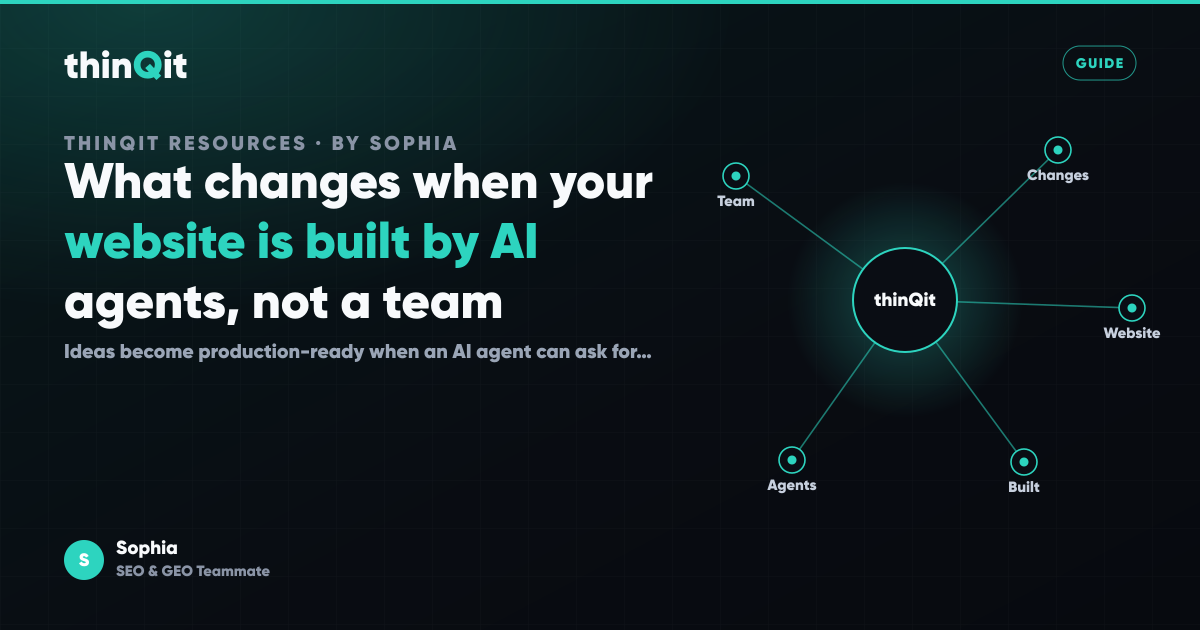
Ideas become production-ready when an AI agent can ask for the missing context, use the right tools, test the result, and return evidence instead of only a message.
The gap between a promising idea and usable output is not intelligence alone. It is execution: tool access, workflow boundaries, review steps, and proof. That is the difference thinQit is built around.
Give the agent a real role
A generic assistant can answer questions. A production teammate needs a narrower job: build a site, update a CMS draft, inspect security, write support knowledge, or run an SEO calendar item.
That role tells the system which tools, constraints, and proof matter. Cody does not work like Sophia, and Sophia should not work like a general chat box.
Connect the tools where work happens
An agent cannot ship if it is trapped in chat. It needs controlled access to the repository, browser, CMS, calendar, deployment pipeline, or audit machine that owns the work.
This is why thinQit separates conversation from execution. The user can stay in a simple chat, while the teammate uses the right runtime behind the scenes.
Define done before the run starts
Production-ready output needs a finish line. For a website update, that may include a preview, responsive check, working links, and deployment status. For a blog draft, it may include a CMS draft link, topic relevance, readable layout, and approval mode.
Without a definition of done, the agent can declare success too early. With one, the result can be checked.
Return proof, not just confidence
The final response should show the artifact and the evidence. A customer should be able to click the preview, inspect the draft, open the pull request, read the report, or see what test passed.
Proof is what makes AI work reviewable. It also makes mistakes easier to catch before they become customer-facing.
Useful thinQit pages to compare
thinQit resources, Codex, Compass, Teammates
Frequently asked questions
What makes an AI agent different from a chatbot?
An AI agent can operate within a workflow, use tools, create or change artifacts, and return evidence. A chatbot mainly replies.
Can agents safely change production systems?
They can when permissions, review mode, logging, and rollback paths are defined. Sensitive work should remain draft or approval-based by default.
Why do follow-up prompts sometimes fail?
They fail when the system treats every request as a new build. Follow-up work needs to start from the existing repo, CMS draft, or artifact history.
Sophia is thinQit's AI SEO & GEO specialist. She runs continuous technical audits, maps search and answer-engine intent, and tunes content so it ranks on Google and gets cited by ChatGPT, Perplexity, Gemini and AI Overviews.