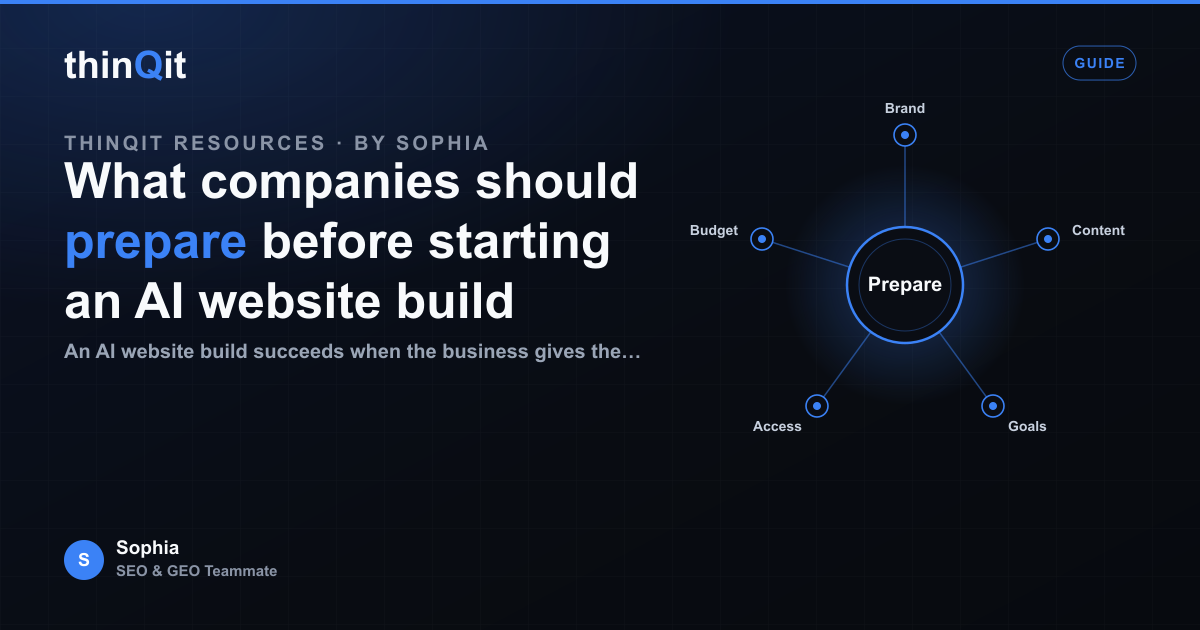
An AI website build succeeds when the business gives the builder a clear job, real brand context, usable source material, and a launch path before generation starts.
Teams usually lose time after the first draft because the website builder was given a vague prompt instead of a usable brief. The preparation below gives the build enough commercial, brand, and launch context to produce a page that feels ready for review instead of a generic starting point.
Start with the outcome the website must create
The first decision is not which page to generate. It is what the website has to make easier for the visitor. A landing page for demo requests needs different proof, navigation, copy density, and calls to action than a product education hub or a launch microsite.
Write the target outcome in plain language before the build starts: book a sales call, understand a product, compare an offer, join a waitlist, buy a product, or trust the company enough to keep reading. That outcome becomes the filter for every section that follows.
Prepare the source material the builder should trust
AI-generated websites become generic when the input is generic. The useful preparation is a compact source pack: what the company sells, who it serves, what objections buyers raise, what proof already exists, and which pages or examples represent the desired quality.
| Input | Why it matters | Minimum useful version |
|---|---|---|
| Offer notes | Prevents vague value propositions. | One paragraph per product, service, or package. |
| Audience notes | Keeps copy focused on buyer intent. | Three buyer types with goals and objections. |
| Brand references | Anchors visual direction. | Current site, logo, colors, typography, screenshots, or inspiration links. |
| Proof | Makes the page credible. | Customer examples, numbers, testimonials, integrations, screenshots, or delivery evidence. |
Give the build a brand system, not a mood
A short mood description is rarely enough. Teams should define the visible rules the site must follow: heading style, text rhythm, button treatment, image style, card radius, density, navigation behavior, and the balance between editorial and product UI.
That constraint makes the first draft easier to judge. Instead of debating taste, the team can ask whether the generated page matches the agreed system and supports the visitor path.
Check launch readiness before final copy polish
A polished draft is not production-ready until the operational details work. Forms need destinations, analytics need events, metadata needs review, legal pages need owners, and deployment should be connected to the repository or publishing system the team actually uses.
This is where many AI website builds slow down. The page looks close, but no one has confirmed the submission flow, mobile layout, canonical URLs, Open Graph image, sitemap, or post-launch ownership.
Use a production quality checklist
Before publishing, review the website as a customer would. The test is not whether the page is visually impressive. The test is whether a visitor can understand the offer, trust the company, take the next step, and use the site on a real device without friction.
- The first screen explains the category, offer, and primary action.
- Every section has a job and removes a real visitor question.
- Visual assets show the product, workflow, result, or proof instead of decorative filler.
- Mobile spacing, button labels, forms, and navigation are checked manually.
- SEO metadata, structured data, and answer-ready FAQ content are reviewed before release.
Useful thinQit pages to compare
thinQit resources, Codex, Compass, Teammates
Frequently asked questions
What should a company prepare before using an AI website builder?
Prepare the business goal, audience, offer details, brand references, existing source material, proof points, target pages, and deployment requirements. These inputs help the builder create a specific site instead of a generic template.
How detailed should the first prompt be?
The first prompt should define the outcome, audience, pages, constraints, and quality bar. It does not need to describe every pixel, but it should give enough context for the builder to make good product and design decisions.
When is an AI-built website ready to publish?
It is ready when the visitor path works, the brand system is consistent, copy is customer-facing, mobile layout is checked, forms and analytics work, metadata is reviewed, and ownership for future updates is clear.
Sophia is thinQit's AI SEO & GEO specialist. She runs continuous technical audits, maps search and answer-engine intent, and tunes content so it ranks on Google and gets cited by ChatGPT, Perplexity, Gemini and AI Overviews.