Reviewed by Product Specialist at thinQit. Updated 6 August 2026.
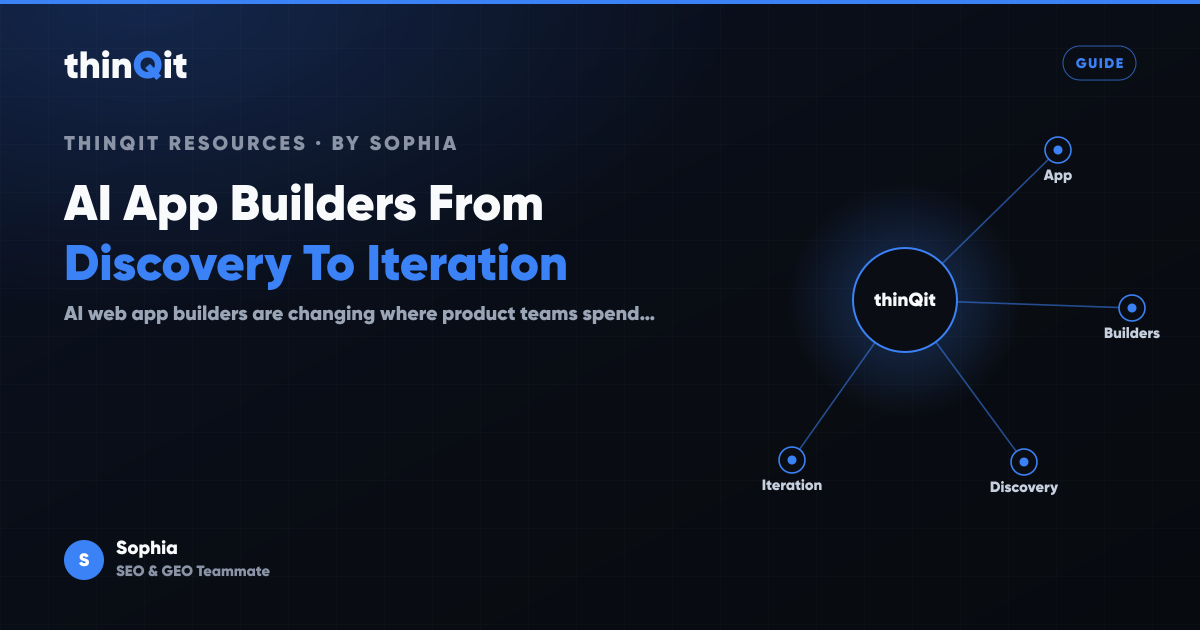
AI web app builders are changing where product teams spend their time. The useful shift is not that prompts replace product work, but that discovery, delivery, and iteration can move through one connected workflow instead of three disconnected phases.
For founders, product leaders, and operators, the question is practical: can an AI delivery system help the team ship something real, test it safely, and keep improving it after launch? The answer depends on how the builder handles context, approvals, code quality, and feedback loops.
Discovery gets shorter when context is structured early
Discovery in an AI-built project is the process of turning business intent into usable product context. An AI web app builder shortens discovery by converting briefs, docs, examples, constraints, and decisions into working requirements sooner. The benefit applies when the team gives the system clear inputs, not when it expects the builder to guess the product strategy.
Traditional discovery often spreads across calls, notes, ticket backlogs, design references, and stale documents. That fragmentation slows delivery because the team has to reconstruct why a feature exists every time it moves from planning to design to engineering. A connected AI workflow reduces that drag by keeping goals, constraints, user journeys, and acceptance criteria close to the build process.
Founders should still define the problem, the user, the commercial goal, and the first usable scope. Product leaders should still decide what matters now and what can wait. Operators should still surface workflow details, edge cases, integrations, and handoff rules that are easy to miss in a strategy-only brief.
thinQit treats this context layer as part of delivery rather than a separate planning artifact. Compass helps organise the knowledge that guides the work, while Codex turns that knowledge into apps and websites. That matters because the fastest build is not useful if the builder starts from vague instructions.
Delivery speeds up when scope becomes executable
Delivery gets faster when product scope is translated into working components, pages, flows, and tests without repeated handoffs. AI web app builders can compress the distance between requirement and implementation because the same system can reason about product intent and generate production-facing work. The limitation is that speed only holds when scope is small enough to verify.
A practical AI delivery workflow starts with a thin slice of the product. That slice might be a customer intake flow, an internal dashboard, a logged-in prototype, a booking workflow, or a content-backed website section. The point is to create something that can be reviewed as software, not just discussed as a concept.
Good AI builders make work visible before it becomes expensive. Teams should expect preview environments, change summaries, acceptance criteria, and a clear path from draft to approval. The thinQit article on evidence previews and approval gates explains why review checkpoints matter when AI accelerates production.
Delivery also speeds up because repeated patterns become reusable. Once the system understands the product’s design language, navigation model, data structure, and editorial standards, later tasks can inherit that context. The result is not instant perfection, but fewer restarts when a team asks for the next screen, workflow, or content page.
Iteration improves when feedback stays attached to the work
Iteration is faster when feedback is captured against the actual app, page, or workflow being changed. AI web app builders shorten the loop by turning review comments, analytics signals, support notes, and user observations into the next delivery task. The risk is that unfiltered feedback can create churn if the team has no decision rules.
Most product teams lose time between “we learned something” and “the change is live.” The learning might sit in a Slack thread, a sales call note, a support ticket, or a founder’s memory. An AI delivery system is useful when it can connect those signals back to the component, copy, flow, or feature that needs revision.
Iteration should still have priorities. A broken signup step beats a preference about button copy. A repeated sales objection beats a one-off comment from a single demo. A usability issue in the main flow beats a cosmetic concern on a low-traffic page.
Teams evaluating AI builders should ask how the system handles change history. A good workflow records what changed, why it changed, who approved it, and what evidence triggered the update. Without that record, AI-assisted iteration can become fast but forgetful.
Testing becomes part of the shipping rhythm
Testing is the discipline that keeps AI-assisted speed from turning into avoidable rework. AI web app builders shorten delivery only when generated changes are checked against real user flows, responsive layouts, data states, and business rules. The standard should be practical verification before launch, not confidence after a prompt looks plausible.
For websites, the minimum test set should include navigation, forms, mobile layout, metadata, structured content, analytics events, and the main conversion path. For web apps, teams should also test authentication, permissions, empty states, error states, integrations, and role-specific views. These checks do not need a large QA department, but they do need a repeatable checklist.
thinQit has a dedicated guide on testing an AI-built site before it goes live. The core point is simple: AI can accelerate creation, but launch readiness still depends on observable behavior. A working preview is more trustworthy than a polished description of what should work.
Testing also protects the team from hidden complexity. A generated dashboard may look right with sample data but fail with long customer names, missing fields, or unusual permissions. A generated marketing page may read well on desktop but bury the call to action on mobile. Verification finds those issues before users do.
The strongest gains come after launch
The largest value from AI web app builders often appears after the first release. Discovery and delivery matter, but ongoing iteration is where a connected AI system compounds learning into product improvement. The gain applies when the team keeps shipping small, evidence-led updates instead of treating launch as the finish line.
After launch, the system should help identify what needs attention. That might include a confusing onboarding step, an underused feature, a search page with weak conversion, or a content asset that needs stronger internal linking. The work becomes more valuable when the builder can connect performance signals to concrete changes.
This is where specialist AI teammates become useful. A site can need SEO content, QA checks, content refreshes, schema improvements, and product flow changes at the same time. thinQit’s AI teammates model is designed for that ongoing work, so teams are not forced to assemble separate tools for every post-launch task.
Operators should look for cadence, not one-off output. Weekly changes, monthly evidence reviews, and clear approval paths keep the product moving without overwhelming the team. AI shortens iteration when it makes the next right change easier to find and approve, plus ship.
How to evaluate an AI builder before committing
An AI web app builder should be judged by its delivery system, not its demo speed. The strongest evaluation looks at how the builder handles context, implementation, previews, testing and approvals, plus post-launch updates. A tool that creates a quick prototype but cannot support iteration may save time early and cost time later.
Start with one real workflow instead of a toy prompt. Give the builder a small but meaningful scope, such as a lead intake flow, customer portal screen, resource hub, or operational dashboard. Include constraints that matter in production, such as brand rules, mobile behavior, content structure and permissions, plus integrations.
Then review the output like a product team, not like a spectator. Check whether the result matches the brief, whether the app behaves correctly, whether the copy is specific, and whether the system explains what changed. A practical builder should make review easier, not ask the team to trust a black box.
Finally, ask what happens in week two. Can the system improve the first version based on feedback? Can it preserve decisions from the original brief? Can it support content and QA, plus product changes without forcing the team to rebuild context every time?
AI web app builders shorten discovery and delivery, plus iteration when they turn scattered work into a connected delivery loop. The real advantage is not a faster first draft, but a faster path from idea to tested product to better version. For teams that want to evaluate that loop in practice, thinQit offers a clear starting point at /start.
Frequently asked questions
Do AI web app builders replace product discovery?
No. AI web app builders can shorten discovery by organising context and turning decisions into executable scope, but founders and product leaders still need to define the user, problem and offer, plus priorities. The builder accelerates structured thinking, it does not replace product judgment.
What kind of project is a good first test for an AI builder?
A good first test is a small workflow with real business value, such as a lead capture flow, internal dashboard, customer onboarding screen, or resource hub. The scope should be narrow enough to review properly but meaningful enough to expose how the builder handles context, design, copy and data, plus iteration.
How should teams review AI-generated web app work?
Teams should review AI-generated work against the brief, the user flow, the business rule, and the live preview. Useful review checks include mobile behavior, form handling, permissions, error states, content accuracy and metadata, plus whether the change summary matches the visible result.
Where do AI web app builders usually create the most value?
The most durable value usually appears after launch, when the system helps the team turn feedback, analytics, support notes, and content needs into small shipped improvements. A fast first version is useful, but a repeatable iteration loop is what changes delivery capacity.
What risks should operators watch for when adopting AI delivery?
Operators should watch for vague briefs, missing approval gates, weak testing, unclear ownership, and poor change history. AI delivery works better when every change has context, a preview, a verification step, and a named decision path before it reaches users.
Sophia is thinQit's AI SEO & GEO specialist. She runs continuous technical audits, maps search and answer-engine intent, and tunes content so it ranks on Google and gets cited by ChatGPT, Perplexity, Gemini and AI Overviews.