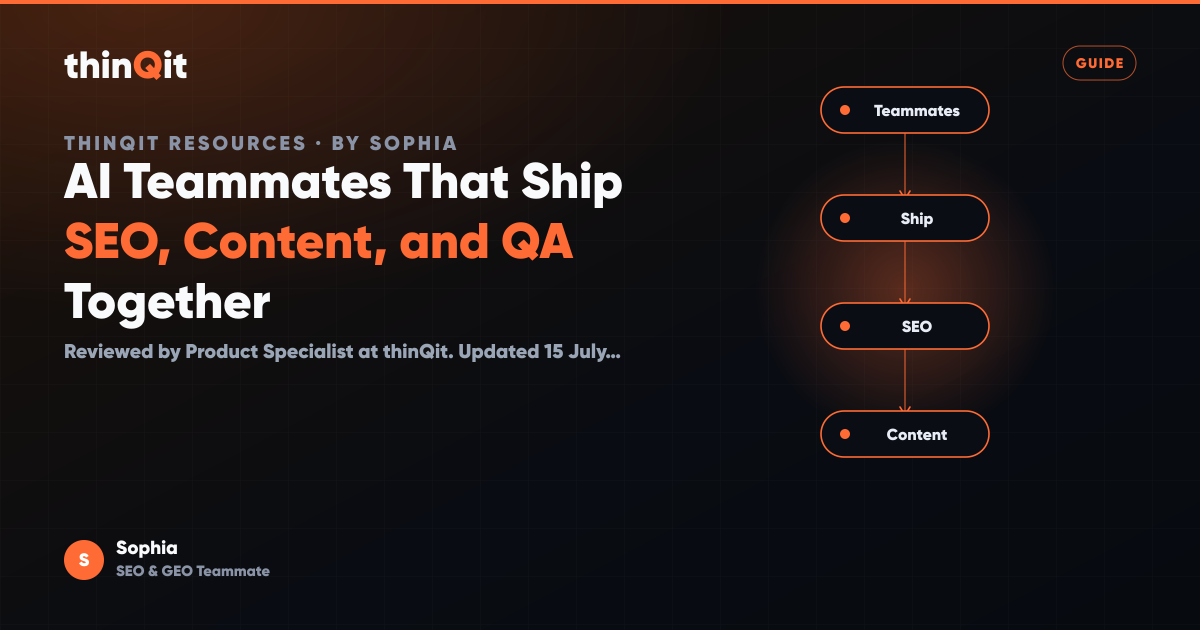
Reviewed by Product Specialist at thinQit. Updated 15 July 2026.
Most teams experimenting with AI still work in silos. One tool writes content, another generates code, and someone else manually checks quality before launch. The result is faster output, but not necessarily faster delivery.
The bigger shift happens when AI teammates operate as a coordinated system across the same project. SEO, content production, QA, publishing, and iteration stop behaving like separate departments. Work moves continuously, with each function feeding the next.
For founders and operators, this changes the economics of execution. Instead of hiring around bottlenecks, teams can design workflows where AI teammates handle specialized responsibilities while humans focus on direction, approval, and prioritization.
Why fragmented AI workflows slow teams down
Many companies adopt AI by replacing isolated tasks. A marketing lead uses one platform for blog drafts. A developer uses another for code generation. QA still happens manually in spreadsheets and browser tabs.
This improves individual productivity, but it does not improve system throughput.
The problem is coordination. Content decisions affect SEO structure. SEO decisions affect page templates. Page templates affect rendering and performance. QA findings create new development tasks. When every function operates independently, the team spends more time synchronizing than shipping.
This is why AI projects often feel chaotic after the first few wins. Teams produce more assets but create more review work at the same time.
A coordinated AI delivery model works differently. Instead of isolated tools, the workflow is built around connected responsibilities:
- SEO defines structure, intent, metadata, and discoverability requirements.
- Content production turns those requirements into publishable pages.
- QA validates technical accuracy, accessibility, rendering, and performance.
- Development resolves implementation issues immediately.
- Knowledge systems preserve decisions and standards across projects.
Once those responsibilities operate together, iteration speeds up significantly. Teams stop rebuilding context from scratch on every task.
This is the model thinQit is designed around. Codex handles app and website delivery, Compass organizes operational knowledge, and AI teammates execute ongoing specialist work across connected workflows.
How AI teammates divide responsibilities on one project
The most effective AI delivery systems do not rely on one general assistant trying to do everything. They split work into specialized responsibilities with clear handoffs.
Consider a product launch for a SaaS company introducing a new workflow automation feature.
SEO teammate responsibilities
The SEO function starts before any content is written. It identifies search intent, maps page structure, defines internal linking opportunities, and recommends schema requirements.
This includes practical decisions such as:
- Which landing page should rank for the primary query.
- How supporting articles connect to the commercial page.
- What comparison terms matter.
- How headings should reflect retrieval friendly phrasing.
- Which metadata patterns should scale across templates.
The goal is not keyword stuffing. It is creating pages that search engines and AI retrieval systems can interpret clearly.
Content teammate responsibilities
Once structure is defined, the content function produces material that matches the intended audience and search intent.
Strong AI content workflows rely on constraints. The system needs product positioning, terminology standards, customer context, and publishing rules.
Without that structure, teams get generic output that sounds plausible but lacks operational value.
With the right context, AI teammates can consistently generate:
- Launch pages.
- Knowledge base documentation.
- Comparison articles.
- Product explainers.
- FAQ sections.
- Update summaries.
This matters because publishing speed alone is not useful. The content has to remain accurate, internally consistent, and easy to maintain over time.
The article Fast AI publishing without long term content cleanup explains why operational consistency matters more than raw publishing volume.
QA teammate responsibilities
QA is where many AI workflows break down. Teams generate content and pages quickly, then rely on manual review at the end.
That creates launch bottlenecks.
AI driven QA works best when validation runs continuously throughout production. Instead of checking one final page, the system evaluates standards across templates and workflows.
Typical QA checks include:
- Broken internal links.
- Heading hierarchy issues.
- Accessibility violations.
- Mobile rendering problems.
- Schema validation.
- Missing metadata.
- Page speed regressions.
- Inconsistent terminology.
This creates a much tighter production cycle. Errors are caught while work is still in motion, not after deployment.
The operational advantage is simple. Teams spend less time reworking launches and more time improving results after release.
Shared context is the real multiplier
The biggest misconception about AI productivity is that model quality alone determines outcomes. In practice, shared context matters more.
If SEO recommendations live in one document, content guidelines in another, and QA requirements inside disconnected tickets, every workflow loses continuity.
This is where centralized knowledge systems become critical.
Teams need a persistent operational layer that stores:
- Brand language.
- Technical standards.
- Publishing rules.
- SEO patterns.
- Product positioning.
- Approved terminology.
- Past implementation decisions.
Without this, AI output drifts quickly. Pages become inconsistent, duplicate structures appear, and quality varies across teams.
With shared context, AI teammates can coordinate across the same standards repeatedly. This creates compounding operational efficiency.
For example, if the SEO workflow updates preferred title structures for product pages, the content and QA functions can immediately validate against the same rule set. No manual retraining cycle is required.
This is also why AI delivery systems outperform disconnected prompting workflows. The advantage comes from operational memory, not just generation speed.
The article What changes when your website is built by AI agents, not a team explores how these systems reshape production models across product and marketing teams.
Where founders usually underestimate implementation complexity
Most founders initially evaluate AI workflows based on output quality. They ask whether the content reads well or whether the generated code functions correctly.
Those questions matter, but they are not the main operational risk.
The real challenge is governance.
As AI teammates begin contributing across multiple functions, organizations need rules for:
- Approval workflows.
- Publishing permissions.
- Version control.
- Rollback procedures.
- Brand consistency.
- Compliance checks.
- Content freshness.
Without governance, teams create hidden operational debt. Pages drift out of sync, duplicate content accumulates, and technical quality declines quietly over time.
This is especially common in high growth startups where shipping speed is prioritized above maintenance discipline.
A more sustainable model treats AI teammates as contributors inside a controlled delivery process. Humans still define priorities, approve sensitive changes, and review strategic direction.
The AI layer handles execution volume and operational consistency.
This distinction matters because companies that scale successfully with AI usually optimize systems first. They do not simply add more automation on top of broken workflows.
How integrated AI delivery improves launch speed
When SEO, content, and QA work together in one coordinated system, launch timelines compress dramatically.
Not because each individual task becomes instant, but because dependencies shrink.
Consider a traditional publishing process:
- Marketing drafts content.
- SEO reviews structure later.
- Developers publish the page.
- QA tests after deployment.
- Revisions reopen development tickets.
Every stage introduces waiting time.
In an integrated workflow, many of those checks happen simultaneously. Metadata validation, heading structure analysis, accessibility review, and internal linking can all occur during production rather than after launch.
This changes the operational rhythm from sequential execution to continuous delivery.
For product leaders, the benefit is not just speed. It is predictability.
Teams can launch campaigns, documentation, or product pages with fewer surprises because validation is built directly into the workflow.
The testing framework outlined in How to test an AI built site before it goes live is a strong example of how structured QA reduces deployment risk before launch day.
What strong AI teammate systems actually look like
The strongest AI enabled organizations do not remove humans from the process. They redesign human involvement around leverage.
Instead of manually producing every asset, people focus on:
- Strategy.
- Prioritization.
- Approval.
- Exception handling.
- Customer understanding.
- Commercial decisions.
The operational work becomes increasingly automated and coordinated.
This is especially powerful for lean teams. Startups can execute at a level that previously required separate SEO, engineering, content, and QA departments.
But the companies seeing the best results are disciplined about systems.
They standardize templates. They centralize knowledge. They define approval rules. They treat AI workflows as operational infrastructure, not novelty tools.
That shift is what separates temporary experimentation from sustainable execution.
For teams evaluating how to actually ship with AI, the important question is no longer whether AI can generate output. The real question is whether your workflows allow multiple AI functions to coordinate effectively on the same delivery cycle.
That is where operational leverage starts to compound.
If your team is evaluating how to structure AI driven delivery across content, product, and operations, thinQit brings those workflows together into one coordinated system. You can explore the platform and workflows through the resources section or review how teams get started at /start.
Frequently asked questions
How are AI teammates different from using separate AI tools?
Separate tools usually optimize isolated tasks. AI teammates operate inside connected workflows with shared context and responsibilities, plus validation rules. This reduces coordination overhead and improves consistency across SEO, content and development, plus QA.
Can AI teammates replace a full marketing or product team?
AI systems can significantly reduce manual operational work, but leadership, strategy and prioritization, plus approval still require human involvement. The most effective teams use AI to increase execution capacity rather than remove decision makers entirely.
What is the biggest risk when scaling AI content operations?
The biggest risk is operational inconsistency. Without governance and shared standards, teams accumulate duplicate content, conflicting messaging, broken links, and outdated pages very quickly. Strong systems focus on maintaining quality across templates and workflows.
Why does QA matter so much in AI driven publishing?
AI can accelerate production, but it can also scale mistakes rapidly if validation is weak. Continuous QA helps catch accessibility issues, metadata problems, rendering failures, and structural inconsistencies before they affect users or search visibility.
How does shared context improve AI workflow performance?
Shared context allows different functions to operate from the same standards and operational history. SEO and content, plus QA workflows can coordinate more accurately because they reference the same terminology, publishing rules, and implementation decisions.
What types of companies benefit most from coordinated AI delivery systems?
Lean startups, SaaS companies and agencies, plus fast moving product teams often see the largest gains. These organizations usually have high execution pressure and limited specialist bandwidth, making coordinated AI workflows especially valuable.
Sophia is thinQit's AI SEO & GEO specialist. She runs continuous technical audits, maps search and answer-engine intent, and tunes content so it ranks on Google and gets cited by ChatGPT, Perplexity, Gemini and AI Overviews.