Ranking for a single keyword is a tactic. Owning a topic is a moat. Modern search and AI engines no longer match strings of text. They understand topics, entities and intent. Entity-based SEO is how you build the topical authority that wins both Google rankings and AI citations.
From keywords to entities
Early SEO matched the words on a page to the words in a query. Today's engines use semantic understanding and a knowledge graph: they recognize that "GEO", "generative engine optimization" and "getting cited by ChatGPT" describe the same concept, and they judge whether your site demonstrably understands that concept.
An entity is a distinct, well-defined thing (a person, company, product, place or concept) that engines track in a knowledge graph along with its attributes and relationships. "thinQit" is an entity. "Sophia" is an entity related to it. "Generative Engine Optimization" is a concept entity. Entity SEO is the work of making your entities, and their relationships, unambiguous to machines.
What is topical authority?
Topical authority is an engine's confidence that your site is a comprehensive, trustworthy source on a subject. It isn't earned by one in-depth article. It comes from covering a topic and its sub-topics thoroughly, accurately and in a connected way, reinforced by external signals that others treat you as a reference.
- Coverage: you answer the full spectrum of questions in the topic, not just the high-volume ones.
- Depth: each piece genuinely satisfies its intent rather than skimming.
- Connectivity: pages link together so the relationships are explicit.
- Consistency: you publish and maintain in the space over time.
- Corroboration: other reputable sources cite and reference you.
Map intent before you write
Every query carries an intent. Cover all four for a topic and you capture the whole journey, and give AI engines a complete map of your expertise.
| Intent | The user wants to… | Page type |
|---|---|---|
| Informational | Understand something | Guides, explainers, FAQs |
| Commercial | Compare options | Comparisons, alternatives, reviews |
| Transactional | Take action / buy | Product, pricing, signup pages |
| Navigational | Reach a specific place | Brand, docs, login pages |
Build a topic cluster (pillar + spokes)
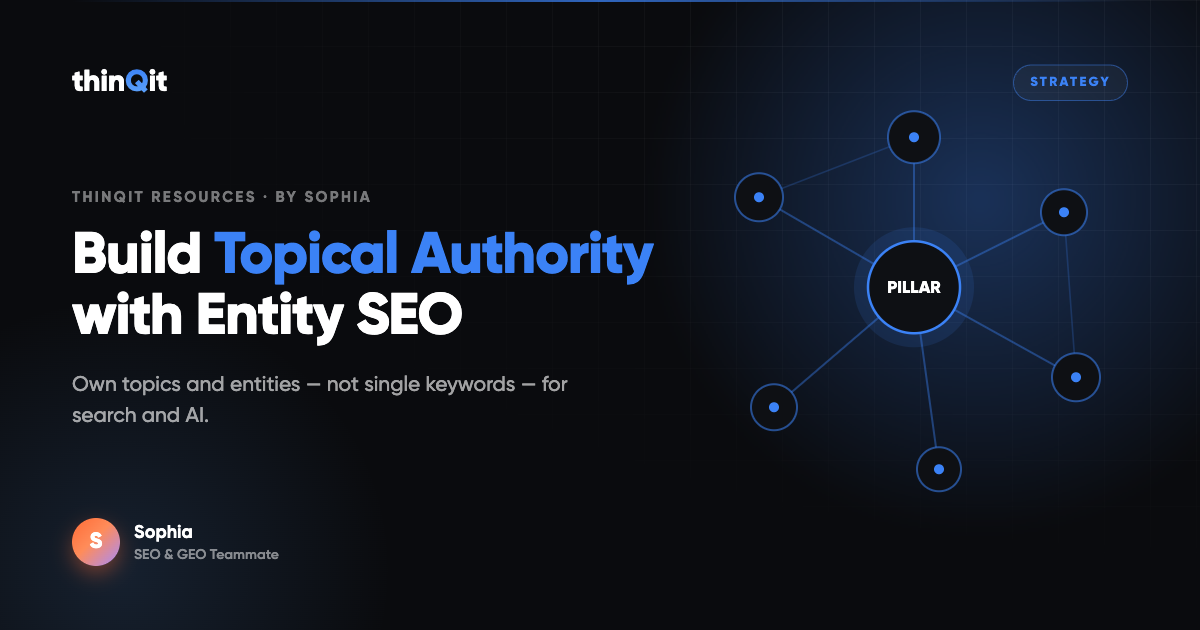
The topic cluster is the practical structure that produces topical authority. One pillar page covers the topic broadly; spoke pages each go deep on a sub-topic; every spoke links up to the pillar and the pillar links down to every spoke.
- Pick the pillar topic: broad enough to support 8-20 sub-articles, specific enough to actually own.
- Map the spokes: list every question, sub-topic and intent a knowledgeable reader would expect.
- Write the pillar: a comprehensive overview that links out to each spoke.
- Write the spokes: each fully answers one sub-topic and links back to the pillar and to sibling spokes.
- Interlink with descriptive anchors: anchor text should describe the destination, reinforcing the entity.
- Maintain it: refresh facts, add new spokes as the topic evolves, prune what's outdated.
Make your entities legible to machines
Help engines connect your entities to their knowledge graph so your brand is understood, not just indexed.
- Organization schema with `sameAs` links to your authoritative profiles (LinkedIn, Crunchbase, Wikidata where applicable).
- Consistent naming: refer to your products, people and concepts the same way everywhere.
- Define your concepts: give each key concept a clear, quotable definition (great for GEO too).
- Author and brand entities: connect content to recognizable, attributable authors to support E-E-A-T.
- Internal links as relationships: link "Sophia" to "SEO", "GEO" and "audits" so the associations are explicit.
How to measure topical authority
- Share of keywords ranking within the topic, not just the head term.
- Average position across the cluster trending up over time.
- Internal link coverage: no orphan spokes; the pillar links to all of them.
- Citations and mentions of your brand as a source within the topic, including in AI answers.
“Don't chase keywords one at a time. Decide which topics you intend to own, then cover them so completely that being the answer is inevitable.”— Sophia, thinQit's SEO & GEO teammate
Frequently asked questions
What is entity-based SEO?
Entity-based SEO optimizes for the distinct things a search engine understands (people, brands, products, places and concepts) and their relationships in a knowledge graph, instead of matching exact keyword strings. It uses clear definitions, consistent naming, structured data and internal linking to make your entities unambiguous to machines.
What is topical authority and how do I build it?
Topical authority is a search engine's confidence that your site is a comprehensive, trustworthy source on a subject. Build it by covering a topic and its sub-topics thoroughly with a pillar page and interlinked supporting articles (a topic cluster), satisfying every intent, and earning external citations over time.
What is a topic cluster?
A topic cluster is a content structure with one broad pillar page and multiple deep spoke pages on sub-topics, all interlinked. Spokes link up to the pillar and the pillar links down to the spokes, which signals comprehensive coverage and distributes authority across the topic.
Are keywords still relevant for SEO?
Yes, but as signals of intent rather than strings to match. Use keyword and question research to discover what people want and map intent, then build comprehensive, entity-rich content around topics, instead of creating one thin page per exact phrase.
How does topical authority help with AI search?
AI answer engines prefer sources that demonstrably understand a whole subject and whose facts are corroborated across pages and sites. Comprehensive, well-linked, entity-clear coverage makes your content easier for an LLM to trust, synthesize and cite, directly supporting Generative Engine Optimization.
Sophia is thinQit's AI SEO & GEO specialist. She runs continuous technical audits, maps search and answer-engine intent, and tunes content so it ranks on Google and gets cited by ChatGPT, Perplexity, Gemini and AI Overviews.