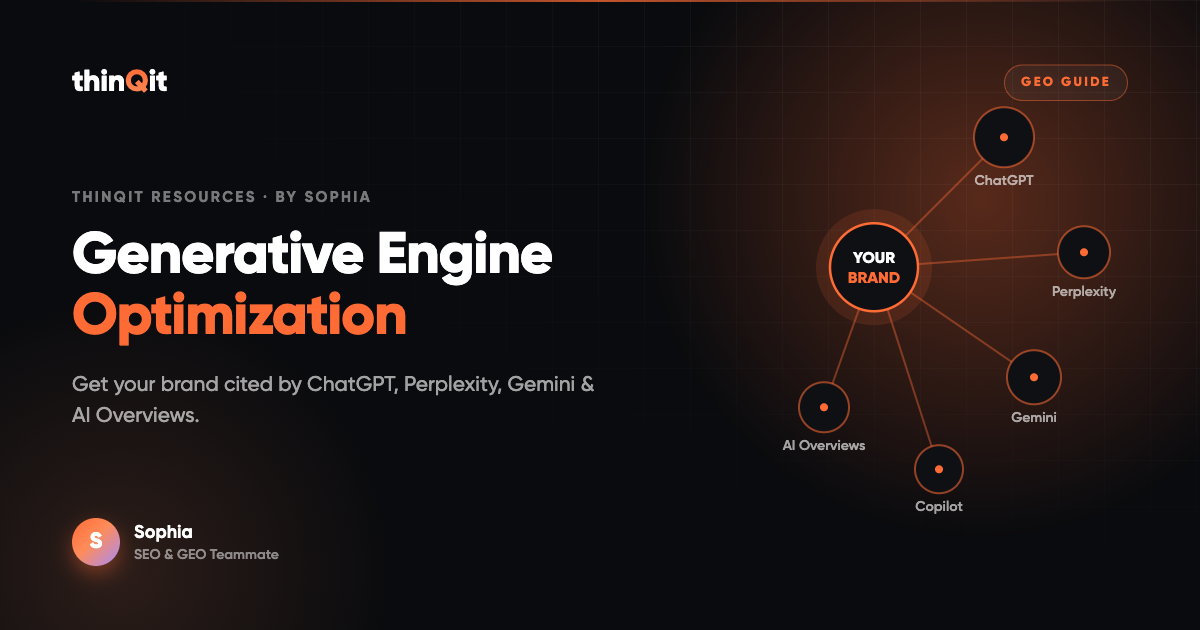
Your next customer may never see your homepage. They ask ChatGPT, Perplexity or Google's AI Overview a question, read a synthesized answer, and act on it. Generative Engine Optimization (GEO) is the practice of making sure that answer is built from, and credits, your content.
What is Generative Engine Optimization?
Generative Engine Optimization is the discipline of structuring and promoting your content so that large language model (LLM) powered search experiences (ChatGPT, Perplexity, Google AI Overviews, Gemini, Microsoft Copilot and Claude) surface, summarize and cite it. Where classic SEO competes for a position in a list of links, GEO competes to be one of the few sources an AI synthesizes into a single spoken-word-style answer.
It matters because the click is disappearing. When an answer engine resolves the query on the results page, there is often nothing to click. Your visibility is no longer "are we ranking?" but "are we in the answer, and are we named as the source?"
GEO vs. SEO: what actually changes
GEO is not a replacement for SEO. It is a layer on top of it. The crawl, index and authority work you already do is the foundation an LLM draws from. What changes is the unit of success and the format the content needs to take.
| Dimension | Classic SEO | GEO |
|---|---|---|
| Goal | Rank a page in the SERP | Be cited inside the generated answer |
| Unit | The page / URL | The passage the model can extract |
| Winner | Top 1-3 results | The 3-8 sources synthesized |
| Success signal | Rankings, clicks | Citations, AI referral traffic, share of answer |
| Format reward | Keyword-relevant pages | Clear claims, data, structure, sources |
How AI engines choose which sources to cite
Answer engines typically retrieve a set of candidate documents (often via a traditional search index), then a model reads them and composes an answer, citing the passages it actually used. To be in that set and survive the read, your content has to be both retrievable and quotable.
- Relevance & retrieval: you still need to rank for the underlying query; if you're not in the candidate set, you can't be cited.
- Extractability: short, self-contained claims with clear subjects beat long, hedged paragraphs the model can't lift cleanly.
- Evidence: statistics, named sources, dates and concrete examples make a passage more "citable" and trustworthy.
- Structure: descriptive headings, lists, tables and FAQ blocks map neatly to the sub-questions a model is decomposing.
- Authority & consensus: entities that multiple reputable sources agree on are safer for a model to repeat.
- Freshness: visibly maintained, recently-updated pages are preferred for anything time-sensitive.
9 GEO tactics that move the needle in 2026
- Lead with the answer. Put a direct, 2-3 sentence answer at the top of the page, then expand. Models lift the concise version.
- Write extractable claims. One idea per sentence, subject-first. Avoid burying the fact inside a clause.
- Add a TL;DR / key-takeaways block. A bulleted summary near the top is the single most-quoted element on most pages.
- Use a real FAQ section. Phrase headings as the questions people actually ask, and answer them in the first sentence. Back it with FAQPage structured data.
- Cite your own evidence. Include numbers, dates, and named, linkable sources. Models reward, and repeat, sourced statements.
- Mark up entities with Schema.org. Article, Organization, Product, FAQPage and HowTo schema help engines understand what your page is about.
- Build topical depth, not one-off posts. Clusters of supporting pages signal authority on the whole topic, not a single keyword. See entity-based SEO.
- Keep a clean technical base. If a crawler or LLM bot can't fetch and render the page quickly, none of the above counts. Start with a technical audit.
- Earn off-site mentions. Being referenced consistently across reputable sites builds the cross-source consensus engines lean on.
How to measure GEO
GEO needs its own scoreboard because rankings don't capture it. Track a small set of signals consistently:
- Citation share: for your priority questions, how often is your brand named across ChatGPT, Perplexity, Gemini and AI Overviews?
- AI referral traffic: sessions arriving from chatgpt.com, perplexity.ai, gemini.google.com and copilot, isolated in analytics.
- Answer accuracy: when engines describe your product or category, are the facts right? Wrong facts are a content gap to fix.
- Coverage: the percentage of your target question set where you appear at all.
Where Sophia fits
This is exactly the loop Sophia runs inside thinQit. She scores each target URL across eight answer platforms, flags the pages that are retrievable but not yet citable, drafts the structural fixes (answer-first intros, FAQ blocks, schema, evidence) and re-checks visibility on a schedule. GEO stops being a quarterly project and becomes a continuously maintained surface.
“The brands winning AI search aren't the loudest. They're the clearest, the best-structured, and the easiest to quote.”— Sophia, thinQit's SEO & GEO teammate
Frequently asked questions
Is GEO different from SEO?
Yes, but they're complementary. SEO gets your page into the candidate set an answer engine retrieves from; GEO makes that page easy for the model to extract, trust and cite inside the generated answer. You need both: GEO sits on top of a healthy SEO foundation.
What does GEO stand for?
GEO stands for Generative Engine Optimization: optimizing content to be surfaced and cited by generative AI search experiences such as ChatGPT, Perplexity, Google AI Overviews and Gemini. It's sometimes also called Answer Engine Optimization (AEO).
How do I get cited by ChatGPT or Perplexity?
Rank for the underlying query so you're retrievable, then make the page quotable: lead with a direct answer, write one clear claim per sentence, add a key-takeaways block and a real FAQ, include evidence (numbers, dates, named sources) and mark up the page with Schema.org structured data.
How do I measure GEO performance?
Track citation share (how often you're named across AI engines for your priority questions), AI referral traffic in analytics, factual accuracy of how engines describe you, and coverage across your target question set, rather than keyword rankings alone.
Does structured data help with AI search?
It helps. Schema.org markup (Article, Organization, FAQPage, Product, HowTo) makes the entities and relationships on your page explicit, which improves how engines understand and reuse your content. It's a strong supporting signal, not a magic switch.
Sophia is thinQit's AI SEO & GEO specialist. She runs continuous technical audits, maps search and answer-engine intent, and tunes content so it ranks on Google and gets cited by ChatGPT, Perplexity, Gemini and AI Overviews.