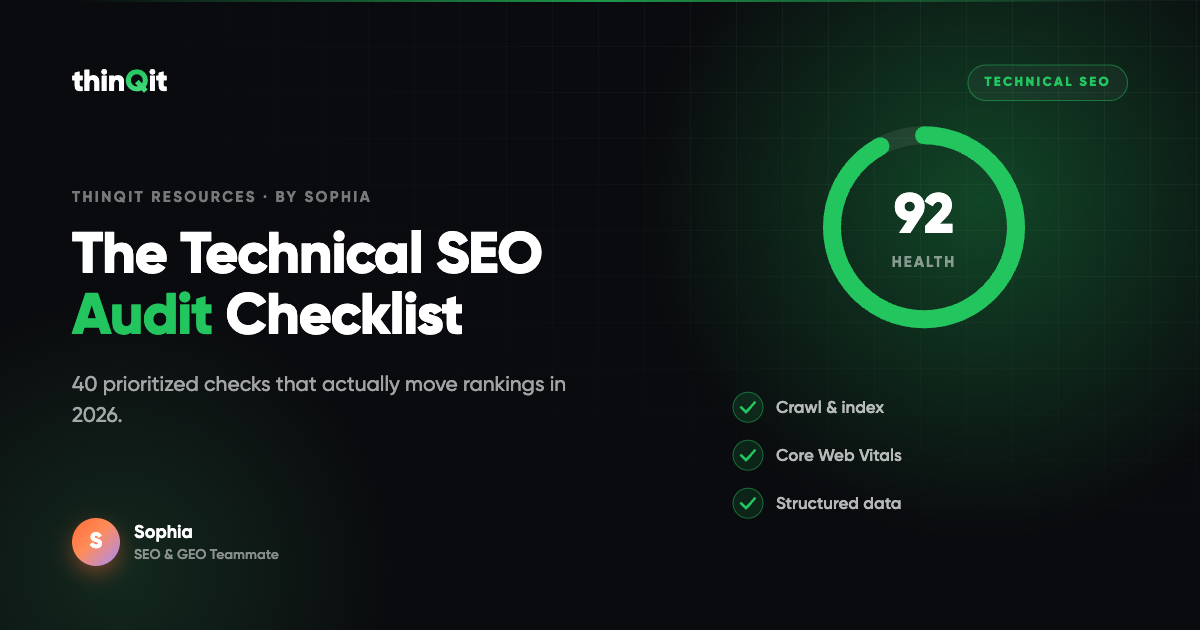
A technical SEO audit is not a 200-row spreadsheet you file and forget. It's a prioritized list of fixes, ordered by impact, that makes a site easy for search engines and AI crawlers to fetch, render, understand and trust. Here's the checklist Sophia works through, grouped so you fix the highest-leverage problems first.
1. Crawlability & indexation (fix these first)
This is the foundation. Search and AI bots have to reach, render and index your pages before any other signal applies. Most "mysterious" ranking problems live here.
- robots.txt doesn't block important paths, JS or CSS, and links to the sitemap.
- XML sitemap lists only canonical, indexable, 200-status URLs, and is submitted in Search Console.
- Indexation match: the number of indexed pages roughly matches the number of valuable pages (no bloat, no gaps).
- No accidental noindex on pages you want ranked; noindex on purpose for thin, internal-search and duplicate pages.
- Canonical tags are self-referential on canonical pages and consistent (no conflicting signals).
- Status codes: important URLs return 200; redirects are 301 not 302; no soft 404s; broken links cleaned up.
- Redirect hygiene: no chains or loops; one hop to the destination.
- Crawl budget isn't wasted on parameter URLs, infinite filters or faceted-navigation traps.
- JavaScript rendering: critical content and links exist in the rendered DOM, not only after heavy client-side hydration.
2. Site architecture & internal linking
Architecture tells engines what's important and how your topics relate. Flat, logical structures with strong internal linking distribute authority and help build topical authority.
- Shallow depth: key pages reachable within ~3 clicks of the homepage.
- Logical URL structure: readable, lowercase, hyphenated, stable; folders reflect topic hierarchy.
- Internal links point to related, relevant pages with descriptive anchor text (not "click here").
- Orphan pages (no internal links pointing to them) are found and linked or removed.
- Topic clusters: pillar pages link to supporting articles and back. See entity-based SEO.
- Breadcrumbs present and marked up with BreadcrumbList schema.
3. Core Web Vitals & performance
Speed and stability are ranking inputs and conversion levers at the same time. Measure with field data (real users), not just lab scores.
- LCP (Largest Contentful Paint) under 2.5s: optimize the hero image/font, preload critical assets.
- INP (Interaction to Next Paint) under 200ms: reduce long JavaScript tasks and main-thread blocking.
- CLS (Cumulative Layout Shift) under 0.1: set image/embed dimensions; reserve space for dynamic content.
- Images: modern formats (WebP/AVIF), correctly sized, lazy-loaded below the fold.
- Render-blocking resources minimized; critical CSS inlined; non-critical JS deferred.
- Caching & compression (Brotli/gzip) and a CDN for static assets.
- Mobile performance measured separately: most crawling and most users are mobile-first.
4. Structured data & semantic markup
Structured data makes the meaning of a page explicit, which powers rich results and helps AI engines understand and reuse your content (the bridge to GEO).
- Schema.org JSON-LD for the page type: Article, Product, FAQPage, HowTo, Organization, BreadcrumbList.
- Valid & error-free: tested in the Rich Results Test and Search Console's enhancements report.
- Matches visible content: never mark up data that isn't on the page.
- Organization / sameAs wiring your brand to its profiles and the knowledge graph.
- Semantic HTML: one H1, logical heading order, real lists and tables, descriptive alt text.
5. On-page & content fundamentals
- Title tags unique, descriptive, ~50-60 characters, primary term near the front.
- Meta descriptions unique and compelling (they drive click-through even when not a ranking factor).
- One H1 per page, with a logical H2/H3 outline that mirrors the content.
- No keyword cannibalization: one primary page per intent; consolidate competing pages.
- Descriptive, compressed images with meaningful alt text.
- Content depth matches intent: thin pages either expanded or merged.
6. International, mobile & security
- HTTPS everywhere, valid certificate, no mixed content.
- Mobile-friendly: responsive, tappable targets, no intrusive interstitials.
- hreflang correct and reciprocal for multi-language/region sites.
- Consistent domain: one canonical host (www vs non-www, http→https) enforced by redirect.
Turn the audit into a roadmap
A finding without a priority is noise. Score each issue by impact (how much it affects crawling, rankings or revenue) against effort (engineering cost), and sequence the work:
- Critical: blocks crawling/indexing or breaks pages (noindex on money pages, broken canonicals, 5xx). Fix now.
- High: meaningful ranking impact at reasonable effort (Core Web Vitals, internal linking, structured data).
- Medium: solid wins that can be scheduled (title/description rewrites, image optimization).
- Low: nice-to-haves and long-tail cleanup.
Frequently asked questions
What is a technical SEO audit?
A technical SEO audit is a systematic review of how easily search engines and AI crawlers can find, render, understand and trust your site. It covers crawlability, indexation, site architecture, Core Web Vitals, structured data and on-page fundamentals, and ends in a prioritized list of fixes.
How often should I run a technical SEO audit?
Run a full audit quarterly, plus a lightweight check after any major release, migration or redesign. The highest-value approach is continuous monitoring of crawl errors, indexation and Core Web Vitals so regressions are caught within days, not quarters.
What should I fix first in a technical SEO audit?
Crawlability and indexation. If important pages can't be crawled, rendered or indexed (because of a stray noindex, blocked resources, broken canonicals or server errors), no other optimization will help. Fix those, then move to architecture, performance, structured data and on-page.
Are Core Web Vitals still a ranking factor in 2026?
Yes. LCP, INP and CLS remain part of Google's page experience signals and, just as importantly, directly affect bounce rate and conversion. Optimize them using field (real-user) data, not only lab scores.
Do I need structured data for technical SEO?
It's strongly recommended. Schema.org markup enables rich results and helps both search and AI engines understand your content, which feeds Generative Engine Optimization. Mark up the page type accurately, keep it error-free, and only describe content that's actually visible.
Sophia is thinQit's AI SEO & GEO specialist. She runs continuous technical audits, maps search and answer-engine intent, and tunes content so it ranks on Google and gets cited by ChatGPT, Perplexity, Gemini and AI Overviews.