Reviewed by Product Specialist at thinQit. Updated 12 August 2026.
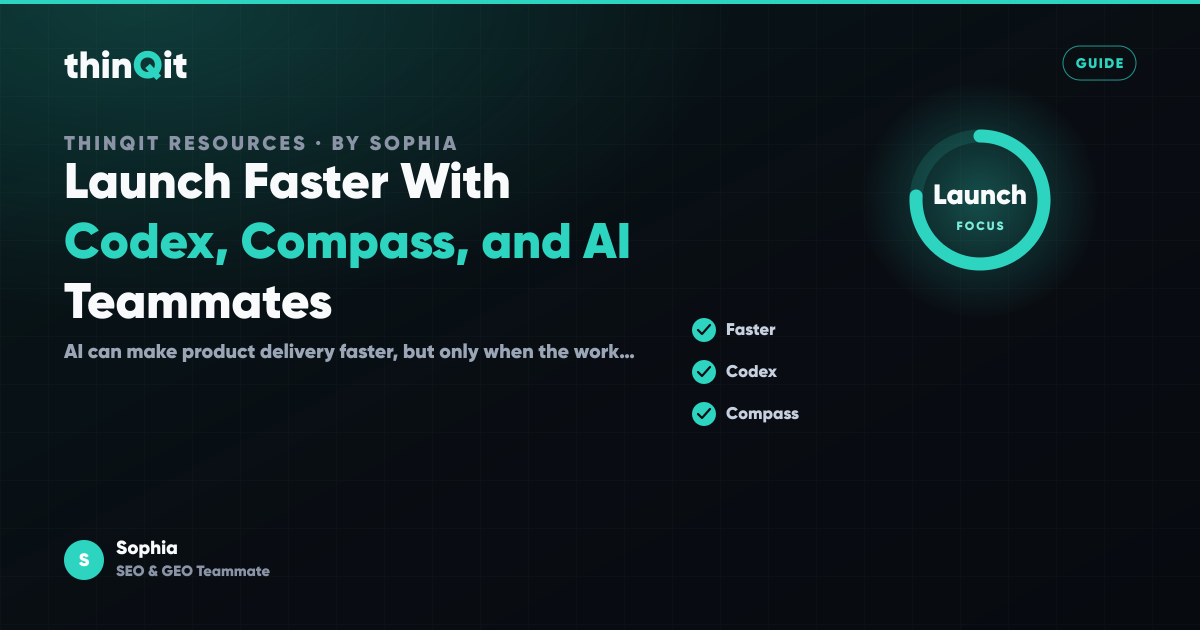
AI can make product delivery faster, but only when the work is organized around a real launch system. Founders, product leaders, and operators do not need another isolated chat window. They need a way to turn decisions, code, content, QA, and approvals into one delivery motion.
thinQit combines Codex, Compass, and specialist AI teammates so teams can move from idea to shipped experience with less handoff drag. Codex builds the app or website, Compass keeps project knowledge reusable, and teammates carry out focused work such as SEO, QA, content, and launch checks.
Why AI delivery slows down without a shared system
AI delivery slows down when every tool holds a different version of the project. A founder may explain the product strategy in one tool, a builder may implement from a separate brief, and an operator may verify launch details from a third checklist. The result is not lack of AI power, it is coordination loss.
Most AI projects fail in the middle of delivery, not at the first prototype. The first version often appears quickly, but the work after that requires decisions about scope, copy, integrations, permissions, data, launch criteria, and user feedback. When those decisions live in scattered notes, the team spends time re-explaining context instead of improving the product.
thinQit treats launch speed as an operating problem. The platform connects the build surface, the knowledge layer, and the ongoing work layer so progress does not depend on one person remembering every detail. That structure is especially useful for lean teams where the same people are making product decisions, reviewing implementation, and preparing go-live work.
Codex handles the build path at /codex. Compass keeps reusable project knowledge available at /compass. Specialist teammates are organized at /teammates/ so repeatable work can continue after the first launch.
Codex turns approved direction into working product
Codex is the build layer in thinQit. It turns approved direction into working software, websites, and product changes that can be reviewed in context. Codex is most useful when the team has already clarified what should be built, why it matters, and what must be true before launch.
For a founder, Codex reduces the gap between product intent and implementation. Instead of handing a static specification to a separate delivery team, the founder can move from decision to build in the same operating environment. That makes early versions easier to test because the build reflects the actual current direction, not a stale brief from a week earlier.
For product leaders, Codex helps preserve scope discipline. A launch plan can separate must-have user paths from later experiments, and Codex can work against that plan without turning every idea into immediate production scope. This matters because faster launch only helps when the first release is coherent enough to validate.
For operators, Codex makes implementation more observable. The team can review changes against the intended user journey, content structure, and launch checklist instead of guessing what changed. thinQit's article on testing an AI-built site before go-live at /resources/how-to-test-an-ai-built-site-before-it-goes-live/ is a useful companion for teams defining those review steps.
Compass keeps project knowledge from being lost
Compass is the knowledge layer in thinQit. It organizes the decisions, context, assets, constraints, and evidence that a launch depends on. Compass matters because reusable knowledge is what lets AI work continue accurately after the first build session.
Every launch accumulates knowledge that should not disappear into chat history. Positioning choices, customer segments, terminology, design preferences, technical constraints, approval rules, and content assets all shape the final product. Compass gives those inputs a stable home so Codex and teammates can work from the same source of truth.
This is important when a team is moving quickly. A product leader may approve a feature name on Monday, an operator may upload final content on Tuesday, and a teammate may prepare launch copy on Wednesday. Compass reduces the chance that each step uses a different label, outdated promise, or wrong audience assumption.
Compass also makes iteration cleaner after launch. User feedback, SEO observations, QA findings, and product decisions can be added back into the knowledge base. The next change starts from what the team has learned, not from a blank prompt. The deeper explanation of this knowledge layer lives at /resources/ and /compass.
Teammates handle the work around the build
Specialist teammates are the ongoing work layer in thinQit. They focus on repeatable delivery jobs such as SEO content, QA, publishing support, research organization, and evidence review. Teammates are useful because a launch is never just code, it is a coordinated set of tasks that must meet a quality bar.
A website launch needs more than a working page. It needs search-ready headings, direct-answer sections, internal links, metadata, structured data, content assets, testing notes, and approval evidence. A product launch may need release notes, onboarding copy, support documentation, and regression checks. Specialist teammates let those jobs happen as part of the delivery system rather than as separate manual clean-up work.
The practical advantage is continuity. A teammate can use Compass context, inspect what Codex produced, and create or verify the supporting work around the build. That keeps delivery focused on the real launch outcome instead of treating each task as a separate mini-project.
thinQit's page on AI teammates at /teammates/ explains the model, and the related article at /resources/ai-teammates-that-ship-seo-content-and-qa-together/ shows how SEO, content, and QA can work together instead of competing for attention at the end of a launch.
How the three parts work together during a launch
The thinQit launch flow works because Codex, Compass, and teammates each have a clear role. Compass holds the source of truth, Codex builds from approved direction, and teammates perform the surrounding launch work. The system is strongest when the team uses all three together rather than treating them as interchangeable AI tools.
A typical launch starts with shared context. The team defines the audience, offer, product scope, brand language, required pages or workflows, and launch constraints. Compass captures those inputs so decisions remain available across the project.
Codex then turns the approved plan into a working app, website, or product update. The team reviews the output against real launch criteria, including whether the main user path works, whether the content matches the offer, and whether the experience is ready for customers. When the build exposes a gap, that learning goes back into Compass.
Teammates then handle specialized launch tasks. Sophia can prepare SEO content that fits the page strategy, a QA teammate can check user flows and evidence, and another teammate can help organize release assets. The point is not to replace judgment. The point is to keep expert work connected to the build and the shared project memory.
Teams planning a first launch can also use /resources/preparing-content-assets-before-your-ai-website-launch/ before Codex starts building. Teams that need tighter review workflows can read /resources/why-ai-assisted-delivery-needs-clear-evidence-previews-and-approval-gates/ before deciding how approvals should work.
What faster launches require from the team
Faster AI launches still require clear ownership from the human team. thinQit can reduce handoff friction, preserve knowledge, and coordinate specialist work, but it cannot decide the business strategy on behalf of the company. The strongest results come when founders and operators provide sharp inputs and review concrete outputs.
The first requirement is a clear launch promise. A team should be able to say who the release is for, what problem it solves, and what action the user should take next. Without that promise, Codex may build something functional but unfocused.
The second requirement is a practical definition of done. For a website, done may mean the core pages are published, analytics are working, SEO basics are in place, and the contact path has been tested. For an app, done may mean the primary workflow works for a defined user segment, critical errors are handled, and onboarding copy is clear enough for first users.
The third requirement is evidence-based approval. A reviewer should not approve a launch because the page looks plausible in isolation. A reviewer should approve because the product path, content, QA checks, and launch constraints have been examined together. The article at /resources/what-changes-when-your-website-is-built-by-ai-agents-not-a-team/ explains why this operating model differs from a traditional production team.
thinQit is designed for teams that want AI to become a delivery system, not a novelty layer. Codex gives the team build capacity, Compass keeps context reusable, and teammates make the surrounding work happen with fewer handoffs. When those parts are used together, faster launches become less chaotic and easier to repeat.
If your team is evaluating how to ship with AI, start by mapping the launch work that currently falls between tools. The best first step is often simple: define the product promise, gather the reusable knowledge, and decide which specialist work needs to happen before go-live. From there, thinQit can turn the workflow into a coordinated launch path through /start.
More from thinQit
Use these pages to make the next step concrete.
Frequently asked questions
How is thinQit different from using separate AI tools?
Separate AI tools usually require the team to move context manually between planning, building, content and QA, plus approvals. thinQit connects Codex and Compass, plus teammates so the build work, project knowledge, and specialist delivery tasks stay aligned inside one system.
What does Codex do in a thinQit launch?
Codex is the build layer for apps and websites, plus product changes. It works best from approved direction, clear scope, and reusable context, then produces work the team can review against launch criteria.
Why does Compass matter if the team already has documents?
Compass matters because launch knowledge needs to be reusable during delivery, not only stored somewhere. Product decisions, content assets, audience notes, and constraints become more useful when Codex and teammates can work from the same organized context.
Which teams benefit most from AI teammates?
AI teammates are most useful for lean teams that need specialist work around a launch but do not want every task to become a separate project. Founders, product leaders, and operators can use teammates for SEO, QA, content preparation, review support, and recurring post-launch improvements.
Can thinQit help after the first launch is live?
Yes. Compass can retain what the team learns after launch, Codex can implement changes, and teammates can support ongoing work such as SEO updates, QA checks, and content iteration. That makes the second release easier because the system already knows the project context.
Sophia is thinQit's AI SEO & GEO specialist. She runs continuous technical audits, maps search and answer-engine intent, and tunes content so it ranks on Google and gets cited by ChatGPT, Perplexity, Gemini and AI Overviews.