Reviewed by Product Specialist at thinQit. Updated 23 October 2026.
AI agents are software systems that take a bounded goal, use the context and tools they are allowed to access, and return a result that can be checked. In product delivery, AI agents are useful when their task, source material, limits, and acceptance evidence are explicit rather than implied by a broad prompt.
What is an AI agent?
An AI agent is more than a model that produces an answer in a chat window. It receives an objective, interprets relevant context, follows a sequence of actions, and produces an output for a defined audience. The output might be a research summary, a design proposal, a code change, a test result, or an SEO finding.
The defining feature is the work loop. An agent takes an input, performs work within a boundary, and returns evidence that another person or system can assess. A reliable delivery workflow defines what the agent may change, what it must not infer, and how the result is accepted.

How do AI agents differ from chat assistants?
Chat assistants usually respond to the current conversation. AI agents work toward a task outcome and can be given a durable boundary, a set of sources, and a handoff format. That distinction matters when work crosses planning, implementation, review, and release.
An agent does not need unrestricted access to be useful. A content agent can write from approved product context without editing production pages. A development agent can prepare a pull request without deciding product scope. A review agent can compare a result with acceptance criteria without becoming the author of the change.
The useful question is not whether an agent is autonomous. It is whether the agent has the right authority for one clearly defined responsibility. Bounded authority reduces the chance that a useful action becomes an unreviewed product decision.
What context does an AI agent need?
An AI agent needs the context that changes its decision, not every document connected to a project. At minimum, the task should identify the intended outcome, the audience or user action, the permitted scope, the current source material, and the evidence required for approval.
A shared project record makes that context reusable. The knowledge base article How do AI agents share project context when building one app? explains why each agent should receive the relevant subset of current decisions while retaining a path back to the approved record. Context is not a long prompt. It is the active information an agent must follow.

Outcome and boundary
The outcome describes what must be true when the task is complete. The boundary states what is included, what remains unchanged, and when the agent must stop. For example, a request to improve a website page should identify the page, the requested field, the constraints, and whether the result needs a live readback.
Source material and decisions
Source material gives the agent facts it may rely on. Decisions distinguish approved choices from open questions. This separation prevents an agent from turning an unanswered question into a confident but unapproved implementation detail. When a decision changes, affected work can be identified and reviewed again.
Acceptance evidence
Acceptance evidence makes a handoff reviewable. Depending on the task, it can be a rendered page, a test result, a pull request, a content preview, or a verified live page. Evidence is part of the definition of done that shapes what the agent returns.
How should a team assign work to AI agents?
Teams should assign work to AI agents as small, accountable units with one purpose and an observable result. A well-scoped task lets an agent act quickly while giving a reviewer a clear way to judge whether the work matches the requested outcome.
- Define the outcome in terms of a user action, page state, decision, or other observable result.
- Provide current sources and identify which decisions are already approved.
- Set the boundary: name the files, pages, tools, or workflow the agent may use and the actions it may not take.
- Specify evidence for acceptance, such as a preview, test result, or live verification.
- Review the returned result against the same outcome and record any follow-up decision.
This procedure supports parallel work because each agent can see where its responsibility starts and ends. It also makes escalation normal. If required context is missing or a decision is still open, the correct result is a question or blocked handoff, not a plausible assumption.

Where do AI agents fit in an AI website build?
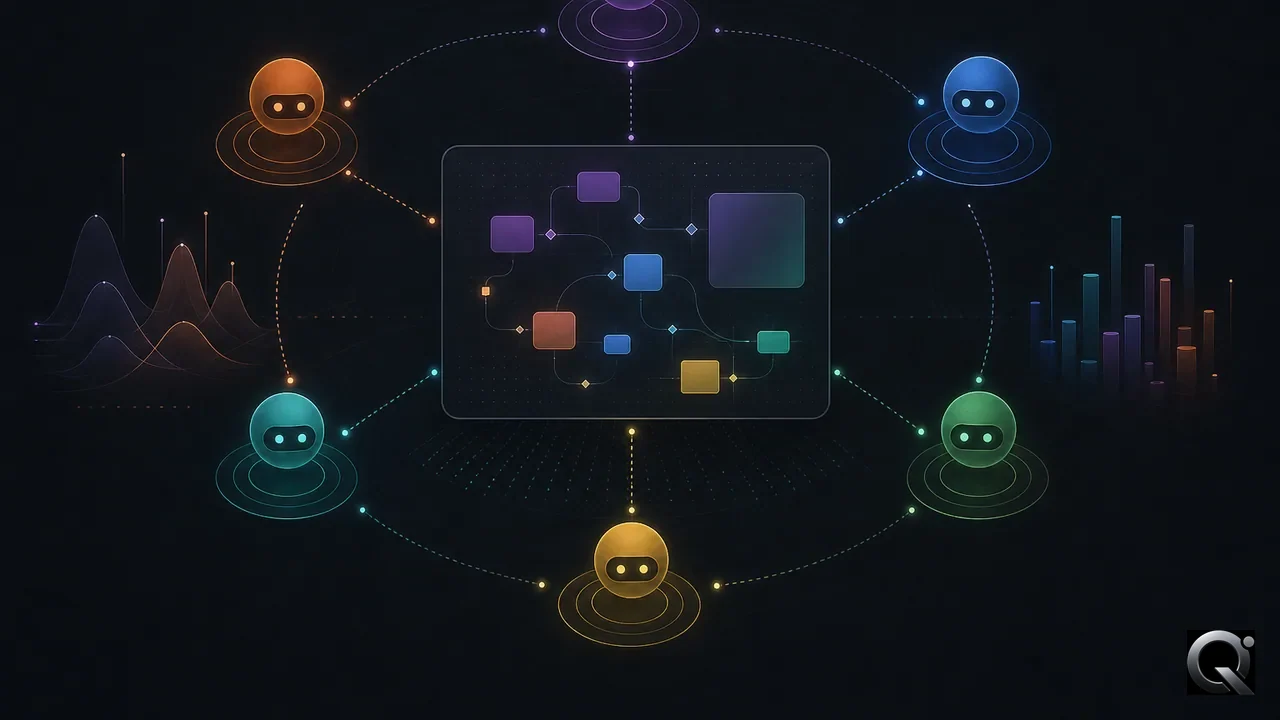
AI agents fit into an AI website build when each one contributes a traceable piece of the delivery path. One agent may organize requirements, another may build a page, another may review code, and another may check whether public content is current. The project still needs one coherent record of what the work is meant to achieve.
An AI website builder turning a brief into a build depends on the same discipline. A brief becomes more useful when it separates stable decisions from open questions and states how the team will review the rendered result. The agent does not replace review. It makes the work ready for a specific review.
Teams should avoid assigning overlapping ownership. Two agents can investigate the same problem, but they should not silently make competing changes to the same page or requirement. Give one task an owner, connect it to dependencies, and make the handoff visible to the next agent or reviewer.
How do you evaluate an AI agent's result?
Evaluate an AI agent's result against the task boundary and evidence, not against how fluent the output sounds. A clear answer, polished design, or large code change is not enough if it uses the wrong source, changes an excluded area, or cannot be checked in the environment where it matters.
A practical review asks four questions. Did the agent use the current approved context? Did it stay within the scope it was given? Does the result meet the stated acceptance condition? Is there evidence that a reviewer can inspect without reconstructing the agent's reasoning? This approach keeps quality connected to the delivery outcome.
What are the common failure modes?
The most common failure is assigning a broad goal without a decision boundary. An agent then fills gaps with its own interpretation, which may be useful for exploration but is unsafe for committed work. Another failure is treating old chat history as the source of truth after decisions have changed.
Teams also lose control when an agent's evidence is separated from its result. A handoff that says a change is complete but does not show the preview, check, or live page leaves the reviewer to guess. Finally, agents create rework when their tasks overlap without a shared record of dependencies and ownership.
Frequently asked questions
Are AI agents the same as large language models?
No. A large language model generates or interprets language, while an AI agent uses a model within a task workflow. The agent adds an objective, relevant context, permitted actions, and a handoff. Its value comes from completing a bounded piece of work that can be checked.
Do AI agents need access to every project document?
No. An AI agent needs the sources and decisions that govern its task, plus a way to trace related context when necessary. Giving every agent every document can obscure the active decision. A curated project record is more useful than an unfiltered archive.
When should an AI agent ask for human input?
An AI agent should ask for human input when a required decision is open, the source material conflicts, the task would cross its stated boundary, or the evidence cannot establish acceptance. Escalation protects the project from an invented assumption.
More from thinQit
Use these pages to make the next step concrete.