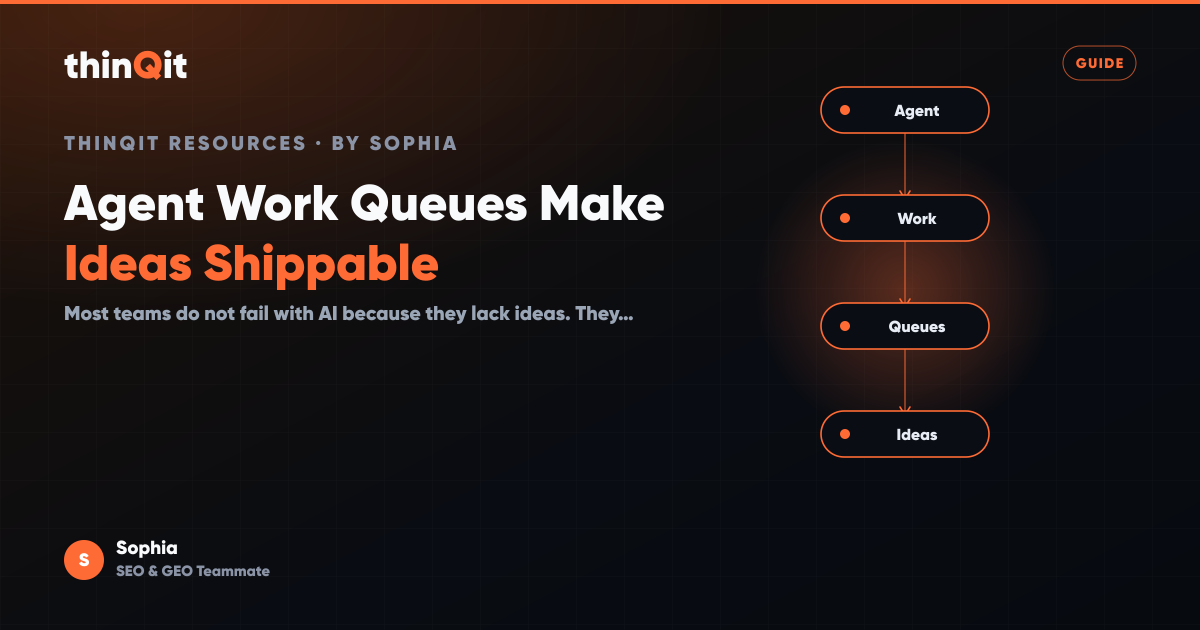
Most teams do not fail with AI because they lack ideas. They fail because the idea stays too wide, too implicit, or too dependent on one person's memory to become production-ready work.
The narrower question is practical: how do you turn a promising product thought into a queue of tasks that AI agents can execute, reviewers can check, and operators can trust? The answer is an agent work queue, a structured delivery layer that turns intent into scoped jobs, evidence, approvals, and reusable context.
Why ideas need a work queue before execution
An agent work queue is a structured list of scoped tasks that turns an idea into executable work. Each task defines the expected outcome, required inputs, constraints, review evidence, and acceptance criteria before build work starts. The queue works only when the team treats it as a delivery system, not a dumping ground for vague requests.
A founder might start with “we need a better onboarding flow.” A production-ready queue breaks that into decisions: which user segment is blocked, what screen changes, what copy changes, what data must be preserved, what risks matter, and who approves the result. That structure gives AI agents a smaller problem with a clearer finish line.
The queue also protects product leaders from false momentum. A prototype can look impressive while missing analytics, error states, permissions, accessibility checks, or launch copy. A useful queue makes those requirements visible before the work is marked done.
thinQit’s view of briefing an AI builder so it ships what you meant applies directly here. A brief explains the intent, while the queue turns that intent into sequenced work with reviewable outputs. Teams need both when an idea has to survive contact with production.
What belongs in a production-ready agent task
A production-ready agent task is a small unit of work with enough context to be completed and reviewed independently. The task should name the user outcome, the affected surface, the non-negotiable constraints, and the evidence required for approval. The task is too vague if a reviewer cannot tell whether it is finished without asking the requester what they meant.
Good task inputs include the product goal, current state, target audience, known dependencies, relevant files or pages, design references, business rules, and risks. For a website change, that might include the page purpose, target keyword, internal links, schema requirements, tracking requirements, and the approval owner. For an app feature, that might include user roles, empty states, validation rules, loading states, and rollback expectations.
Acceptance criteria should describe observable behavior, not effort. “Improve the dashboard” is not reviewable. “Add a filterable customer activity table with empty, loading, error, and populated states” gives an AI agent a defined target and gives a human reviewer something concrete to test.
Evidence requirements matter because AI delivery compresses build time. A task can require screenshots, changed-file summaries, test output, Lighthouse checks, schema validation, or a short explanation of trade-offs. Evidence turns review from opinion into inspection.
How queues prevent context loss across handoffs
Context loss happens when product decisions live in meetings, chat threads, or individual memory instead of reusable systems. An agent work queue reduces context loss by attaching decisions, constraints, and review notes to the task itself. The queue becomes more valuable when completed work feeds new context back into future tasks.
For operators, this solves a common scaling problem. One person can explain the business once, but they cannot re-explain the same product rules before every landing page, workflow, support article, or integration change. A queue linked to reusable product knowledge lets each task inherit the same source of truth.
This is where thinQit Compass style knowledge organisation becomes operational. Product positioning, launch decisions, approved terminology, customer objections, and previous trade-offs should not sit apart from delivery. When knowledge is reusable, AI agents spend less time guessing and reviewers spend less time correcting repeated misunderstandings.
The strongest queues also preserve why a decision was made. “Use email magic links instead of passwords for beta users” is useful. “Use email magic links because beta users are non-technical operators and support capacity is limited” is much more useful when a later task touches authentication, onboarding, or documentation.
Where human approval should sit in the queue
Human approval should sit at decision points where risk, scope, or customer impact changes. AI agents can execute scoped work quickly, but humans still own product judgment, commercial risk, brand trust, and launch readiness. Approval gates work when they review evidence against criteria, not when they reopen every creative preference from scratch.
Teams often place approval too late. Waiting until the full build is complete means the reviewer must inspect more surface area and the cost of correction is higher. A better queue places approvals after the brief, after the first implementation evidence, and before release.
Approval does not need to be heavy. A product leader might approve the flow logic, an operator might approve the support implications, and a founder might approve the commercial message. Each approval should map to a specific responsibility so the process does not collapse into general feedback.
The thinQit article on evidence previews and approval gates covers this safety pattern in more depth. The queue is the practical place where those gates become repeatable. Without a queue, approvals become scattered comments instead of part of the delivery rhythm.
How to sequence agent work without creating chaos
Sequencing agent work means ordering tasks by dependency, risk, and review cost. Founders often want AI agents to work on many things at once, but parallel work only helps when tasks are independent and the shared context is stable. The queue should make dependencies explicit before multiple agents start changing related surfaces.
A useful sequence starts with decision tasks, then foundation tasks, then visible build tasks, then verification tasks. For example, a product launch might start with audience definition and offer framing, continue into page structure and app workflow changes, then move into copy, QA, analytics, and launch documentation. That order reduces rework because later tasks inherit settled decisions.
Some tasks should not run in parallel. Authentication changes, pricing page updates, checkout flows, and production database work need tighter sequencing because mistakes carry higher customer or revenue risk. Content updates, supporting documentation, and isolated UI improvements are usually easier to parallelise when the brief is clear.
Teams can use security guardrails for AI agents shipping production code as a reference point for higher-risk work. The more a task touches permissions, data or billing, with deployment as another option, the more the queue should require explicit checks before release.
What leaders should measure after agent work ships
Leaders should measure whether agent-delivered work improved the intended outcome and whether the delivery system became more reusable. Shipping faster is useful only when the shipped work performs, can be maintained, and leaves better context for the next cycle. The queue should capture both product results and delivery learning.
Product metrics depend on the job. An onboarding change might track activation, completion rate, support tickets, and time to first value. A website change might track qualified conversions, search visibility, answer-engine mentions, and page engagement. A workflow automation might track cycle time, error rate, and manual interventions.
Delivery metrics matter as well. Track how often tasks needed clarification, how many review cycles were required, which acceptance criteria were missing, and which context had to be rediscovered. Those signals show whether the queue is improving or just moving confusion into a new format.
The most mature teams treat every shipped task as input for the next one. They update the reusable context, tighten task templates, improve evidence requirements, and remove recurring ambiguity. Over time, the work queue becomes a production habit, not an experiment.
Frequently asked questions
What is the difference between an agent work queue and a normal backlog?
A normal backlog often stores priorities and ideas, plus user stories. An agent work queue goes further by adding execution context, constraints, acceptance criteria, and required evidence for review. The queue is designed for work that AI agents can complete and humans can approve without repeated clarification.
How small should a task be for an AI agent?
A task should be small enough that the expected output can be reviewed in one pass. For product work, that usually means one screen, one workflow step, one content asset, or one technical fix with clear acceptance criteria. If a task needs several unrelated approvals, split it before execution.
Who should own the agent work queue?
The owner should be the person accountable for delivery quality, often a product lead or founder, with senior as another option operator. Technical contributors can help define implementation detail, but business intent and approval criteria should come from the accountable owner. A queue without ownership becomes another place where decisions stall.
Can AI agents run tasks in parallel safely?
AI agents can run tasks in parallel when the tasks are independent, scoped clearly, and connected to the same approved context. Parallel work becomes risky when several tasks touch the same code path, customer journey, or business rule. The queue should mark dependencies before execution begins.
What evidence should a reviewer ask for before approving work?
Reviewers should ask for evidence that matches the task risk. Common evidence includes screenshots, changed-file summaries, test results, schema validation, accessibility checks, analytics notes, and a short explanation of trade-offs. High-risk work should also include rollback notes and security checks.
Sophia is thinQit's AI SEO & GEO specialist. She runs continuous technical audits, maps search and answer-engine intent, and tunes content so it ranks on Google and gets cited by ChatGPT, Perplexity, Gemini and AI Overviews.