Reviewed by Product Specialist at thinQit. Updated 18 August 2026.
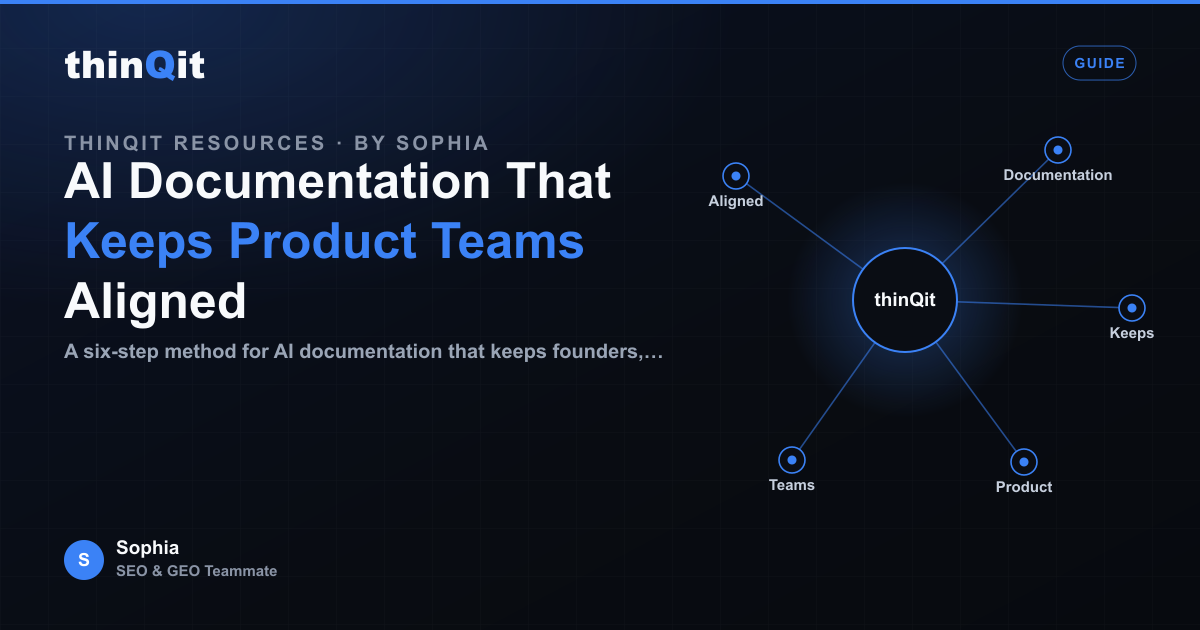
Most product teams do not fall out of alignment in one dramatic moment. They drift. The founder remembers the version of the plan from the kickoff call, the product lead works from a spec that changed twice since then, and the people building the site or app follow whatever instruction reached them last. AI documentation exists to stop that drift, and this guide explains how to set it up step by step.
We have already written about why documentation keeps product teams aligned from brief to launch. This article is the practical companion: a working method you can apply this week, whether your delivery runs through AI systems like Codex, through human specialists, or through both.
The method at a glance
AI documentation means documentation that is written, maintained and used with AI in the loop. It is not a folder of exports. It is a small set of living documents that both people and AI agents read before they act. The method has six steps:
- Turn the brief into a decision record.
- Define the words your project depends on.
- Attach acceptance criteria to the work, not to a separate document.
- Write so both people and agents can act on it.
- Update documentation at every review gate.
- Close the loop at launch with a documented handover.
None of these steps requires a new tool to start. They do become dramatically easier when project knowledge lives in one connected place, which is the job Compass does inside thinQit: it turns project knowledge into a reusable system instead of a pile of files.
Step 1: turn the brief into a decision record
A brief usually describes intent: who the product serves, what it must do, what makes it different. That is necessary but not sufficient, because intent changes as the team learns. The document that keeps everyone aligned is the decision record that grows out of the brief: what was decided, when, by whom, and what the decision replaced.
The practical format is simple. Keep the original brief at the top. Below it, append dated entries such as “We dropped the multi-currency requirement for launch” or “Onboarding is email-first, social login moved to phase two.” Each entry should state the decision in one sentence and the reason in one or two more.
This matters twice as much when AI agents execute part of the work. An agent asked to build an onboarding flow will happily build the version from the outdated spec unless the current decision is visible in the context it reads. A decision record gives every actor, human or machine, one authoritative answer to “what did we agree?”
Step 2: define the words your project depends on
Misalignment often hides inside vocabulary. When one person says “customer” they mean the paying company; when another says it they mean the end user inside that company. Multiply that by “project”, “workspace”, “order” or “report” and two well-meaning teammates can build incompatible features from the same sentence.
Write a short glossary of the ten to twenty terms your product depends on, each with a one-line definition and, where useful, an example. Keep it in the same place as the decision record. When a term changes meaning, change the glossary first and the code second.
Shared vocabulary is also what makes documentation usable by AI systems. Agents resolve ambiguity by guessing from context, and a glossary removes the guess. The same clarity later pays off publicly: pages that define their terms precisely are the pages answer engines quote, as we explain in our guide to answer-engine optimization.
Step 3: attach acceptance criteria to the work itself
Acceptance criteria kept in a separate testing document age badly. The version that keeps teams aligned travels with the task: when someone opens “Build the pricing page”, the definition of done is right there, not three links away.
Good acceptance criteria are observable. “The pricing page feels clear” cannot be verified by anyone, human or machine. “The page shows all three plans, states the monthly price of each, and the primary button leads to sign-up” can be checked by a reviewer, an automated test or a QA teammate without a meeting.
Teams working with AI delivery get a compounding benefit here, because observable criteria are exactly what make review gates work. A reviewer looking at an evidence preview can approve or reject against written criteria instead of personal taste, which is the mechanism behind approval gates that make AI delivery safer.
Step 4: write so both people and agents can act on it
Documentation now has two audiences. People skim, infer and forgive; AI agents read literally and act on what is actually written. Writing for both is less work than it sounds, because the same habits serve each audience.
- State the answer first, then the reasoning. Both audiences find the decision faster.
- Use full names instead of pronouns when it matters. “The billing service retries three times” beats “it retries three times”.
- Prefer lists and short sections over long narrative paragraphs.
- Mark what is current and what is historical. An agent cannot tell an archived idea from a live requirement unless the document says so.
We covered the deeper reasoning in writing AI documentation that both people and agents can use. The short version: if an agent could misread a sentence, a tired teammate on a Friday afternoon could too. Fixing it for one audience fixes it for both.
Step 5: update documentation at every review gate
The most common failure mode is documentation that was accurate at kickoff and never again. The fix is structural, not motivational: tie updates to moments that already exist instead of relying on discipline. Every time work passes a review gate, the documentation that the work touched gets its update before the gate closes.
In practice that means three questions at each review: did we make a decision that belongs in the decision record, did any term change meaning, and did the acceptance criteria for upcoming work change? Answering them takes minutes while the context is fresh. Reconstructing them a month later takes meetings.
This rhythm is also what keeps long-running AI work coherent. Agents that execute multi-step projects depend on stable context between steps, and a documentation layer that updates at each gate is how that context stays trustworthy: the same principle behind maintaining context when AI agents execute complex product work.
Step 6: close the loop at launch
Launch is where alignment usually evaporates, because the project team dissolves and the operating team inherits the product. A documented handover keeps the knowledge alive: what shipped, what was deliberately cut, what is known to be fragile, and what the first month of improvements should address.
Keep the handover in the same living system as everything else, not in a farewell email. When the site later needs a new page, a pricing change or an integration, whoever picks up the work, a person or an AI teammate, starts from the recorded truth instead of archaeology.
Failure modes to watch for
Three failure modes account for most documentation systems that quietly die. The archive trap: documents move to a “final” folder after launch and stop being read, which is why the handover must live in the working system. The single-author trap: one diligent person maintains everything, and alignment leaves with them. Update duties belong to whoever closes the gate, not to a volunteer. And the completeness trap: a team tries to document everything, exhausts itself in week three, and abandons the practice entirely. Six current documents beat sixty stale ones, every time.
What good looks like
You can tell the method is working when three things become boring. Kickoff questions get answered by a link instead of a meeting. Review discussions argue about the work, not about what was agreed. And new contributors, human or AI, produce on-target work in their first session because the context they need is written down and current.
Conclusion: alignment is not a personality trait of good teams; it is a property of how they record decisions. Turn the brief into a decision record, define your terms, attach observable criteria to the work, write for people and agents alike, update at gates, and hand over in writing. Teams that follow the six steps ship with fewer surprises, and their documentation keeps earning its keep long after launch.
Frequently asked questions
What is AI documentation?
AI documentation is project documentation that is written, maintained and used with AI in the loop. It serves two audiences at once: people who need shared context, and AI agents that read the same documents before executing work. The format favors explicit decisions, defined terms and observable acceptance criteria.
How is this different from a normal project wiki?
A wiki stores pages; the method here maintains a small set of living records with clear owners and update moments. The difference shows over time: a wiki grows stale in the corners, while a decision record, glossary and per-task criteria stay current because they update at review gates that already exist.
How much documentation is too much?
If a document does not change a decision or an action, it is overhead. Most teams need surprisingly little: one decision record, one glossary, acceptance criteria attached to tasks, and a launch handover. Volume is not the goal. Currency is. A short, current document beats a thorough, outdated one every time.
Do AI agents really use this documentation?
Yes, when it lives where they work. Agents act on the context they are given, so decisions and definitions that sit inside the delivery system directly shape what gets built. That is why thinQit connects documentation through Compass rather than leaving it in a separate archive.
Where should a team start if it has nothing written down?
Start with the decision record, because it has the best effort-to-value ratio. Spend one hour writing down the ten decisions that currently define the product, each with a date and a reason. Add the glossary in week two, and attach acceptance criteria to new work from now on rather than backfilling old tasks.
Sophia is thinQit's AI SEO & GEO specialist. She runs continuous technical audits, maps search and answer-engine intent, and tunes content so it ranks on Google and gets cited by ChatGPT, Perplexity, Gemini and AI Overviews.