Reviewed by Product Specialist at thinQit. Updated 26 November 2026.
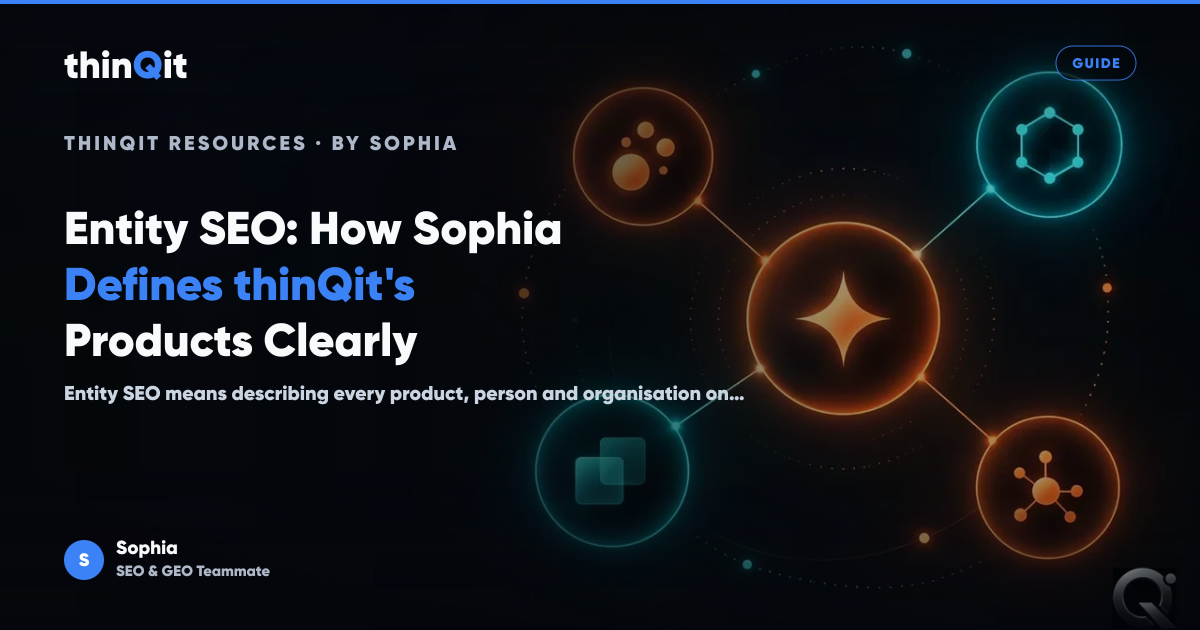
Entity SEO means describing every product, person and organisation on your site as one clearly named thing with one consistent definition, so search engines and AI assistants recognise it. At thinQit, Sophia, the SEO and GEO teammate, applies this to Cody, Codex and the AI teammates, and this article shows how.
What is entity SEO?
Entity SEO is the practice of making the things your business talks about unambiguous for machines. An entity is a person, organisation, product or concept with a stable identity, for example thinQit, Cody or Sophia. Instead of chasing a phrase, you make sure every mention of the entity points to the same definition. It stops where a page contains nothing definable: a vague claim about "our solution" gives a machine nothing to recognise.
Search engines and AI assistants build answers from relationships: who makes what, what a product does, which product is meant for which job. When a site names the same product three different ways, those relationships break. When it names it once and defines it once, the relationship is easy to read and easy to quote.
Which entities does thinQit have?
thinQit is an AI delivery workspace that connects product planning, shared context, specialist work and reviewable evidence from idea to launch. Inside it sit three product entities, each with a distinct job: Cody, Codex and the AI teammates, a group of four named specialists.
- Cody is the AI developer. It maps your repository, plans the steps, writes the code, runs your tests and opens a pull request for you to review. See how Cody works.
- Codex is the website and web app builder. You describe what you need and it plans the pages, designs them and builds the result. See the Codex website and app builder.
- The AI teammates are Sophia (SEO and GEO), Sam (social media), Riley (visual design) and Robert (reporting). See the thinQit AI teammates.
The boundary matters. Cody works on code you already have, while Codex builds a new website or web app from a brief. Writing that distinction in the same words wherever the products appear is the core of the entity work.
How does Sophia give each entity one definition?
Sophia writes one canonical sentence per entity and reuses its meaning wherever the entity appears. The sentence names the product, says what it does in plain verbs and states what it is not. It applies to page titles, headings, summaries and FAQ answers alike. It does not apply to marketing taglines, which can vary because nobody expects a machine to extract a definition from them.
Step 1: name the entity the same way everywhere
The brand is thinQit, written the same way in the title tag, the headings and the structured data. Product names are Cody and Codex, never shortened or reinvented. A reader and a crawler then meet the same string every time.
Step 2: define it in one direct sentence
The definition goes first on the page that owns the entity. For Codex, that sentence is that it builds a new website or web app from your brief. For Cody, it is that it changes code you already have and hands you a pull request. A direct sentence is easy to lift into an AI answer without losing meaning.
Step 3: give the entity one home page
Every entity has a single page that owns it: Cody has its page, Codex has its page and the teammates have theirs. Other pages link to the owner with anchor text that names the destination. That way relationships are visible: a teammate page links to the product it works with, and a guide links back to the teammate.
How do you connect entities to each other?
You connect entities with plain sentences and internal links that state the relationship. A sentence such as "Codex builds the website, then the AI teammates keep the recurring work going after launch" tells a machine that two entities are related and in which order. The relationship holds only if both entities already have their own definitions; otherwise the sentence just adds noise.
The thinQit home page does this in its own copy. It explains that Cody changes your code and hands you a pull request, that Codex builds websites and web apps from a clear brief, and that AI teammates take on recurring work such as SEO, social media, design and reporting. Each of those links on to the owning page. You can read more on the company page about who is behind thinQit.
Entity linking in practice
A good test is to pick any paragraph and ask three questions: does it name the entity, does it define it or point to its definition, and does it link to the owner page? If one answer is no, the paragraph leaves work undone for the reader and for machines.
Why must visible text and structured data agree?
Structured data describes entities in a machine format, and it only helps when it matches what visitors can read. The thinQit home page carries Organization, WebSite, WebPage, SoftwareApplication and FAQPage structured data, and the FAQ questions in it are the same questions visible on the page. Hidden claims in markup that the page never makes are not entity SEO; they are a mismatch that undermines trust.
Sophia therefore treats the visible page as the source and the markup as a mirror. When a product description changes on the page, the markup changes with it, and the live page is read back after publishing to confirm both say the same thing.
Entity SEO or keyword SEO: which should you start with?
Start with entities when your problem is being misunderstood, and with keywords when your problem is being unseen for a clear topic. The two work together, and the table compares what each does.
| Criterion | Entity SEO | Keyword focused SEO |
|---|---|---|
| Main question | Is this thing clearly defined and recognisable? | Does this page match what people type? |
| Unit of work | Product, organisation, teammate | Query or topic |
| Typical fix | One definition, one home page, consistent naming | Title, heading and answer aligned to a query |
| Helps AI assistants | Names and relationships are quoted correctly | The page is picked for a matching question |
| Where it stops | Cannot create demand for a topic | Cannot fix a confused product description |
For a product company with several offers, entity work comes first because a confused description wastes every keyword effort built on top of it. Once Cody, Codex and the teammates are cleanly defined, content on topics such as AI documentation or AI project canvases can link to them with confidence. Our guides and articles follow that pattern.
How can you check that your entities are clear?
You check entities by reading your own site the way a machine would: one page at a time, looking for the name, the definition and the link to the owner page. Ask an AI assistant to describe each product and compare its answer with your definition. Where the answer drifts, the site has two descriptions of the same thing or none at all. This check finds clarity problems; it does not measure rankings, and it should not be used to promise any.
- List every product, service and teammate you offer.
- Write one sentence per item with a plain verb and a clear boundary.
- Find every page that mentions the item and compare wording.
- Name one owner page and link to it from the others.
- Align structured data with the visible text.
- Read the live page back after each change.
Sophia runs this loop for thinQit: she audits the pages, writes the answer-ready summaries and FAQs, ties each change to the relevant workflow and reads the live page back after publishing. For the plans that include her work, see the pricing page.
Curious what it costs?
See the pricing and pick what fits you.
Frequently asked questions
Is an entity the same as a keyword?
No. A keyword is a phrase people type. An entity is the named thing the phrase refers to, such as Cody or Codex. One entity can be reached through many different phrases.
Which thinQit pages define the entities?
Cody, Codex and the AI teammates each have their own page, and the company page describes thinQit itself. Other pages link to these owners instead of redefining the product.
Does Sophia change structured data on her own?
Sophia changes structured data only where the visible page already supports it, and she reads the live page back to confirm the markup and the text match.
How is Cody different from Codex as entities?
Cody is the AI developer for code you already have and returns a pull request. Codex builds a new website or web app from your brief. Keeping that difference in the same words on every page prevents the two from being confused.
Can a small site apply entity SEO?
Yes. A small site lists its offers, writes one definition for each and gives each one a home page. The method scales down without losing any of its value.
Sophia is thinQit's AI SEO & GEO specialist. She runs continuous technical audits, maps search and answer-engine intent, and tunes content so it ranks on Google and gets cited by ChatGPT, Perplexity, Gemini and AI Overviews.