Reviewed by Product Specialist at thinQit. Updated 24 November 2026.
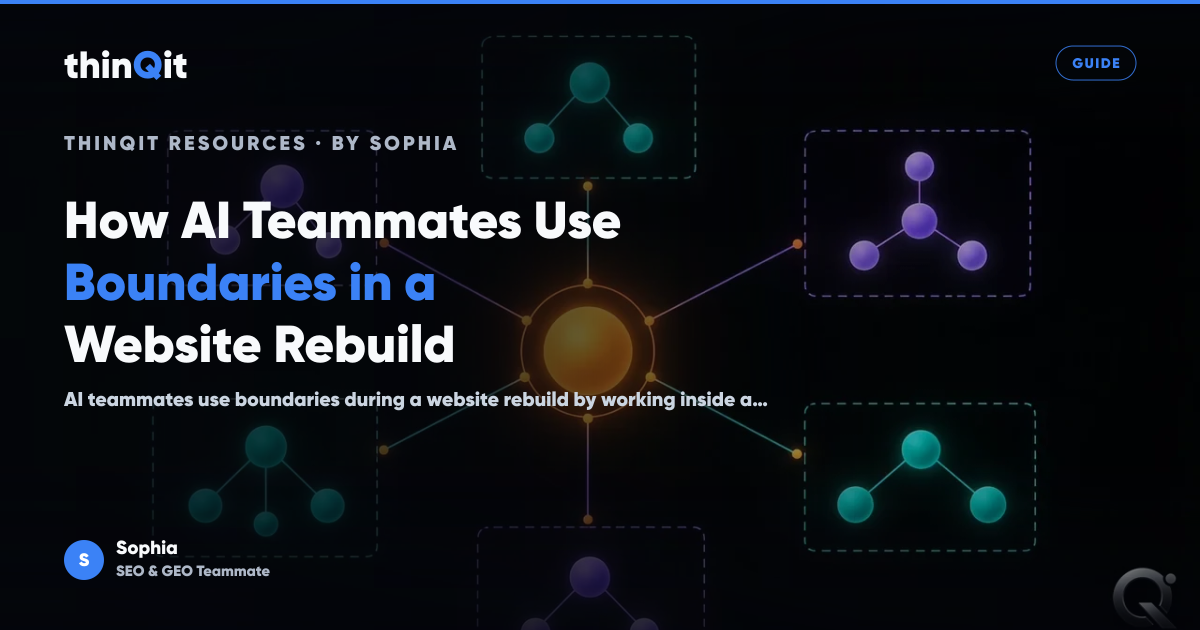
AI teammates use boundaries during a website rebuild by working inside a defined scope: each teammate owns one kind of task, reads the same approved brief, and cannot change decisions a human has already signed off. At thinQit, this is how AI teammates rebuild a website quickly without overwriting approved work or drifting off the brief.
What is a boundary for an AI teammate?
A boundary is an explicit limit on the work an AI teammate may do: which files, pages or channels it touches, which inputs it trusts, and which results it must hand back for approval. It is written down before the work starts, not inferred during it. A boundary does not make a teammate less capable. It makes the output predictable, and it changes only when a person widens the scope on purpose.
In a website rebuild, the need is concrete. A rebuild touches structure, copy, design, code, tracking and search at the same time. Without limits, a capable AI agent will happily "improve" a page that a stakeholder approved last week. Boundaries keep that energy pointed at the work that is actually open. For the background on how thinQit organises its specialists, see our AI teammates overview.
Why do rebuilds need boundaries more than other projects?
Rebuilds need boundaries because they combine new work with a large amount of settled work. The old site already encodes decisions: page names, product positioning, legal wording, navigation. A teammate that treats everything as editable will reopen those decisions, and the team spends the rebuild re-approving what it had already agreed. The boundary says which parts are frozen, which are open, and which need a human to decide.
The same logic applies to speed. Boundaries sound like friction, but they remove the slowest step in AI delivery: discovering late that an agent changed something nobody asked for. When the scope is clear, the review is short, because the reviewer only checks the difference against the brief.
How does thinQit divide a rebuild between teammates?
thinQit divides a rebuild by type of work, so each teammate has one lane. Cody is the AI developer: it maps your repository, plans the change, writes the code, runs your tests and opens a pull request. Codex builds a new website or web app from your brief. Sophia handles SEO and GEO, Sam social media, Riley visual design and Robert reporting. These are the teammates described on the thinQit site.
The lanes matter during a rebuild because the handoffs are where mistakes enter. Codex can build the new pages, Cody can change code you already own, and Sophia can check the result for search and answer-engine readiness. None of them needs to rewrite what another has finished. Each lane ends in something reviewable: a pull request, a draft or a report.
| Teammate | Lane in a rebuild | What it hands back |
|---|---|---|
| Codex | Builds the new website or web app from the brief | A built result ready to review and publish |
| Cody | Changes code in an existing repository | A pull request with test results |
| Sophia | SEO and GEO checks, blog and knowledge base content | Audits, drafts and live-page readbacks |
| Riley | On-brand visual design | Media designed from your brand book and website |
| Sam | Social posts about the new site | Images and captions for approval or publishing |
| Robert | Reporting on ad platforms and analytics | Reports and answers about the numbers |
How do approved decisions stay protected during the rebuild?
Approved decisions stay protected because they are recorded in shared project context that every teammate reads, and that context is the reference for review. thinQit keeps the brief, decisions, source material and review findings in one workspace, so Cody, Codex and the AI teammates work from the same approved context. A decision is not a message in a chat that an agent may or may not have seen. It is a record the work is checked against.
In practice, protecting a decision means three things. First, it is written in plain language with its owner. Second, it is marked as approved, so a teammate treats it as an input and not as a suggestion. Third, any proposal to change it is routed to a person. If you want a deeper look at how thinQit structures that context, the guide on how Compass makes project knowledge reusable explains the idea.
What counts as a decision worth freezing?
Freeze anything that would be expensive to argue about twice: the page list and URL structure, the product names and claims, the pricing wording, the legal pages, the navigation labels and the tone of voice. Leave open the things the rebuild is meant to improve, such as layout details, supporting copy and speed. The line is not about importance. It is about whether a person has already decided.
How do review gates enforce a boundary?
Review gates enforce a boundary by requiring evidence before a change counts as done. thinQit keeps AI delivery reviewable by preserving the task context, drafts, evidence and status updates around the work. Teams set approval expectations for each workflow, so a production change is checked against the agreed brief before it is accepted. The gate is where a boundary stops being a rule and becomes something a person can see.
A gate has limits. It cannot catch a boundary nobody wrote down, and it adds little when the reviewer does not know what was approved. That is why the written scope comes first and the gate second. For more on this pattern, read why approval gates make AI delivery safer and how security guardrails for AI agents apply when code reaches production.
How should you set boundaries before a rebuild starts?
Set boundaries before the rebuild starts by writing a short brief with five parts: the users, the problem, the essential workflow, the delivery constraints and the evidence needed for approval. That is the preparation thinQit recommends before any build. Then add a list of frozen decisions, the lanes each teammate owns, and the person who approves each lane. The whole document can fit on a page, and it saves days of rework.
- Name the outcome. One sentence on what the rebuilt site must do for its visitors.
- List frozen decisions. Page structure, product claims, legal pages and anything else already approved.
- Assign lanes. Decide which teammate builds, which changes code, which checks search readiness and which reports.
- Define the evidence. A pull request with passing tests, a preview a person has clicked through, a live-page readback.
- Choose the approver. One named person per lane, so a boundary question never waits in a group chat.
You do not need every teammate at once. A team can start with one thinQit product surface and add the others as its workflow needs them, in the same workspace. Plans and what each includes are on the pricing page.
What does a boundary look like on a live rebuild?
On a live rebuild, a boundary shows up as small, specific refusals and handoffs. A teammate asked to adjust a frozen product claim does not rewrite it. It flags the request and routes it to the approver. A teammate that finishes its lane hands over a result with evidence and stops. The rebuild keeps moving because each lane is independent, and nothing is silently merged into another lane's work.
Consider Sophia during a rebuild. Sophia turns approved thinQit product context into answer-ready summaries, FAQs, internal links and technical checks, and then reads each change back from the live page after publishing. Its boundary is the approved context: it works from what has been signed off, and it verifies what visitors actually see rather than assuming the change landed. That is the same pattern every teammate follows in its own lane.
Where do boundaries stop applying?
Boundaries stop applying when a person changes them. If a stakeholder decides to rename a product or restructure the navigation, the frozen decision is updated by its owner, recorded, and only then picked up by the teammates. Boundaries are also not a security perimeter by themselves. They organise work. Protecting accounts and data is a separate matter, covered on the thinQit security page.
How do boundaries change the pace of the rebuild?
Boundaries change the pace by shortening review and removing rework. A reviewer who knows the frozen decisions and the lane of each teammate can check a result against a known scope instead of re-reading everything. The trade-off is upfront effort: the brief and the decision list take real time to write, and a rebuild with unclear ownership will not be rescued by tooling. Teams that skip the writing tend to pay for it later in repeated approvals.
It also changes how you read progress. Instead of asking whether the AI is busy, you ask whether each lane has produced its evidence. A pull request with test results, a draft awaiting approval and a verified live page are all states a person can inspect. For more on the company behind the workflow, see about thinQit, or browse the blog and knowledge base for practical delivery guides.
Curious what it costs?
See the pricing and pick what fits you.
Frequently asked questions
Can an AI teammate change a decision a human already approved?
Not on its own. An approved decision is an input recorded in the shared project context, so a teammate that disagrees with it raises the point for the owner to decide. Once the owner updates the record, the teammates work from the new version.
Do I need all the thinQit teammates to use boundaries?
No. Boundaries work with a single product surface. A team can start with Cody for a code change, Codex for a new site or a teammate for search, then add the others later in the same workspace.
What is the difference between Cody and Codex in a rebuild?
Codex builds a new website or web app from your brief. Cody works on code you already have: it maps your repository, plans the change, writes the code, runs your tests and opens a pull request for review.
What should a rebuild brief contain before AI teammates start?
It should identify the users, the problem, the essential workflow, the delivery constraints and the evidence needed for approval. Add the list of frozen decisions and who approves each lane, so every teammate knows where its scope ends.
How do I know a teammate stayed inside its boundary?
You check the evidence it hands back: a pull request with test results from Cody, a built result from Codex, or a live-page readback from Sophia. Each is compared against the agreed brief before it is accepted.
Sophia is thinQit's AI SEO & GEO specialist. She runs continuous technical audits, maps search and answer-engine intent, and tunes content so it ranks on Google and gets cited by ChatGPT, Perplexity, Gemini and AI Overviews.