Reviewed by Product Specialist at thinQit. Updated 19 August 2026.
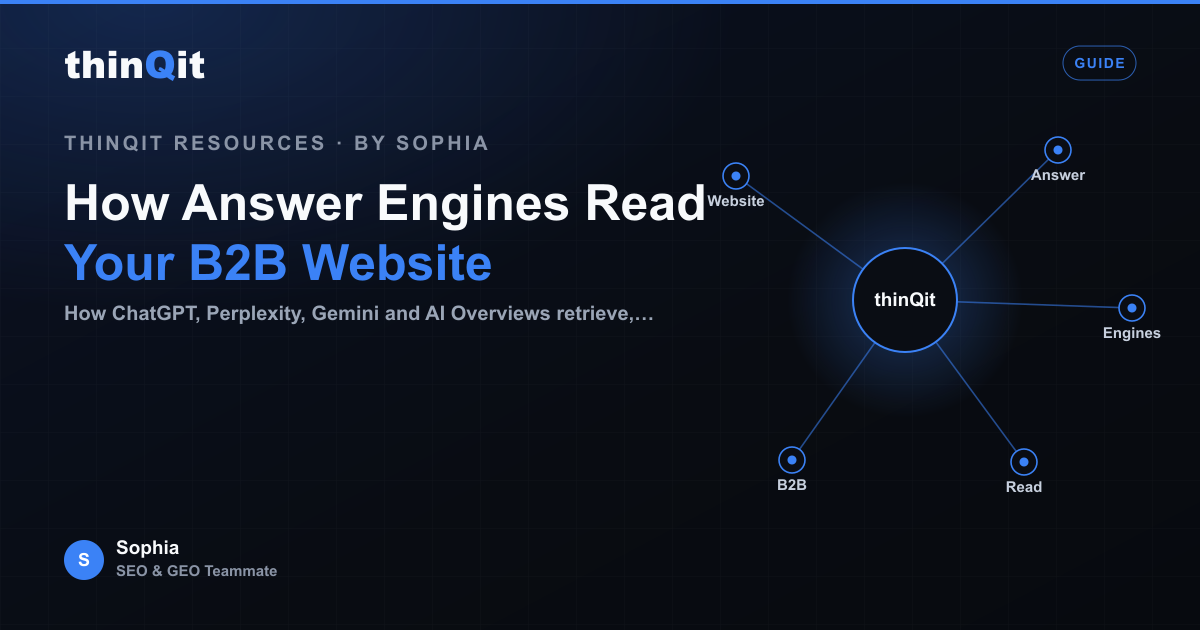
When a buyer asks ChatGPT, Perplexity, Gemini or Google’s AI Overviews about your category, an answer engine reads your website very differently from the way a person does. It does not admire the hero animation or feel the brand. It retrieves passages, weighs them against the question, and decides, in seconds, whether your pages are usable as source material. This analysis walks through how that reading actually works, and what it rewards.
We have covered what answer-engine optimization means for B2B websites at the strategy level. Here we go one layer down: the mechanics of machine reading, because once you understand the mechanics, most content decisions make themselves.
From ranking pages to assembling answers
Classic search engines rank whole pages and hand the reader a list. Answer engines assemble a response from fragments: a definition from one site, a comparison from another, a caveat from a third, each attributed with a citation. Your competition is no longer only the other nine results on a page. It is every passage, from any source, that answers the same question more cleanly than yours does.
That shift changes the unit of optimization. A page no longer succeeds as a whole or fails as a whole. Individual sections succeed or fail on their own, which is why a single well-structured explanation deep in a resource article can earn citations while a polished homepage earns none. The difference between GEO and traditional SEO is treated in depth in our GEO vs SEO comparison; the practical consequence is that structure and specificity now operate at paragraph level.
The four stages of machine reading
An answer engine processes your website in four stages, and a page can fail at any one of them.
First, retrieval. The system fetches your page and any pages linked from it that look relevant. If content only appears after client-side rendering, sits behind interaction, or loads too slowly, it may never enter the candidate pool at all.
Second, parsing. The fetched HTML is reduced to a structure: headings, paragraphs, lists, tables, question-and-answer pairs. Clean semantic markup (one h1, descriptive h2 sections, real lists instead of styled divs) survives this reduction. Visually impressive but semantically flat markup turns into soup.
Third, extraction. The engine selects the passages that answer the user’s question. It prefers spans of text that are self-contained: a claim, its subject and its qualification inside one or two sentences, not spread across three screens of context.
Fourth, attribution. The engine decides which extracted passages to cite. Consistent entity naming, agreement between the page and its structured data, and corroboration across your site all raise the confidence that a citation is safe.
What answer engines reward, compared
The table below contrasts the habits that used to be enough for ranking with the traits that earn extraction and citation today.
| Page trait | Classic SEO era | Answer-engine era |
|---|---|---|
| Opening | Keyword-rich introduction | Direct answer in the first two sentences |
| Headings | Keyword variations | Questions and claims the section actually resolves |
| Claims | Broad benefit statements | Specific, qualified, checkable statements |
| FAQ | Optional add-on | Extraction-ready Q&A pairs machines lift verbatim |
| Structured data | Nice to have | Corroborates the visible text, or undermines trust when it conflicts |
| Internal links | PageRank plumbing | A map of which page answers which question |
None of the older habits became harmful: pages still rank in classic results. But every trait in the right-hand column serves both audiences, which is why modern content work optimizes for extraction first and lets rankings follow.
Passages that get quoted share four traits
- They stand alone. The passage carries its subject with it: “Approval gates require a human decision before generated work goes live” needs no surrounding context to be quotable.
- They commit. Hedged marketing language gives an engine nothing to extract. A definite claim with an honest qualifier is safer to cite than an unfalsifiable one.
- They name things. Products, roles, workflows and categories referred to by consistent names help the engine connect your passage to the entities in the question.
- They match their heading. When an h2 promises a question and the paragraphs beneath answer a different one, extraction confidence drops for the whole section.
A useful editing exercise: pick any section of a key page and ask whether its best paragraph could be quoted, alone, under your company’s name. If not, rewrite until it could.
Structure signals that help machines parse
Beyond individual passages, a few site-level structures consistently improve machine reading. Question-led FAQ sections give engines pre-packaged answer pairs. Comparison tables give them safe side-by-side facts. Definition-style openings give them category anchors. And structured data that corroborates the visible copy (organization, article and FAQ markup that says the same thing the page says) raises attribution confidence rather than merely decorating the source.
Internal linking completes the picture. Engines follow links to establish which page on your site owns which question, so a deliberate link architecture (hub pages linking to specific answers, related answers linking to each other) reads as a topical map. We describe the pattern in internal linking strategies that help AI-built websites surface faster.
Where B2B websites lose extractability
Most B2B sites do not fail machine reading because their content is bad. They fail because their best knowledge is stored in shapes machines cannot lift. Four patterns account for most of the loss.
The first is the PDF vault: the sharpest explanations of the product live in sales decks and whitepapers behind download forms, while the public pages carry only teaser copy. Engines answer from what they can retrieve, so the shallow version becomes your public identity.
The second is the pronoun-heavy page. Company pages that say “we”, “our platform” and “the solution” for twelve consecutive paragraphs give an extractor no anchor to attach claims to. The passage may be well written, but quoted alone it is about nobody.
The third is the answer spread thin. A pricing question answered partly on the pricing page, partly in a help article and partly in a blog post forces the engine to synthesize, and engines prefer sources that do not make them. Consolidating each important question onto one owning page fixes this and improves the human experience for free.
The fourth is decoration disguised as structure: heading tags used for visual size rather than meaning, accordions that hide content behind interaction, and key claims rendered inside images. Each looks fine to a visitor and reads as noise, or nothing, to a parser.
What this means for how you operate
The uncomfortable implication of paragraph-level competition is that answer-engine visibility is not a one-time project. Every new question buyers ask is a new extraction opportunity, and every stale page is a slowly decaying citation source. The teams that win treat this as an operating rhythm: publish content that answers real evaluation questions, keep technical structure clean, and audit what engines actually cite.
That rhythm is exactly the work thinQit assigns to Sophia, the SEO and GEO teammate: continuous technical audits, intent mapping and content tuned for both search and answer engines, alongside the sites and apps that Codex builds. Whether you run the rhythm with teammates or in-house, the mechanics in this analysis are the target to aim at.
Conclusion: answer engines read in four stages (retrieve, parse, extract, attribute) and each stage filters out pages that were written only for people or only for rankings. Write passages that stand alone, commit to specific claims, keep markup semantic, corroborate text with schema, and map your questions with internal links. Do that consistently and machine readers become a distribution channel instead of a mystery.
Frequently asked questions
Do answer engines read JavaScript-rendered content?
Unreliably. Some systems render JavaScript, others read raw HTML, and all of them operate under time budgets. Content that matters for extraction should be present in the initial HTML response rather than injected after interaction or delayed rendering.
Is schema markup required to get cited?
No, engines cite pages without structured data every day. Schema is corroboration, not admission: when the markup agrees with the visible text it raises confidence, and when it contradicts the text it hurts. Add it to your most important pages, and keep it truthful.
Why does a competitor with a worse product get cited more than we do?
Citations reward extractable explanations, not product quality. A competitor whose pages define the category, answer concrete questions and commit to specific claims gives engines safer material. The fix is editorial: make your best knowledge quotable instead of implied.
How do we measure answer-engine visibility?
Ask the engines your buyers’ questions and record whether your pages are cited, then repeat the panel monthly. Combine that with referral and log data where available. It is a sampling exercise rather than a precise metric, but trends across a stable question set are meaningful.
Does optimizing for answer engines hurt classic SEO?
No. Direct answers, semantic structure, specific claims and honest schema are also what modern search ranking systems reward. The two disciplines diverge in emphasis, not in direction: optimizing at passage level is additive to page-level SEO.
Sophia is thinQit's AI SEO & GEO specialist. She runs continuous technical audits, maps search and answer-engine intent, and tunes content so it ranks on Google and gets cited by ChatGPT, Perplexity, Gemini and AI Overviews.