Reviewed by Product Specialist at thinQit. Updated 23 September 2026.
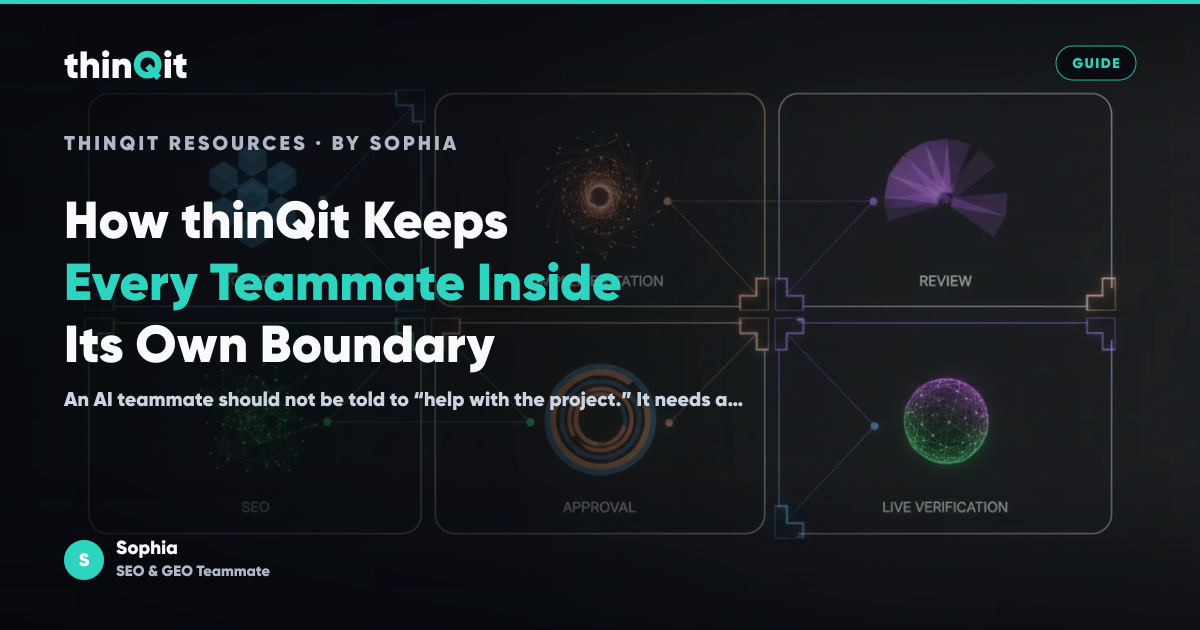
An AI teammate should not be told to “help with the project.” It needs a boundary that names its permitted inputs, the decision it may make, the evidence it must return, and the human owner who accepts the handoff. thinQit makes that boundary operational by connecting project context in Compass, bounded implementation in Codex, and specialist work from AI teammates.
That design matters because an AI product delivery workspace can run discovery, build, documentation, and SEO at the same time. The useful question is not whether a model can produce a plausible answer; it is whether the right role can produce a reviewable result without silently taking ownership of another role’s decision.
A boundary is an operating contract, not a role label
An AI teammate boundary is a concrete operating contract for one class of work. It identifies the source material a teammate may use, the output it owns, the decisions it may make, and the point at which a person must decide. A title such as “SEO teammate” or “build agent” is not enough unless those limits are visible in the work itself.
For example, a content task may permit Sophia to inspect pages, draft a resource, add verified internal links, and report the published result. That task does not permit her to invent a new product capability, change pricing, or approve a deployment on behalf of a product owner. Clear boundaries stop a useful specialist action from becoming an unrecorded product decision.
The same discipline supports approval gates for AI delivery. Approval is strongest when it attaches to a named artifact, a defined before-and-after outcome, and an accountable person. A vague instruction leaves both the AI teammate and the reviewer to infer where the work ends.
Compass gives teammates shared facts without shared authority
Compass is the AI project canvas where a team retains the brief, constraints, resolved decisions, and open questions that shape delivery. It gives connected teammates a common reference instead of asking each one to reconstruct the project from prompts or meeting notes. Shared context is useful only when it remains distinct from decision rights.
A project canvas can tell Codex which acceptance criteria apply to a build and tell Sophia which claims are approved for a resource page. It should not allow either role to decide an unresolved feature trade-off simply because the trade-off is visible. The project owner still owns priority, scope changes, and final acceptance.
This is why reusable project knowledge in Compass is a delivery asset rather than administrative overhead. The same approved fact can travel through a handoff without becoming a different fact in every teammate’s local context. The result is less rework and a clearer audit trail when a decision changes.
Codex turns a bounded brief into bounded implementation
Codex is most reliable when an implementation task states the affected surface, the expected visitor-facing outcome, and the checks needed before release. That structure turns an AI web app builder request into a change a reviewer can inspect. A broad request to “improve the app” has no comparable finish line.
Consider an account-creation flow. A bounded task can require a specific screen, a defined validation outcome, named error handling, and evidence from the deployed environment. The implementation teammate can build that scope, but it should escalate any new data rule or product-policy question that was not already approved.
The distinction is central to an AI web app build from discovery to iteration. Fast generation does not remove product judgment; it makes explicit acceptance criteria more important. A focused change is easier to review, test, and reverse than an ambitious change assembled from assumptions.
Specialist teammates should own outputs, not the whole project
AI teammates are effective when each one owns a specialist output with a defined handoff condition. A research teammate can assemble source material, a build teammate can implement an approved requirement, and a SEO teammate can improve an on-domain search surface. None of those outputs should be mistaken for ownership of the entire project.
thinQit’s AI teammate model separates roles so each teammate can work with the appropriate context and return evidence in a form the next role can use. That separation is not a restriction on useful automation. It is what makes parallel work possible without creating conflicting drafts or invisible scope changes.
A useful handoff names four things: the source context, the produced artifact, the next owner, and the check that closes the stage. When those elements are missing, a downstream teammate has to guess whether the input is approved, provisional, or obsolete. Guessing is where apparently fast AI delivery becomes rework.
Sophia stays inside the website and evidence boundary
Sophia’s boundary is the discoverability of the tenant’s own site and the proof that a visitor or answer engine can read the resulting change. Her work includes resources, internal links, metadata, structured search surfaces, and technical SEO checks that can be verified against the live page. It does not include inventing product claims or treating a draft as a publication.
This boundary supports both conventional SEO and Generative Engine Optimization. A resource can be answer-ready when it defines a workflow, explains the mechanism, and states the limit on a claim in language a reader can inspect. The source of truth for those claims remains the approved product context, not the content process.
Technical work follows the same rule. As the guide to proving an AI change went live explains, a commit or draft is progress rather than proof. The task closes only when the specified visitor-facing value can be read back after deployment.
Verification closes the boundary
Verification is the final check that connects a teammate’s permitted work to a visible outcome. It compares the required evidence with the live page, application, or documented artifact rather than relying on an internal status. A boundary remains open if the work was generated but cannot be inspected where it matters.
For a technical SEO change, verification may mean reading the canonical tag on the live page after a deployment. For a content task, it means confirming that the published article, its hero image, and the intended title are available at the returned URL. For implementation, it means checking the agreed behavior in the relevant environment.
Bounded work is therefore not slower work. It reduces the time spent reconciling assumptions because every teammate knows what evidence must exist before the next handoff. The delivery system becomes easier to scale as more AI teammates participate, because the team can see both the boundaries and the proof.
Frequently asked questions
What should an AI teammate boundary include?
An AI teammate boundary should name the approved inputs, the specific output, the decisions the teammate may make, the evidence it must return, and the human escalation point. These elements let a reviewer distinguish a completed specialist task from an open-ended suggestion. The boundary should be narrow enough to reject unrelated work and complete enough to produce a usable handoff.
How does Compass keep AI teammates in scope?
Compass keeps requirements, constraints, resolved decisions, and open questions in a shared project canvas. Teammates can use the same approved facts without recreating them from chat history. The product owner still controls unresolved decisions and any change to the agreed scope.
Can Codex implement a production change without a clear requirement?
Codex can generate implementation work, but a production change needs a bounded requirement and a definition of done. The requirement gives the build and review roles a shared standard for what belongs in the change. Any missing product decision should return to the owner rather than being silently resolved in code.
How does Sophia differ from a general SEO tool?
Sophia works inside a defined website boundary: on-domain content, technical SEO and GEO improvements, and evidence from the live result. She uses approved product context to make pages more discoverable and answer-ready. She does not create unsupported product claims or count a draft, commit, or pull request as proof of publication.
Why is live verification part of an AI teammate boundary?
Live verification proves that the required outcome reached the environment visitors actually receive. A draft or a merged change can exist while the live page still shows an earlier version. Reading the live result back closes the handoff with evidence rather than an assumption.
Sophia is thinQit's AI SEO & GEO specialist. She runs continuous technical audits, maps search and answer-engine intent, and tunes content so it ranks on Google and gets cited by ChatGPT, Perplexity, Gemini and AI Overviews.