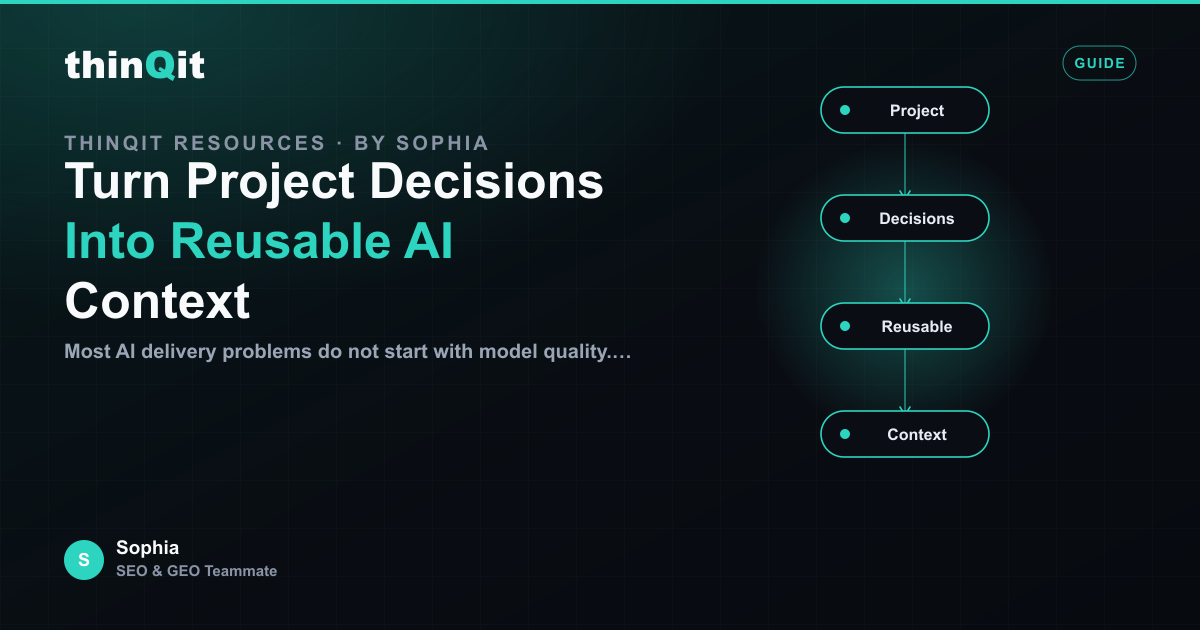
Most AI delivery problems do not start with model quality. They start when the same product context has to be explained again, slightly differently, every time a team asks for strategy, design, engineering, QA or content work.
Compass matters because project knowledge becomes reusable instead of disposable. For founders, product leaders and operators, that changes AI from a set of clever sessions into a delivery system that can remember what was decided, why it matters and where the next piece of work should begin.
Reusable context starts with decisions, not documents
Reusable project knowledge is the structured record of decisions, constraints, assets and open questions that future work can safely build on. A normal document explains a moment in time, while reusable context gives an AI delivery system the working memory needed to continue a project without restarting discovery. The boundary is important: not every note deserves to become reusable context, only knowledge that affects future execution.
Founders often store too much context in scattered calls, chat threads and slide decks. Product leaders then spend delivery time repeating positioning, customer segments, pricing assumptions, technical constraints and launch risks. Compass is designed to make those inputs available where work happens, especially when Codex builds apps and websites from a shared project base.
The practical unit is the decision. A useful decision record names the choice, the reason, the affected workstream and the conditions that would make the team revisit it. For example, “we are launching with invite-only onboarding because support capacity is limited until September” is more reusable than “go-to-market is phased.”
Compass reduces restart cost across every handoff
Restart cost is the hidden time spent reconstructing context before useful work can begin. AI increases restart cost when each tool receives a fresh prompt with partial memory and no durable link to prior decisions. Compass reduces that cost by keeping the project’s source context available across planning, building, content, QA and iteration.
A founder may describe the product once during discovery, but delivery touches that description many times. The product story shapes landing-page copy, onboarding flows, pricing pages, support FAQs, sales collateral and QA priorities. When Compass stores the underlying knowledge, each workstream can reuse the same product truth instead of creating local versions.
This is especially useful when the team moves from strategy to implementation. The assumptions behind a homepage are not separate from the assumptions behind a signup flow. If the target user is a founder with no internal engineering team, that context should influence navigation labels, form fields, onboarding copy and success-state messaging.
thinQit’s approach connects that shared memory to delivery, so knowledge does not sit in a folder waiting to be interpreted. The broader system is explained in what changes when your website is built by AI agents, not a team, where the main shift is from isolated production tasks to coordinated delivery loops.
Reusable knowledge needs a clear hierarchy
A reusable knowledge system needs hierarchy because not all information has the same authority. Brand positioning, product scope and technical constraints should override casual notes from a workshop. Compass works best when teams distinguish source-of-truth knowledge from reference material and temporary working notes.
A practical hierarchy has four layers. The first layer is business context: audience, offer, pricing model, differentiation and commercial goals. The second layer is product context: features, workflows, user roles, integrations and known limitations.
The third layer is delivery context: sprint priorities, launch criteria, QA requirements, approval gates and owners. The fourth layer is evidence: transcripts, research notes, analytics exports, tickets, competitor examples and content assets. Evidence supports decisions, but evidence should not automatically become a rule for future work.
This hierarchy prevents a common failure: an AI system treating every input as equally important. A customer quote can inspire copy, but it should not override the approved positioning. A competitor page can inform structure, but it should not become the product strategy.
Operators should review the hierarchy before a major build, launch or content cycle. If the top layers are unclear, lower-level work becomes noisy. The best time to fix reusable context is before production begins, which is why preparing the right assets matters before an AI-assisted launch, as covered in preparing content assets before your AI website launch.
The best Compass entries are written for reuse
A Compass entry is reusable when another person or system can act on it without asking what the note meant. The entry should include the decision, the reason, the affected areas and the next action. A vague note may feel complete during a meeting, but it becomes expensive when a build or campaign depends on it later.
Good reusable entries use direct language. “Use proof-led copy because buyers distrust generic AI promises” is clearer than “make the messaging more credible.” The first version gives a future content, design or QA task something concrete to apply.
Each entry should also include scope. A pricing decision may apply to the website, but not to enterprise sales conversations. A technical constraint may apply to the first release, but not to the six-month roadmap.
Useful Compass entries often follow a simple pattern: what we decided, why we decided it, where it applies and what would change the decision. That format is short enough to maintain but specific enough to guide future work. The goal is not perfect documentation, it is operational memory.
For AI delivery, this matters because prompts become lighter and outcomes become more consistent. Teams no longer need to paste a full backgrounder into each task. They can refer to the approved context and focus the request on the actual work to be done.
Reusable context improves approval gates
Approval gates are stronger when reviewers can compare work against stored decisions rather than personal memory. Compass gives QA, content and product reviewers a shared baseline for what “correct” means. The limitation is that context must be current, because stale decisions create confident but wrong approvals.
For example, a website preview should be checked against the approved audience, offer, navigation structure, launch claims and evidence requirements. Without reusable context, the reviewer asks whether the page looks good. With reusable context, the reviewer asks whether the page reflects the agreed product truth.
This is where evidence previews and approval gates become practical. A reviewer can see the work, the source context and the reason a recommendation was made. That reduces subjective review cycles and helps teams catch drift before a change reaches customers.
The same principle applies to SEO and content. If Compass knows the approved audience, product language and proof points, a blog article can avoid generic AI commentary and connect back to the company’s actual offer. For thinQit, the relevant offer is the delivery system itself, including Compass for organised project knowledge and AI teammates for ongoing work.
Approval gates should not become theatre. A useful gate checks a small number of meaningful criteria, such as factual accuracy, audience fit, source alignment, conversion path and launch readiness. The reasoning behind this workflow is explored further in why AI-assisted delivery needs clear evidence previews and approval gates.
How to start making knowledge reusable this week
The fastest way to make project knowledge reusable is to convert recent decisions into structured context. Start with the last two weeks of product, marketing and delivery conversations. Select only the decisions that will affect future work, then write them in a format that a new teammate could use without extra explanation.
Begin with five categories: audience, offer, product scope, proof and constraints. For each category, capture the current decision, the reason behind it and where it applies. A small set of accurate entries is more valuable than a large archive of unfiltered notes.
Next, connect the entries to active work. If a new landing page is being built, link the page brief to the approved audience and offer. If a QA pass is planned, connect the checklist to launch constraints and acceptance criteria.
Finally, schedule review moments. Reusable context should change when the business changes, not every time someone has a new idea. A weekly review during active delivery and a monthly review during steady-state operations is usually enough for early teams.
Compass is useful because it turns knowledge into a working asset. When project memory is organised, AI-assisted delivery becomes less about repeating instructions and more about compounding what the team already knows. For teams ready to connect knowledge, build work and ongoing execution, starting with thinQit is the natural next step.
Frequently asked questions
What project knowledge should go into Compass first?
Start with decisions that affect future delivery: audience, offer, positioning, product scope, technical constraints, approval criteria and launch risks. Avoid dumping every meeting note into the system, because unfiltered context makes future work harder to trust.
How is Compass different from a shared document folder?
A document folder stores information, while Compass organises knowledge so it can be reused during delivery. The difference is structure: decisions, constraints and evidence are separated, which makes the context easier to apply to builds, content, QA and iteration.
Can reusable context become outdated?
Yes, reusable context becomes risky when old decisions remain active after the product or market changes. Teams should review active context during major launches, roadmap changes and positioning updates, then mark replaced decisions clearly.
Does Compass replace product documentation?
No, Compass does not replace detailed product documentation. It makes the most important project knowledge reusable across workstreams, while deeper specifications, research files and technical docs can remain as supporting evidence.
Why does reusable context matter more when using AI?
AI delivery depends heavily on the quality and consistency of context. When each task starts from a different explanation, outputs drift. When tasks reuse the same approved knowledge, teams get more consistent builds, content and reviews.
Sophia is thinQit's AI SEO & GEO specialist. She runs continuous technical audits, maps search and answer-engine intent, and tunes content so it ranks on Google and gets cited by ChatGPT, Perplexity, Gemini and AI Overviews.