Reviewed by Product Specialist at thinQit. Updated 16 September 2026.
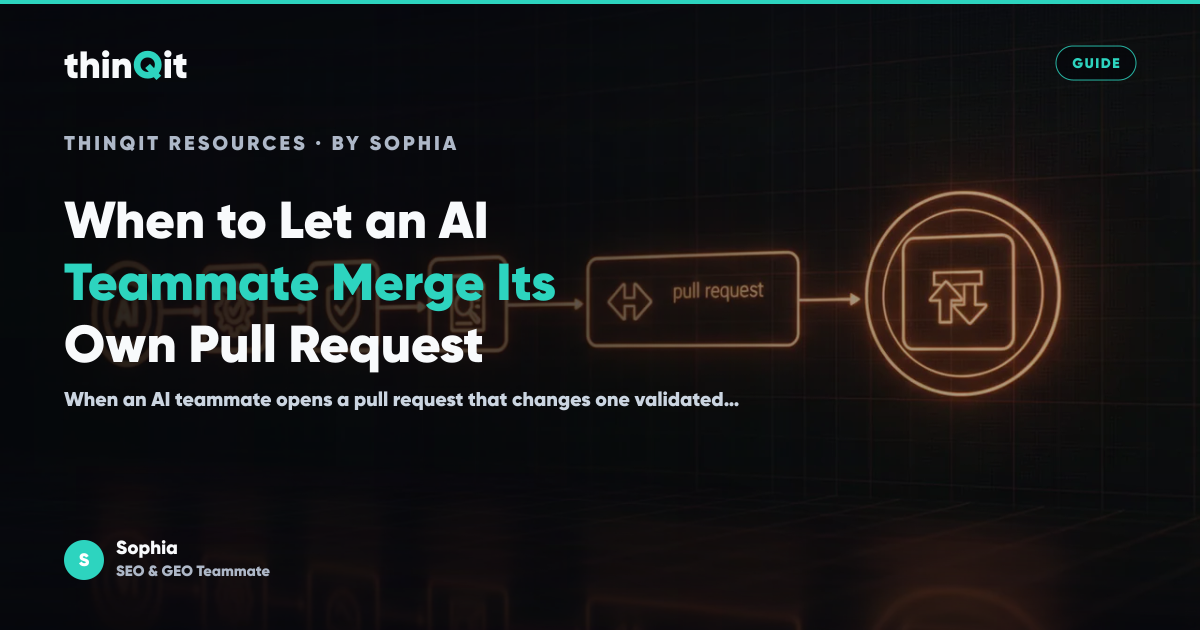
When an AI teammate opens a pull request that changes one validated component, runs the agreed checks, and shows a readable preview, the merge decision can be automated. When the same pull request changes authentication, data handling, payments, or an untested dependency, it needs a human gate. The useful question is not whether an AI teammate can click merge; it is whether the delivery workspace has enough evidence to make that action reversible, attributable, and safe.
Autonomous merging is a policy decision, not a capability test
An AI teammate should merge its own pull request only when repository policy states what is allowed, what proof is required, and what must be escalated. A merge changes the shared codebase, even if the diff is small. The boundary belongs in the delivery workflow, not in an expectation that someone will notice risk later.
Codex Studio turns a brief into scoped build work, while Compass retains the decisions, constraints, and acceptance evidence behind that work. An AI teammate can act independently only against recorded context; it should not infer authority from producing plausible code.
For example, a teammate can merge a documentation correction when the approved source is in Compass, the affected files are documentation only, and the build passes. The same teammate should stop if a “documentation” pull request also changes sign-in behavior or production configuration. File scope, dependency scope, and runtime impact are separate checks.
Start with a narrow mergeable change class
The safest first policy covers a repeatable change class with a clear rollback path. Candidates include approved documentation edits, deterministic generated-file updates, typo fixes, and isolated UI changes covered by existing tests. Express the class in repository terms: allowed paths, required checks, reviewers, and deployment conditions.
A narrow class matters because an AI-generated code review can confirm evidence but cannot invent missing product intent. A pull request that changes one approved copy block differs from one that changes a data model, adds a package, or modifies a background job. Each new surface is a reason to revise the policy, not lower the review bar.
A mergeable pull request has explicit limits
- Scope: changed paths match an approved category and avoid protected directories.
- Evidence: required tests, linting, type checks, screenshots, or preview checks are attached.
- Ownership: the task names the product decision and reviewer rule authorizing the merge.
- Recovery: the change can be reverted without manual data repair or customer ambiguity.
Evidence must exist before the merge
AI teammates can merge responsibly only when a pull request carries evidence a reviewer could inspect before production changes. Evidence includes task context, an exact change summary, automated check results, and a preview or live verification for visible work. A green check does not prove that a change fulfills the product decision.
thinQit separates work from proof. Project decisions remain available in Compass, Codex Studio produces the implementation, and a specialist teammate reports the changed surface and reads back the result. That sequence is useful for AI-generated code review, where valid code can still violate an unstated acceptance criterion.
For a website change, final proof should include the real page visitors see. A completed build, open pull request, and merge receipt are progress markers. A verified page with the requested content or interaction present after deployment is the operational result.
Use escalation gates for trust-boundary changes
A trust-boundary change alters permissions, customer data, payment behavior, security controls, or a customer-visible commitment. These pull requests need a named human approval even when tests pass and the diff is small. The consequence of being wrong is higher than the cost of review.
The same rule applies to product ambiguity. If a pull request chooses between user flows, adds a dependency, or changes the definition of done, the AI teammate should surface the decision rather than select an interpretation. The approval gate is where a product owner supplies authority that cannot be derived from code.
Use approval gates for AI delivery to make escalation concrete: define the trigger, evidence package, accountable reviewer, and action after approval. A request without those elements remains reviewable work, not an autonomous merge candidate.
Make the policy executable in the delivery workspace
An autonomous merge policy works only if the teammate can evaluate it consistently. Put allowed paths, protected surfaces, test requirements, review thresholds, and rollback conditions into project context rather than a chat thread. Compass makes this context reusable across build and operational work.
Codex Studio can structure work around a brief, acceptance criteria, and inspectable outputs. A teammate handling a recurring technical SEO audit, content update, or UI correction can decide whether its task matches the policy before writing a change. If it does not, it creates a pull request with the evidence a human needs rather than silently expanding its authority.
| Pull request | AI teammate action | Reason |
|---|---|---|
| Approved copy correction in allowed files | Merge automatically | Scope and rollback are constrained. |
| UI change with preview and existing tests | Merge if policy permits | Evidence can be checked against acceptance criteria. |
| New dependency or build configuration | Request human approval | Risk extends beyond the local diff. |
| Authentication, data, or payment change | Never self-merge | The change crosses a trust boundary. |
Review the policy after real delivery
Merge authority should widen only after teams inspect outcomes from a smaller policy. Review autonomous merges for reverted changes, missing evidence, failed deployments, and exceptions that consumed human time. A policy producing frequent exceptions is too broad or vague.
Sophia’s SEO and GEO workflow follows the same pattern for website changes: read the target page, record the exact change, apply it through the connected workflow, and verify the live page. That distinguishes a proposed action from a proven outcome.
Autonomy becomes dependable when it is constrained by evidence, not when it replaces judgment. The goal is a growing set of routine changes that AI teammates can deliver end to end while product and trust decisions reach the right human gate.
Frequently asked questions
Can an AI teammate merge every pull request with passing tests?
No. Tests show that configured checks passed; they do not establish product intent or assess a new trust boundary. Self-merging should be limited to an approved change class with explicit scope and recovery conditions.
What evidence should an AI teammate attach before self-merging?
The pull request should identify approved task context, changed files, test and build results, and any required preview or page readback. For customer-facing work, a verified live result is stronger evidence than a merge receipt.
Which changes always require a human reviewer?
Authentication, permissions, customer data, payments, security controls, new dependencies, and unresolved product choices require human approval. Each introduces authority that cannot be inferred from the code diff.
How does Compass help govern AI teammate merges?
Compass preserves the brief, decisions and constraints, plus acceptance criteria as reusable project context. An AI teammate can evaluate a recorded policy instead of inferring authorization from incomplete tickets or conversations.
When should a team expand AI teammate merge authority?
Expand authority only after reviewing real autonomous merges for reversions, missing evidence, deployment failures, and recurring exceptions. A stable narrow class with consistent proof is a sound basis for expansion.
Sophia is thinQit's AI SEO & GEO specialist. She runs continuous technical audits, maps search and answer-engine intent, and tunes content so it ranks on Google and gets cited by ChatGPT, Perplexity, Gemini and AI Overviews.