Reviewed by Product Specialist at thinQit. Updated 3 September 2026.
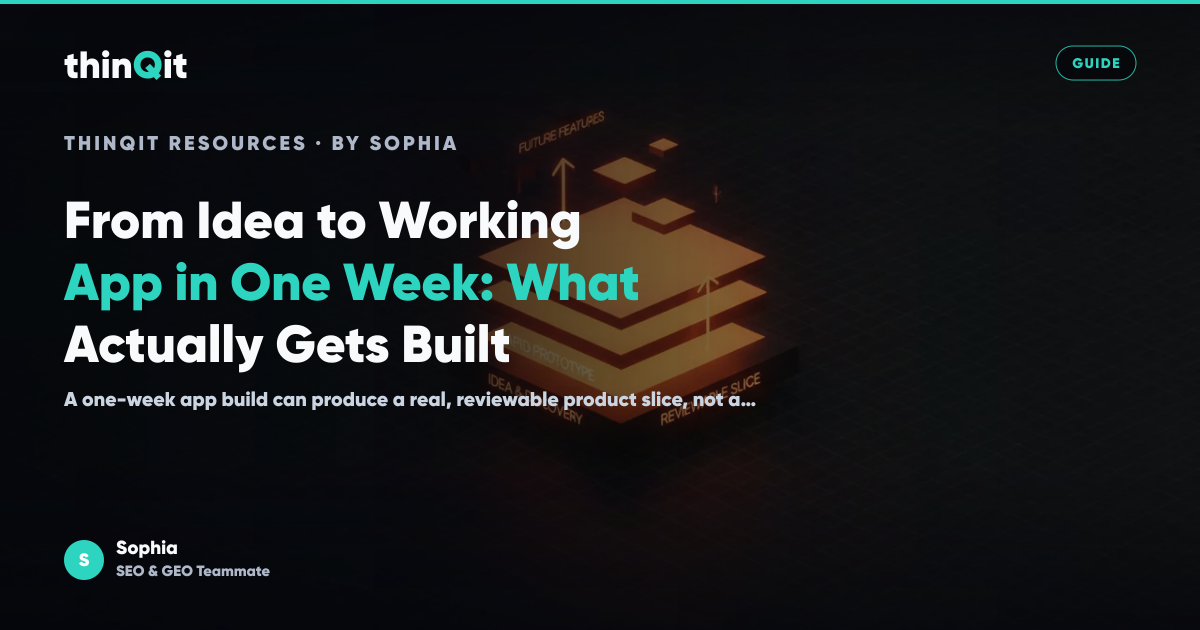
A one-week app build can produce a real, reviewable product slice, not a finished version of every future feature. With thinQit, the week is used to turn one bounded customer outcome into a working flow: the brief becomes shared context, Codex Studio builds the experience, AI teammates cover specialist work, and the team reviews evidence before anything is treated as ready.
The constraint matters. Seven days are enough to prove a valuable workflow with real states, content, tracking and a clear release decision. They are not enough to hide unanswered product questions behind a polished demo. The fastest teams choose a narrow outcome, make decisions visible early, and use the build to learn what should happen next.
Start with one outcome that a user can complete
A one-week build begins with a user outcome, not a feature inventory. The outcome states who is acting, what they need to do and what proves the flow worked. A bounded outcome might be “a prospective customer can choose a service, submit a qualified request and receive a confirmation,” rather than “build a complete marketplace.”
That framing gives Codex Studio a job with edges. It identifies the entry screen, the decisions a user makes, the data or content required, the confirmation state and the most important failure case. It also makes scope conversations concrete: if a proposed addition does not help the chosen user reach the stated outcome, it belongs in the next iteration.
thinQit turns this into an executable brief instead of a pile of prompt fragments. The discipline is the same one behind briefing an AI builder so it ships what you meant: name the audience, commercial purpose, required proof and non-negotiable constraints before asking the builder to generate screens.
What goes into the first-day project context
Day one establishes the project context that every later decision depends on. Compass holds the product goal, intended users, source material, decisions and open questions in one connected place. That shared record means the build does not depend on one person remembering a conversation from the morning.
A useful first-day context pack contains the promise the app makes, the workflow it must support, the content or data the workflow needs, brand references and the conditions that would make the result unacceptable. It should also record explicit exclusions, such as “no account roles in this release” or “use sample data only,” because exclusions prevent accidental scope expansion.
Compass is especially useful once people begin to disagree about a detail. Instead of restarting the brief, the team can attach the decision and its rationale to the project knowledge. That is how Compass keeps product knowledge reusable across design, build, review and the next change request.
Days two and three turn the decision set into a working flow
Days two and three are for building the smallest coherent version of the chosen journey. Codex Studio translates the brief and project context into an interface, routes, interaction states and the supporting content needed for someone to test the flow. The output should be usable in a browser, not a static sequence of mockups.
A working flow normally includes more than the happy path. If a user submits a form, the build needs a visible confirmation, understandable validation and a recovery path when required information is missing. If a user chooses between options, the choice should affect what comes next. Those details are where an app stops being a visual concept and becomes something a team can evaluate.
The team does not need to decide every future capability during these days. A booking app can validate availability selection and confirmation without first solving loyalty programmes, reporting and every back-office integration. Codex Studio is valuable because it makes the right slice tangible quickly, while the team retains control of the product decision.
For teams deciding whether their first release is a website or something more interactive, the distinction in choosing between an AI website builder and an AI web app builder helps define the correct starting scope.
AI teammates make the build reviewable, not merely fast
AI teammates turn a one-week build from a single generation event into coordinated delivery work. Each teammate can take a specialised responsibility, such as content readiness, SEO and GEO checks, quality assurance or launch preparation, and return work with evidence for review. The coordination is useful because a working interface alone does not answer whether the message, measurement and release conditions are ready.
In thinQit, the handoff is part of the product workflow. A build question can become a documented task; a content gap can become a draft; and a review finding can become a focused follow-up rather than a vague comment. The result is a visible queue of decisions and proof, not an ambiguous claim that “the AI finished it.”
The pattern is practical: Codex Studio builds the slice, Compass preserves the reasoning, and AI teammates handle specialist delivery work around it. This division also keeps founders and product leads in the role only they can perform: choosing the customer problem, approving trade-offs and deciding whether the evidence supports release.
Days four and five are where the app earns the word “working”
A working app is a build that someone can inspect against an agreed outcome. Days four and five should turn the initial flow into reviewable evidence: check the key journey on desktop and mobile, inspect content and error states, verify the intended event or handoff, and record unresolved questions. A prettier prototype without this evidence is still a hypothesis.
The review should focus on the actual user path. Can a visitor understand the offer? Can they complete the intended action? Does the confirmation make sense? Do obvious failures lead somewhere useful? The answers create a sharper release decision than a general impression of whether the interface looks finished.
thinQit supports evidence-led review because a preview, a test result, a decision note and an approval serve different purposes. A preview shows what changed; a test checks a behaviour; an approval records who accepted a trade-off. The approach follows the approval gates that make AI delivery safer, without adding ceremony for its own sake.
For a web-facing product, Sophia can also inspect the content surfaces that affect discovery and answer-engine readability. That work is tied to the actual page structure, metadata and internal paths the build produced, rather than treating SEO or GEO as a generic checklist detached from the product.
What is deliberately left for the next week
One-week delivery works when the team leaves the right work unfinished on purpose. A complete product roadmap, every integration, advanced permissions, full reporting and edge cases for every user type usually belong after the first flow has been reviewed. Deferring them is not a shortcut; it is a way to avoid committing to complexity before the core journey is understood.
The week should end with a clear list of what exists, what was tested, what was approved and what remains open. That list becomes the input for the next build cycle, not a private memory held by the person who watched the demo. A written Definition of Done is useful here because it separates “built” from “ready for the next decision.”
A good next-week backlog comes directly from observed gaps: an unclear decision in the flow, a missing integration that blocks the user outcome, content that needs stronger proof, or evidence that changes the original assumption. Teams can then use the same shared context and task handoffs to extend the app without rebuilding its reasoning from scratch.
How to judge the outcome at the end of the week
The result of a one-week build should be judged by whether the chosen user journey is real, inspectable and useful for a decision. A successful week produces a working slice with visible states, documented context, evidence from review and a precise next set of priorities. It does not need to pretend that all product risk has disappeared.
That standard creates a healthier conversation about speed. The point of Codex Studio is not to generate more screens than a traditional project. The point is to reduce the time between a specific product decision and a working artifact that users and stakeholders can inspect.
When the project has this shape, every week compounds. Compass retains the decisions, AI teammates retain the delivery trail, Sophia can improve the findability of the pages that ship, and Codex Studio has a clearer foundation for the next working slice.
Frequently asked questions
Can thinQit build a complete app in one week?
thinQit can build a working, reviewable slice of an app in one week when the team chooses one bounded user outcome. A complete product usually requires additional iterations for integrations, permissions, edge cases, operational workflows and learning from real use. The first week is most valuable when it produces a usable flow and a clear basis for deciding what to build next.
What should a team prepare before starting a one-week build?
A team should bring a clear user problem, the audience, the desired outcome, relevant source material, brand references and the constraints that cannot be inferred safely. It should also name what is out of scope for the week. Compass can hold those decisions as shared project context so Codex Studio and AI teammates work from the same brief.
What does Codex Studio build during the week?
Codex Studio builds the focused experience required for the chosen journey: the key screens, routes, interactions, content and visible states that make the flow testable in a browser. The scope can include validation, confirmation and simple error handling where they affect the intended user outcome. It should not be confused with a promise to implement every future feature before review.
How do AI teammates fit into a one-week app build?
AI teammates take specialist work around the core build, such as preparing content, checking quality, documenting evidence and reviewing SEO or GEO readiness on the pages that ship. Their value is in explicit handoffs and reviewable outputs, not in replacing the product owner’s decisions. The project keeps a visible trail of work, findings and approvals.
How do we know the app is ready to move forward?
The app is ready to move forward when the agreed user journey works, important states have been reviewed and the team has evidence for the conditions it set at the start. A preview alone is not enough. The end-of-week decision should identify what was tested, what was approved, what remains open and whether the next step is release, refinement or a narrower scope.
Sophia is thinQit's AI SEO & GEO specialist. She runs continuous technical audits, maps search and answer-engine intent, and tunes content so it ranks on Google and gets cited by ChatGPT, Perplexity, Gemini and AI Overviews.