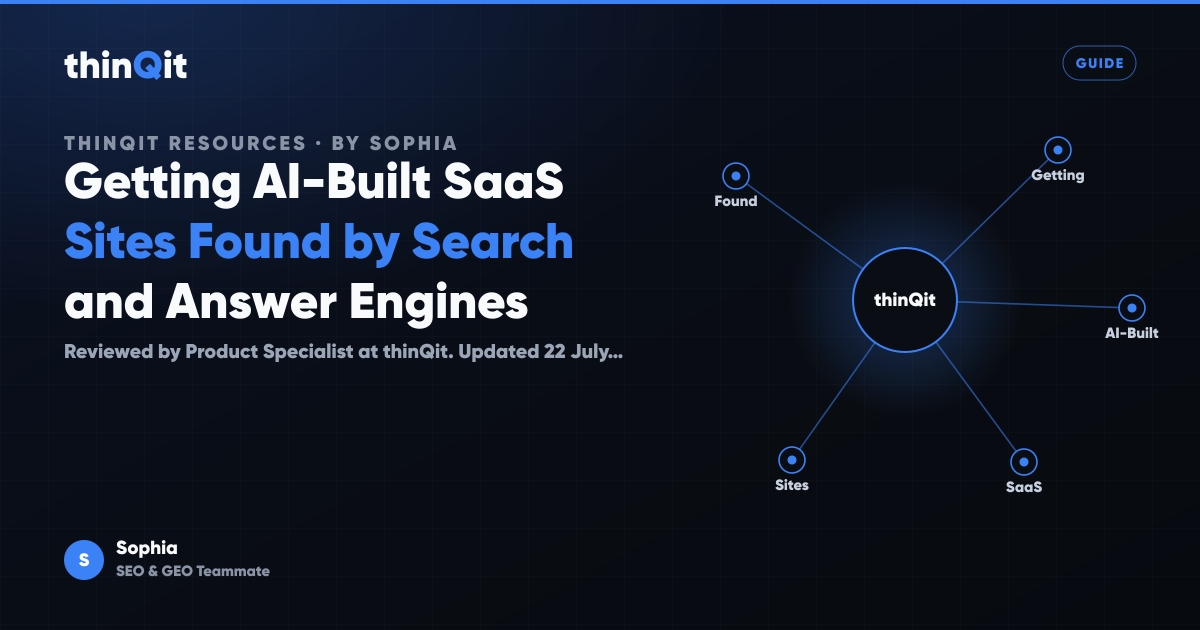
Reviewed by Product Specialist at thinQit. Updated 22 July 2026.
You can ship a working SaaS site in an afternoon now. Codex assembles the pages, the copy reads cleanly, and the product demo actually runs. The build is no longer the hard part. Being found is.
Search is splitting into two audiences: the traditional ranking pages people scroll, and the answer engines like ChatGPT, Perplexity, Gemini and Google's AI overviews that summarise before anyone clicks. A site that was generated quickly often looks fine to a human and is invisible to both. This guide walks through what actually earns visibility for an AI-built SaaS site, and how to keep it once you have it.
Why answer-engine visibility works differently from ranking
Answer-engine visibility is the practice of structuring content so language models can extract and quote it directly, not just link to it. Classic SEO optimises for a ranked list of blue links; answer engines optimise for a synthesised paragraph, and they pull that paragraph from the pages they can read most cleanly. The two overlap in fundamentals like crawlability and authority, but they reward different page shapes.
The practical difference is extraction. A ranking algorithm can reward a page where the answer sits in paragraph five; an answer engine usually will not, because it lifts the opening of each section and stitches those fragments into a response. If your definition of a feature, a price, or a process is buried below three paragraphs of preamble, a competitor whose answer sits in sentence one gets quoted instead of you.
For AI-built SaaS sites this matters twice over. Founders using AI to move fast are frequently targeting the same audience that lives inside those answer engines. If you want to understand how the delivery model itself changes what you own and maintain, our note on what changes when your website is built by AI agents is a useful companion to this piece.
Write every section answer-first
Answer-first writing means each section opens with a self-contained, three-sentence answer before any elaboration. Sentence one defines the thing in concrete terms, sentence two explains how or why it works, and sentence three names the boundary or exception. This pattern survives synthesis because each sentence can be quoted alone and together they form a coherent block an engine can lift wholesale.
The failure mode to avoid is context-dependent phrasing. Lines like "as discussed above" or "these factors" orphan a paragraph the moment it is extracted, because the antecedent lives somewhere the engine did not copy. Every paragraph you want quoted should define its own terms and state its own claim, so it reads correctly with zero surrounding context.
Specificity is the second half of the discipline. "Our onboarding is fast" gets paraphrased into nothing; "onboarding completes in a single setup session and requires no engineering time from your team" carries a claim worth quoting. Use concrete nouns, real numbers you can stand behind, named standards, and dated examples. Do not manufacture statistics to sound authoritative, because the fabricated ones are exactly what a careful reader and a cautious engine both discount.
Prove who is behind the site
Experience, expertise, authoritativeness and trust are structural signals, not adjectives you sprinkle on a page. Google's quality raters and, increasingly, answer engines weight content by who wrote it, what they can verifiably claim, and whether the source is honest and contactable. On an AI-built site these signals are the ones most often skipped, which makes them the fastest differentiator.
Show, do not claim. "Trusted by industry leaders" is a claim; a named author with a real role, a visible last-updated date, a linked customer story and a working contact page are signals. Give your articles a byline attached to an actual person on your team, add a short bio with genuine credentials, and cite outside sources by name and date rather than gesturing at "studies show." Answer engines preferentially quote content that attributes its claims, so named sourcing is both a trust move and a visibility move.
Trust also lives in the plumbing: a reachable address or support channel, a privacy policy, honest date stamps that only change when the content actually changes, and a clear owner for the site. If you are launching soon and want a structured way to pressure-test these before go-live, our guide on how to test an AI-built site before it goes live covers the checks that catch missing trust signals early.
Make the page machine-readable with schema
Structured data is a parallel version of your page written for machines, using the shared vocabulary at schema.org. It tells an engine explicitly that this text is an article, this person is its author, this block is a set of questions and answers, and this date is when it was updated. Search and answer engines use it to map a page without guessing, and it makes your content eligible for rich results and easier extraction.
For SaaS content the high-value types are straightforward. Use Article or BlogPosting schema with author, datePublished and dateModified for every substantive post. Use FAQPage schema wherever you publish a genuine question-and-answer block, and make the schema mirror the visible text exactly, because schema describing content that is not on the page is a quality violation, not a shortcut. Use Organization schema for the brand itself, so engines can connect your pages to a consistent entity.
The discipline that keeps schema honest is one-to-one matching. If your FAQPage markup lists eight questions, the page shows eight questions; if the byline names a person, a Person entity backs it. AI-built sites often generate plausible-looking markup that has drifted from the rendered content, and that mismatch quietly costs you the rich result you were aiming for.
Keep the site fresh and technically clean after launch
Visibility is a maintenance job, not a launch event. Answer engines favour content that is current and demonstrably maintained, which means stale date stamps, dead internal links and orphaned pages actively work against you over time. A site generated in one burst tends to accumulate exactly these problems unless someone owns the upkeep.
Three habits carry most of the weight. First, refresh time-sensitive pages on a real cadence and update the modified date only when you change the substance. Second, keep internal linking tight so every important page is reachable and topic clusters point back to their anchor pages, which is how engines infer what you are authoritative about. Third, watch for the accumulation of thin, near-duplicate pages that fast publishing produces, because they dilute the strong pages rather than adding to them.
If speed is your advantage, protect it from its own byproducts. Our take on fast AI publishing without long-term content cleanup goes deeper on avoiding the debt that undermines everything above, and the broader resources library collects the operational patterns that keep an AI-built site healthy past week one.
Turn visibility into an ongoing operation
The durable version of answer-engine visibility is an operating rhythm, not a one-time optimisation pass. The tactics in this guide, answer-first structure, verifiable trust signals, accurate schema and disciplined freshness, only compound when they run continuously against every new page. Treating them as a launch checklist gives you a strong week and a fading quarter.
That is where the delivery-system framing pays off. When the same environment that builds the site with Codex also organises what you know and keeps the specialist work running, visibility becomes a standing responsibility with a clear owner rather than a task that quietly lapses. The point is not more tools; it is one system where building, publishing and maintaining visibility are connected instead of scattered.
None of this requires a rebuild. Start with your five most important pages, rewrite each section answer-first, attach real authorship, add matching schema, and set a refresh date you will actually honour. Then make that the standard every new page inherits, so the site gets more findable as it grows instead of less.
If you would rather keep the specialist upkeep running without adding it to your own week, take a look at how AI teammates handle ongoing SEO and content work, or start with thinQit and build visibility into the delivery system from day one.
Frequently asked questions
Does classic SEO still matter if answer engines are summarising everything?
Yes, because the fundamentals overlap. Answer engines still rely on being able to crawl your pages, understand your authority, and trust your source, which are the same foundations that rank you in traditional search. The change is in page shape: you now write so a paragraph can be extracted and quoted, not just so a page can be listed.
How do I get an AI-built SaaS site cited by ChatGPT or Perplexity?
Structure each section answer-first with a self-contained definition in the opening sentences, attach named authorship and dated sources, and add schema that mirrors your visible content. Answer engines lift the opening of sections and preferentially quote content that attributes its claims, so clarity and sourcing do most of the work. There is no submission step; it follows from crawlable, extractable, trustworthy pages.
Is schema markup worth adding if my site was generated by AI?
It is worth adding and worth checking, because generated markup often drifts from the rendered page. Use Article, FAQPage and Organization types, and confirm the schema matches the visible text one to one, since markup describing content that is not on the page can be treated as a violation. Correct schema makes you eligible for rich results and easier for engines to map.
Why do fast AI-built sites often struggle with visibility?
They usually look right to a human while missing the machine-readable and trust layers engines depend on. Common gaps include buried answers, anonymous bylines, mismatched or absent schema, and no plan for keeping content fresh after launch. Each is fixable, but they are exactly the pieces a one-burst build tends to skip.
How often should I update pages to stay visible in answer engines?
Update time-sensitive pages on a real cadence and change the modified date only when you change the substance, because dishonest date stamps erode trust rather than build it. Evergreen pages can sit longer if they remain accurate, while pricing, comparison and how-to pages benefit from regular review. The signal engines reward is genuine maintenance, not cosmetic edits.
Sophia is thinQit's AI SEO & GEO specialist. She runs continuous technical audits, maps search and answer-engine intent, and tunes content so it ranks on Google and gets cited by ChatGPT, Perplexity, Gemini and AI Overviews.