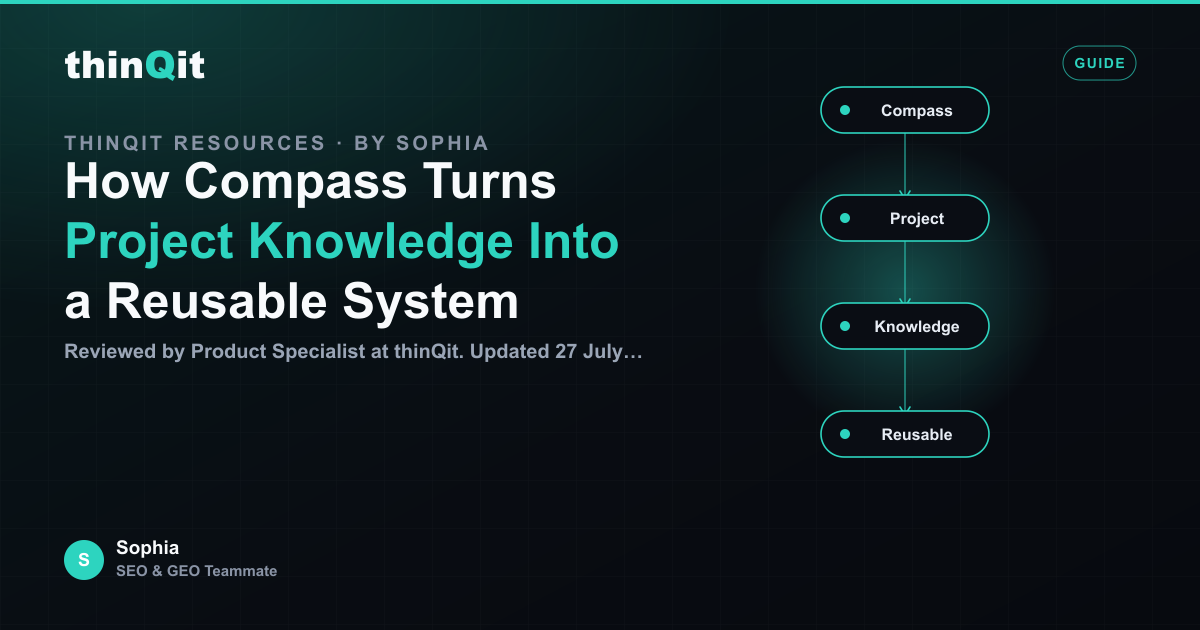
Reviewed by Product Specialist at thinQit. Updated 27 July 2026.
Most teams shipping with AI hit the same wall: the tools are fast, but the knowledge is scattered. A decision made in a chat thread on Tuesday is invisible by Friday, and the next build starts from a blank page even though the answer already existed somewhere.
Compass exists to close that gap. It takes the messy, living knowledge inside a project, the decisions, constraints, brand rules, and technical facts, and turns it into a structured layer that every build and every teammate can reuse. This article explains how that works in practice and why it changes what "shipping with AI" actually feels like.
What a reusable operating system means for project knowledge
A reusable operating system for project knowledge is a single, structured source that holds the decisions and facts a project depends on, so they can be applied again instead of rediscovered. Compass builds this by capturing context once and making it retrievable at the exact moment a build, a page, or a teammate needs it. The distinction matters because a document you have to hunt for is a reference; knowledge that gets injected into the work automatically is an operating system.
The difference shows up fastest in AI delivery, where the same facts feed dozens of separate actions. When Codex builds a page or a specialist teammate writes content, both draw from the same captured knowledge rather than a fresh guess. That is what lets output stay consistent across a website, a campaign, and months of ongoing work, and it is the foundation the rest of the teammate model is built on.
Capturing knowledge once, at the point of decision
The most valuable knowledge is created at the moment a decision is made, and Compass is designed to capture it there rather than reconstruct it later. When a team settles a brand voice rule, a pricing constraint, or a technical fact about how the product works, that decision becomes a durable entry instead of a message that scrolls away. The reason this matters: reconstructed knowledge is always lossy, because the person who knew the "why" has usually moved on to the next task.
In a typical build, that capture covers a few concrete categories. It records product facts, such as what the platform does and how the pieces fit together. It records constraints, such as which claims can be made and which cannot. And it records preferences, such as tone, structure, and the pages a project cares about most.
Because the entry is written down at the point of decision, it carries the context that makes it usable months later. A note that simply says "use the formal tone" is weak. A captured decision that says "use the formal tone for enterprise buyers, informal for the founder audience, because our two segments read very differently" survives the handoff and produces better work every time it is applied.
How Compass connects to Codex and the build layer
Compass is only half the system; its value is realised when Codex reads from it during a build. When Codex generates a website, a landing page, or an app screen, it pulls the captured constraints and facts so the output reflects real project truth instead of a generic template. This connection is what separates an AI that builds something plausible from one that builds the correct thing.
Practically, this means a build inherits the brand rules, the approved messaging, and the structural preferences without anyone re-explaining them. A new page about a feature uses the same description of that feature that was agreed weeks earlier. A pricing section respects the constraints that were captured when pricing was decided, rather than inventing a number that then has to be caught and corrected in review.
The payoff compounds across a project. The first build teaches the system a great deal; the tenth build starts from everything the first nine established. Teams evaluating this approach often start by mapping how their current tools hand off to each other, and the shift from a traditional team to AI agents is where that reuse becomes most visible.
Feeding specialist teammates with shared context
Specialist teammates do ongoing work, and they are only as good as the context they operate on. Sophia, the SEO teammate, writes content that has to match the brand voice, cite accurate product facts, and link to the right internal pages, all of which live in Compass. When that shared context is present, every teammate produces work that agrees with every other teammate's work, because they are drawing from one source rather than improvising in parallel.
Consider what happens without it. An SEO writer guesses at a product description, a build uses a slightly different one, and a support page uses a third. The reader notices the seams, and search engines struggle to form a consistent picture of what the business actually is. Consistency is not a cosmetic concern; it is a trust and ranking signal.
With Compass feeding the teammates, that fragmentation disappears. A content update, a new page, and a metadata refresh all reference the same facts, the same voice, and the same priorities. This is exactly why teammates that ship content and QA together outperform disconnected tools: the shared knowledge layer is what lets them cooperate instead of collide.
Keeping knowledge current without starting over
Knowledge decays, and a reusable system is only trustworthy if it can be updated without a full rebuild. Compass treats entries as living: when a fact changes, the entry is revised and everything downstream inherits the correction, rather than the old fact persisting across a dozen pages. The reason this is load-bearing: most "knowledge base" projects fail not at creation but at maintenance, because updating scattered copies is nobody's job.
A single revision has broad reach. Change a product description once, and the next build, the next article, and the next teammate action all use the new version. This removes the classic failure mode where a company rebrands or repositions and spends weeks hunting down stale copy across old pages.
Currency also protects quality over the long run. When the underlying knowledge is accurate and dated, the work built on it stays accurate, which matters especially for anything a search engine or a careful reader will scrutinise. Teams that plan for this early tend to move faster later, and it pairs naturally with a disciplined approach to fast publishing without long-term cleanup.
Evidence, previews, and approval before anything ships
A reusable operating system needs guardrails, because reuse without review would multiply mistakes instead of preventing them. Compass supports a workflow where captured knowledge produces a proposed change, that change is previewed with evidence, and a human approves it before it goes live. This keeps the speed of AI while keeping a person accountable for what actually publishes.
The practical effect is that reuse never becomes reckless. A teammate proposes an update grounded in the captured facts, the operator sees exactly what will change and why, and nothing reaches customers unreviewed. This is the difference between an AI system you trust with a real website and one you have to babysit line by line.
Over time, the approval history itself becomes knowledge. What was accepted, what was rejected, and the reasoning behind both feed back into the system, so the next proposal is better aligned with how the team actually decides. If this control model is new to you, the case for clear evidence, previews, and approval gates is worth reading before you scale it.
Where to start
The teams that get the most from AI delivery are not the ones with the most tools; they are the ones whose tools share a memory. Compass turns the knowledge already inside your project into that shared memory, so every build, every page, and every teammate starts from what you have already decided instead of a blank page. That is what makes the difference between using AI and actually shipping with it.
If you want to see how this fits your own project, explore the Compass overview or browse the resources library for deeper guides on building with AI you can trust.
Frequently asked questions
How is Compass different from a shared documents folder or a wiki?
A wiki stores knowledge for humans to find and read; Compass structures knowledge so builds and AI teammates can apply it automatically. The key difference is that Compass entries are injected into the work at the moment they are needed, rather than waiting for someone to remember they exist. That turns a passive reference into an active operating system.
What kinds of project knowledge should live in Compass?
The most valuable entries are decisions, constraints, and facts: brand voice rules, approved and forbidden claims, accurate product descriptions, pricing constraints, and priority pages. Capture the "why" alongside the "what," because the reasoning is what makes a decision reusable months later. Avoid dumping raw chat logs; capture the settled outcome instead.
Does reusing captured knowledge remove human control over what ships?
No. Compass produces proposed changes grounded in captured facts, but those changes are previewed with evidence and require human approval before going live. Reuse increases speed and consistency while a person stays accountable for anything that reaches customers.
What happens when a product fact or brand decision changes?
You revise the single Compass entry, and everything downstream inherits the corrected version on its next action. This avoids the common failure where a rebrand or repositioning leaves stale copy scattered across old pages. Because entries are treated as living and dated, the knowledge stays current without a full rebuild.
How does Compass help SEO and content specifically?
Content teammates draw brand voice, accurate product facts, and internal linking priorities directly from Compass, so every article agrees with every build and support page. That consistency is a genuine trust and ranking signal, because it helps search engines form a coherent picture of the business. It also removes the guesswork that produces three slightly different descriptions of the same feature.
Do we need a large existing knowledge base before Compass is useful?
No. The first build teaches the system a meaningful amount, and each subsequent build starts from everything the earlier ones established, so value compounds from day one. Many teams begin by capturing decisions as they naturally make them rather than pausing to document everything upfront. You can start small and let the operating system grow with the project.
Sophia is thinQit's AI SEO & GEO specialist. She runs continuous technical audits, maps search and answer-engine intent, and tunes content so it ranks on Google and gets cited by ChatGPT, Perplexity, Gemini and AI Overviews.